Calochortus luteus
Douglas
Yellow mariposa, Butterfly tulip
iNaturalist· cc-by-nc-sa
(c) randomtruth, some rights reserved (CC BY-NC-SA)
iNaturalist· cc0
no rights reserved
Summary
Source: WikipediaCalochortus luteus, the yellow mariposa lily, is a mariposa lily endemic to California.
Description
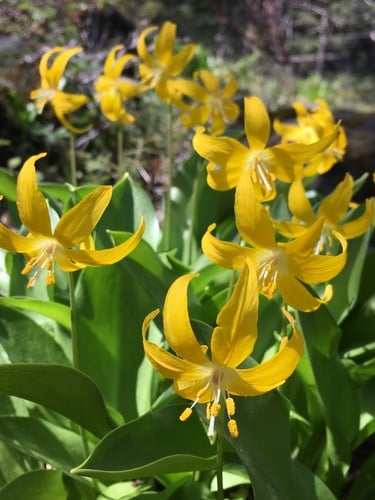
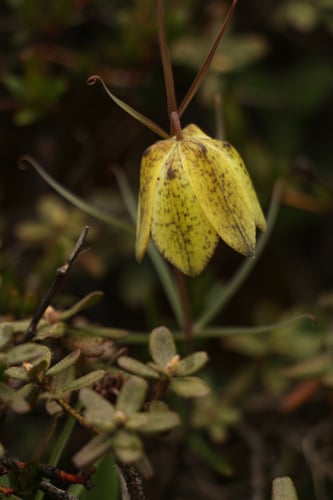
A bulb plant. It grows 20-50 cm high and spreads 15 cm wide. The leaves are sword shaped at the base. The flowers are open and bell shaped. They are on slender stems. The flowers are yellow and 8 cm wide. There is usually a brown spot at the base of each petal. The nectar gland is crescent shaped.
Edible Uses
Edible Parts: Root Edible Uses: Bulb - raw or cooked. About the size of a walnut, it is very palatable and nutritious. The bulb can be harvested in early spring, peeled and eaten raw. It can also be baked and eaten like potatoes. The bulb can be used as a staple food.
Traditional Uses
The bulbs are eaten raw or cooked.
This uses section is brief — help expand it
Medicinal Uses
None known
Distribution
It is a temperate plant. It grows best in light to medium well-drained soils. It suits an open sunny position. It is resistant to drought and frost. It suits hardiness zones 5-9.
Where It Grows
Australia, Mexico*, North America, Tasmania, USA,
Cultivation
Requires a deep very well-drained fertile sandy soil in a warm sunny position and must be kept rather dry after it flowers and over winter. This is a rather difficult plant to cultivate in Britain, it is very cold hardy but is intolerant of wetness especially in the winter. It is easiest to grow in a bulb frame but is worth trying outdoors at the base of a south-facing wall, especially with shrubs that like these conditions. Bulbs have succeeded in a cold frame with the cover removed from March to October. Bulbs can be lifted as soon as the foliage dies down in the summer and stored overwinter in a cool dry place, replanting in spring. Another report says that the bulbs must be replanted as soon as they have been divided. Bulbs frequently divide after flowering, the bulblets taking 2 years to reach flowering size. Hand pollination is necessary if seed is required. This species is closely allied to C. venustus.
Propagation
Seed - sow as soon as ripe or early spring in a cold frame in a very sharply draining medium. Stratification may be helpful. Germination usually takes place within 1 - 6 months at 15°c. Leave the seedlings undisturbed for their first two years growth, but give them an occasional liquid feed to ensure they do not become nutrient deficient. It is quite difficult to get the seedlings through their first period of dormancy since it is all too easy either to dry them out completely or keep them too moist when they will rot. After their second year of growth, pot up the dormant bulbs in late summer and grow them on for at least another 2 years in the greenhouse before trying them outside. Seedlings take about 5 - 7 years to come into flower. Division of the bulbs as soon as the foliage dies down. One report says that the bulbs must be planted into their permanent positions immediately, whilst another says that they can be stored overwinter and replanted in the spring. Stem bulbils, harvested from the stems after flowering. They can be stored cool and dry then planted in pots in the cold frame in the spring.
Other Uses
None known Special Uses
Notes
There are about 60-100 Calochortus species. There are 7-9 species in tropical America. They have also been put in the family Calochortaceae.
Also Known As
Gold nuggets, Sego lily
References (10)
- Beckstrom-Sternberg, Stephen M., and James A. Duke. "The Foodplant Database." http://probe.nalusda.gov:8300/cgi-bin/browse/foodplantdb.(ACEDB version 4.0 - data version July 1994)
- Bodkin, F., 1991, Encyclopedia Botanica. Cornstalk publishing, p 200
- Brickell, C. (Ed.), 1999, The Royal Horticultural Society A-Z Encyclopedia of Garden Plants. Convent Garden Books. p 211
- Cundall, P., (ed.), 2004, Gardening Australia: flora: the gardener's bible. ABC Books. p 289
- Elmore, F. H., 1944, Ethnobotany of the Navajo. University of New Mexico Press. p 105
Show all 10 references Hide references
- Hedrick, U.P., 1919, (Ed.), Sturtevant's edible plants of the world. p 144
- Hibbert, M., 2002, The Aussie Plant Finder 2002, Florilegium. p 50
- Kermath, B. M., et al, 2014, Food Plants in the Americas: A survey of the domesticated, cultivated and wild plants used for Human food in North, Central and South America and the Caribbean. On line draft. p 164
- Plants for a Future database, The Field, Penpol, Lostwithiel, Cornwall, PL22 0NG, UK. http://www.scs.leeds.ac.uk/pfaf/
- Stromberg, M. R. et al, California Grasslands: Ecology and Management. p 63