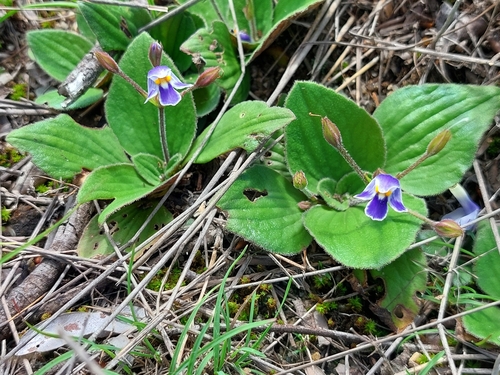
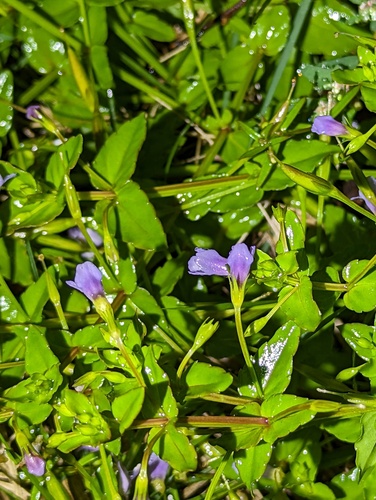
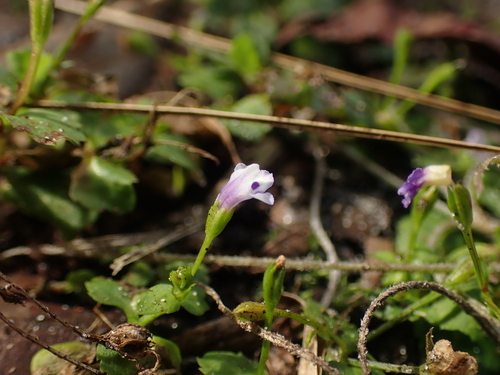
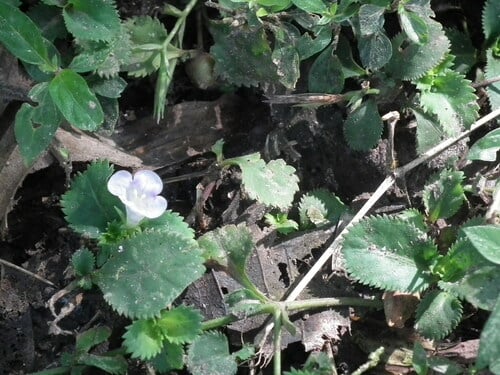
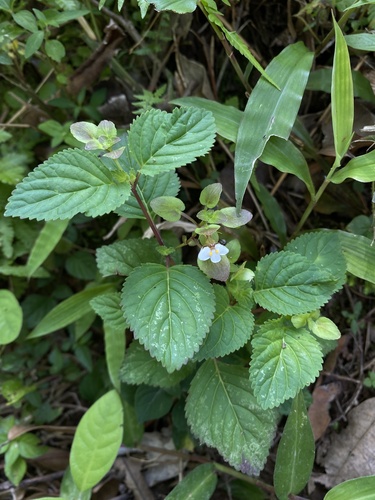
Artanema longifolium
(Linn.) Vatke
Subihere
iNaturalist· cc-by-sa
(c) Vinayaraj, some rights reserved (CC BY-SA)
iNaturalist· cc-by-sa
(c) Vinayaraj, some rights reserved (CC BY-SA)
iNaturalist· cc-by-sa
(c) Vinayaraj, some rights reserved (CC BY-SA)
Summary
Source: WikipediaArtanema longifolium is an edible flowering plant species found in tropical Africa, India and South-East Asia. Extracts are used in Ayurveda medicines to treat myositis and nausea. The leaves can also be cooked and eaten as a leafy vegetable. The roots are root used to treat rheumatism, diarrhea, syphilis and ophthalmitis.
Description
A herb. It grows 1 m high. The stems are hollow and slightly fleshy. They are almost square or winged. The leaves are simple and opposite. The leaves are broadly sword shaped. They are 4-25 cm long by 1-9 cm wide. It has deep purple red flowers. These are at the top of the plant along stalks 40 cm long. The fruit is a flattened round capsule. It has many seeds. The seeds are narrowly oval and yellow-brown.
Edible Uses
The leaves are eaten as a vegetable and represent a minor leaf vegetable traditionally eaten in West Africa.
Traditional Uses
The leaves are eaten as a vegetable.
This uses section is brief — help expand it
Medicinal Uses
An aqueous extract of the plant is a component of Ayurvedic medicines used against inflammations of the skeleto-muscular system. It is also used against nausea. A decoction of the root is used in the treatment of rheumatism, diarrhoea, syphilis and ophthalmia. The seeds are used as a cure for biliousness, to improve vitality and favour conception.
Distribution
It is a tropical plant. It grows in water and wet places in West and Central Africa. It can grow near rice fields and in soggy grassland. It grows up to 400 m above sea level. They grow in the moist tropics. It grows in marshy places.
Where It Grows
Africa, Asia, Benin, Cameroon, Central Africa, Congo, Côte d'Ivoire, East Africa, Gabon, Ghana, India, Indochina, Ivory Coast, Liberia, Malaysia, Myanmar, Nigeria, SE Asia, Singapore, Tanzania, Thailand, Togo, Uganda, West Africa,
Cultivation
It can be grown from seed or stem cuttings.
Other Information
It is a minor leaf vegetable. It is recorded as eaten in Lagos, West Africa.
Notes
There are about 4 Artanema species. It has been put in the family Scrophulariaceae.
Synonyms
Also Known As
Kekulut gajah, Sesawi pasir
References (7)
- Bircher, A. G. & Bircher, W. H., 2000, Encyclopedia of Fruit Trees and Edible Flowering Plants in Egypt and the Subtropics. AUC Press. p 41
- Burkill, H. M., 1985, The useful plants of west tropical Africa, Vol. 5. Kew.
- Burkill, I.H., 1966, A Dictionary of the Economic Products of the Malay Peninsula. Ministry of Agriculture and Cooperatives, Kuala Lumpur, Malaysia. Vol 1 (A-H) p 245 (As Artanema angustifolium)
- Grubben, G. J. H. and Denton, O. A. (eds), 2004, Plant Resources of Tropical Africa 2. Vegetables. PROTA, Wageningen, Netherlands. p 93
- Martin, F.W. & Ruberte, R.M., 1979, Edible Leaves of the Tropics. Antillian College Press, Mayaguez, Puerto Rico. p 219 (As Artanema angustifolium)
Show all 7 references Hide references
- Reis, S. V. and Lipp, F. L., 1982, New Plant Sources for Drugs and Foods from the New York Botanical Garden herbarium. Harvard. p 274 (var. amplexicaule)
- World Checklist of Useful Plant Species 2020. Royal Botanic Gardens, Kew