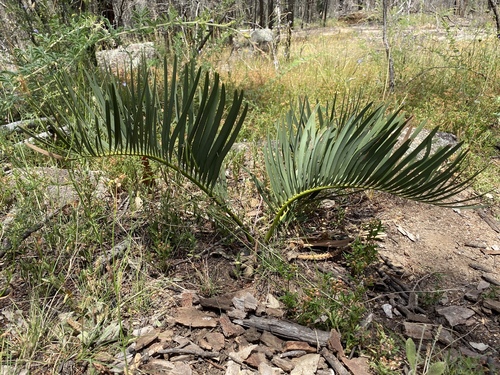
Encephalartos villosus
(Gaertn.) Lemaire
Ground cycad, Poor man's cycad
iNaturalist· cc-by-nc
(c) anneloesmaas, some rights reserved (CC BY-NC)
iNaturalist· cc-by-nc
(c) Gawie Malan, some rights reserved (CC BY-NC), uploaded by Gawie Malan
iNaturalist· cc-by-nc
(c) Nicole, some rights reserved (CC BY-NC), uploaded by Nicole
Summary
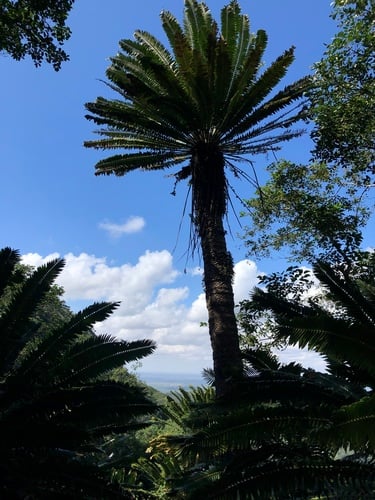
Source: WikipediaEncephalartos villosus is a South African cycad occurring from the East London vicinity, where it is found near the coast, to the northern border of Eswatini (Swaziland) where it may grow as far as 100 km inland. The species is common throughout its range and is the most frequently cultivated in Southern Africa, largely because of its affordable price. As a result of its large geographical distribution, it is notably variable in leaf and cone shape.
Description
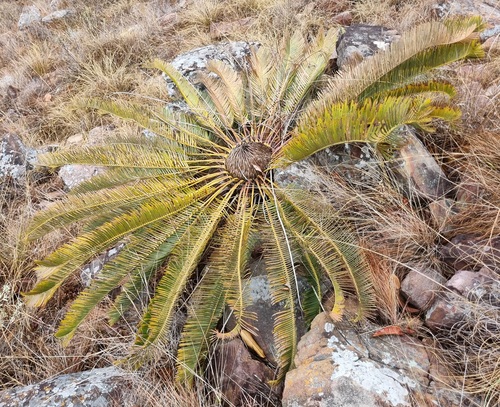
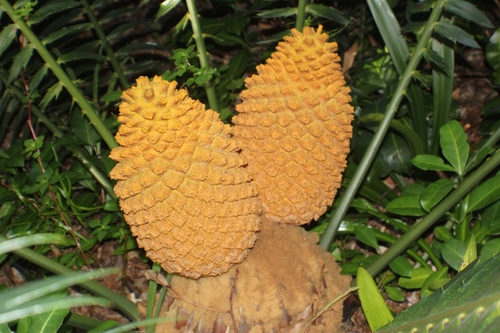
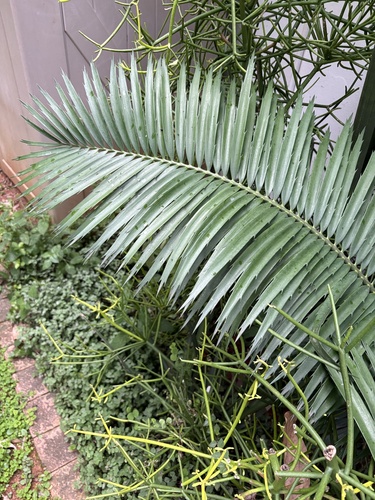
A small cycad. It forms clumps. The stems are 40 cm tall and 25 cm across. The young leaves have white hairs. The mature leaves are dark green and shiny. They are light green underneath. They are 3 m long. The female cones are deep yellow. There are many seeds.
Edible Uses
The pith of the stem is edible and produces good quality starch.
Traditional Uses
The pith of the stem is edible and makes good quality starch.
This uses section is brief — help expand it
Distribution
It is a subtropical plant. It grows in lowland forests and temperate regions wit a summer rainfall of 1,000-1,250 mm each year. It grows in places with a mild, dry winter.
Where It Grows
Africa, Asia, Australia, East Africa, Eswatini, Indonesia, Mozambique, SE Asia, South Africa, Southern Africa*, Swaziland,
Cultivation
Plants can be grown from seeds or suckers.
Also Known As
Lisitsa, Mayiphuku, Sikas bulu
References (1)
- Sukarya, D. G., (Ed.) 2013, 3,500 Plant Species of the Botanic Gardens of Indonesia. LIPI p 828