Ceropegia stapeliiformis subsp. serpentina
(E. A. Bruce) R. A Dyer
Serpent ceropegia
iNaturalist· cc-by-nc
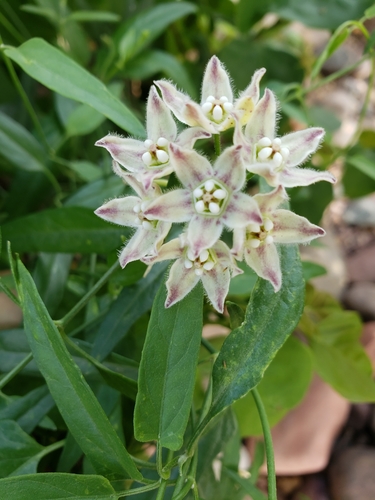
(c) Chrissie Fourie, some rights reserved (CC BY-NC), uploaded by Chrissie Fourie
iNaturalist· cc-by-nc
(c) Craig Peter, some rights reserved (CC BY-NC), uploaded by Craig Peter
iNaturalist· cc-by-nc
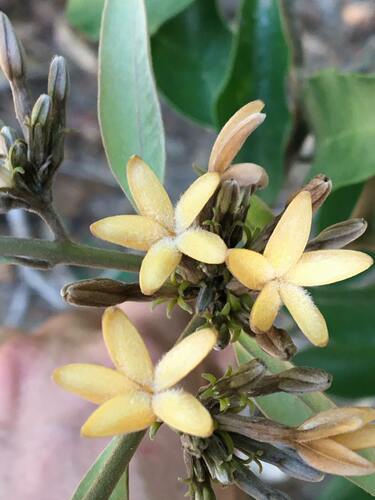
(c) Luc Strydom, some rights reserved (CC BY-NC), uploaded by Luc Strydom
Summary
Source: WikipediaCeropegia stapeliiformis is a flowering plant in the genus Ceropegia (Apocynaceae), native to South Africa and Eswatini. Common names include serpent ceropegia, snake creeper, and slangkambro. Ceropegia stapeliiformis is a prostrate, creeping, trailing or climbing succulent creeper with fibrous roots (which develop where the warty, trailing stems touch the ground) and has clear sap. The leaves are minute and rudimentary, soon falling off the stems. The flowers are 5–7 cm long and have a distinctive funnel or flask-shape, which create a pitfall in which pollinators may be temporarily trapped. The stapeliiformis has a greenish white colour that is spotted or streaked with maroon. The petals surrounding the mouth are free-spreading, reflexed and fringed with hairs. The fruit a follicle with tubercles. This species is usually found rooted in leaf mould under the protection of shrubs. Two subspecies have been described: Ceropegia stapeliiformis subsp. stapeliiformis Ceropegia stapeliiformis subsp. serpentina (E.A.Bruce) R.A.Dyer The subspecies stapeliiformis is known from areas of karroid scrub in the Eastern Cape province of South Africa, with a distribution from Uitenhage and Willowmore to Graaff Reinet and King William's Town. This subspecies is known to flower from October to March. The subspecies serpentina, which was initially described as Ceropegia serpentina by E. A. Bruce, has a distribution which ranges from Northern KwaZulu-Natal and Eswatini to Gauteng, Mpumalanga and Limpopo provinces of South Africa, where it occurs in scrub bush. The flowering time from December to March. The names have the derivations stapeliiformis = resembling Stapelia (Latin), and serpentina = serpentine (Latin).
Description
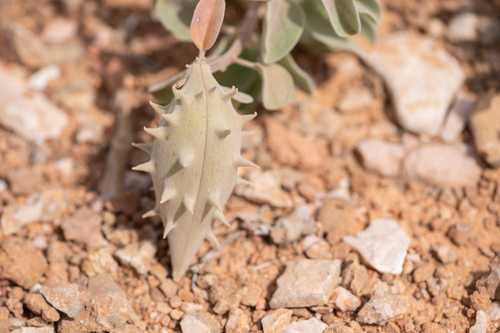
A vine that keeps growing from year to year. It climbs 1 m high and spreads 1 m wide. The stems are stout and have purple and grey marks. The leaves are small and like scales. The flowers are white and tube shaped. They have dark purple edges.
Edible Uses
The roots and tubers are eaten, traditionally used as a famine food.
Distribution
It needs a humus-rich soil and a sunny position. It is damaged by frost or drought.
Where It Grows
Africa, Eswatini, South Africa, Southern Africa, Swaziland,
Cultivation
Plants are grown by seeds, cuttings or division of the tubers.
Other Information
A famine food.
Notes
Also put in the family Asclepiadaceae.