Acer saccharum
Marshall
Sugar maple, Hard Maple
iNaturalist· cc-by
(c) James St. John, some rights reserved (CC BY)
iNaturalist· cc-by-nc
(c) scottmo, some rights reserved (CC BY-NC), uploaded by scottmo
iNaturalist· cc-by-nc
(c) Mario Rodrigo Chávez Chávez, some rights reserved (CC BY-NC), uploaded by Mario Rodrigo Chávez Chávez
Summary
Source: WikipediaAcer saccharum, the sugar maple, is a species of flowering plant in the soapberry and lychee family Sapindaceae. It is native to the hardwood forests of eastern Canada and the eastern United States. Sugar maple is best known for being the primary source of maple syrup and for its brightly colored autumn foliage. It may also be called "rock maple," "sugar tree," "sweet maple," or, particularly in reference to the wood, "hard maple," "birds-eye maple," or "curly maple," the last two being specially figured lumber.
Description
A shrub or small tree. It grows 5 m tall. There are prickles along the stem. The leaves are twice divided and there are 8-18 pairs of pinnae. There are up to 50 pairs of pinnules on each pinnae. The flowers are yellow. They are in large clusters at the ends of branches. The pods are flattened.
Edible Uses
The sap contains a notably high proportion of sugar — around 2–6% — and can be drunk fresh as a refreshing beverage or boiled down into a syrup used as a sweetener on many foods. Approximately 32 litres of sap are needed to produce one litre of maple syrup. Harvest in late winter or early spring; the flow is best on a warm sunny day after a frost, with trees on southern slopes in sandy soils giving the best yields. Tap a hole about 7cm deep, roughly 1.3 metres above the ground; yields of 40–100 litres per tree can be obtained. The best production comes from cold-winter areas with continental climates. Self-sown seedlings gathered in early spring can be eaten fresh or dried for later use. The seeds are cooked — wings removed, then boiled and eaten hot; they are about 6mm long and produced in small clusters. The inner bark is dried, ground into a powder, and used as a thickener in soups or mixed with cereals when making bread.
Traditional Uses
The sweet sap is eaten. The seeds have also been eaten but contain poisonous substances.
This uses section is brief — help expand it
Medicinal Uses
A tea made from the inner bark acts as a blood tonic, diuretic, and expectorant, and has been used to treat coughs and diarrhoea. A compound infusion of the bark has been used as eye drops in treating blindness. The sap has been used to treat sore eyes. The inner bark is also used as an expectorant and cough remedy. Maple syrup is used in cough syrups and is said to be a liver tonic and kidney cleanser.
Distribution
It is a temperate plant. A plant native to north America. It requires light fertile soils. It needs a protected position and can stand shade when young but full sun when mature. It is frost resistant but drought tender. It cannot tolerate coastal locations. It cannot tolerate pollution. It suits hardiness zones 4-8. Arboretum Tasmania. National Arboretum Canberra.
Where It Grows
Asia, Australia, Britain, Canada, Europe, Korea, North America, Russia, Tasmania, USA,
Cultivation
Grows well in heavy clay soils. Trees need full light and a lot of space. This species is one of the most shade tolerant of the N. American maples. It tolerates atmospheric pollution and so is often used as a street tree, though it can suffer from soil compaction and the use of salt on the roads in frosty weather. Tolerates a pH in the range 4.5 to 7.3. Hardy to about -45°c when fully dormant. A fast-growing tree for its first 40 years in the wild, this species is not a great success in Britain, though it does better than once thought. It grows well in Cornwall. In cultivation it has proved to be slow growing when young. Trees can live for 250 years in the wild. A very ornamental tree but a bad companion plant, inhibiting the growth of nearby plants. This species is commercially exploited in America for its sap. Along with its sub-species it is the major source of maple syrup. There are some named varieties. The sap can be tapped within 10 - 15 years from seed but it does not flow so well in areas with mild winters.
Propagation
Seed is best sown as soon as it is ripe in a cold frame, usually germinating the following spring. A significant proportion of seed is non-viable; cutting a few open to check for an embryo is recommended. An average germination rate of 95% can be achieved from viable seed. Pre-soak stored seed for 24 hours then stratify for 2–4 months at 1–8°C; germination can be slow and sometimes takes two years. Seed can also be harvested green — fully developed but before drying and producing germination inhibitors — and sown immediately for late-winter germination. Seed harvested too early produces very weak or no plants. Prick seedlings out into individual pots and grow on until 20cm or more tall before planting out. Layering takes about 12 months and is successful with most species in this genus. For cuttings taken in June or July, use young shoots with 2–3 pairs of leaves plus one pair of buds at the base; remove a thin slice of bark at the base and use a rooting hormone. Rooted cuttings must put on new growth during summer before being potted up, or they are unlikely to survive winter.
Other Uses
Leaves packed around apples and rootcrops help preserve them. The wood is close-grained, tough, hard, heavy, and strong; it takes a high polish, remains smooth under abrasion, and has high shock-resistance. It holds nails well, glues reasonably, dries easily, and shrinks moderately, weighing 43lb per cubic foot. Considered by many to be the most valuable hardwood tree in North America, it is used for furniture, flooring, turnery, musical instruments, and shipbuilding. Accidental forms with curled or contorted grain — known as curly maple and bird's eye maple — are common and highly prized in cabinet making. The wood is also an excellent fuel, producing a great deal of heat and very hot embers. The wood ash is rich in alkali and yields large quantities of potash. The tree acts as a dynamic accumulator, gathering minerals and nutrients from the soil and storing them in a more bioavailable form for use as fertilizer or mulch improvement.
Production
Yields of 80 to 180 litres of sap can be produced in a season from one tree. The sap can be concentrated by boiling or by leaving it out in the frost and removing the ice which forms on top. Sap flow occurs from the end of spring until buds swell. A good sap flow requires freezing nights and sunny days. A hollow metal tube 11 mm across is driven slightly upwards and 5-8 cm into the trunk. It is often slow growing for the first 10 years. About 40 litres of sap produce one litre of syrup.
Other Information
It is the main source of maple syrup. Cultivated.
Notes
There are about 120-150 Acer species.
Nutrition
| Part | Moisture | kJ | kcal | Protein | Vit A | Vit C | Iron | Zinc |
|---|---|---|---|---|---|---|---|---|
| Sap | 1200 | 287 | — | — | — | — | — | — |
| Seeds | 1200 | 287 | — | — | — | — | — | — |
Synonyms
Also Known As
Rock Maple
References (30)
- Arbust. amer. 4. 1785
- Beckstrom-Sternberg, Stephen M., and James A. Duke. "The Foodplant Database." http://probe.nalusda.gov:8300/cgi-bin/browse/foodplantdb.(ACEDB version 4.0 - data version July 1994)
- Bircher, A. G. & Bircher, W. H., 2000, Encyclopedia of Fruit Trees and Edible Flowering Plants in Egypt and the Subtropics. AUC Press. p 6
- Bodkin, F., 1991, Encyclopedia Botanica. Cornstalk publishing, p 43
- Bremness, L., 1994, Herbs. Collins Eyewitness Handbooks. Harper Collins. p 33
Show all 30 references Hide references
- Brickell, C. (Ed.), 1999, The Royal Horticultural Society A-Z Encyclopedia of Garden Plants. Convent Garden Books. p 68
- Coombes, A.J., 2000, Trees. Dorling Kindersley Handbooks. p 101
- Cundall, P., (ed.), 2004, Gardening Australia: flora: the gardener's bible. ABC Books. p 89
- Duke, J.A., 1992, Handbook of Edible Weeds. CRC Press. p 16
- Elias, T.S. & Dykeman P.A., 1990, Edible Wild Plants. A North American Field guide. Sterling, New York p 125, 257
- Esperanca, M. J., 1988. Surviving in the wild. A glance at the wild plants and their uses. Vol. 2. p 262
- Etherington, K., & Imwold, D., (Eds), 2001, Botanica's Trees & Shrubs. The illustrated A-Z of over 8500 trees and shrubs. Random House, Australia. p 70
- Facciola, S., 1998, Cornucopia 2: a Source Book of Edible Plants. Kampong Publications. p 1
- Farrar, J.L., 1995, Trees of the Northern United States and Canada. Iowa State University press/Ames p 134
- Grandtner, M. M., 2008, World Dictionary of Trees. Wood and Forest Science Department. Laval University, Quebec, Qc Canada. (Internet database http://www.WDT.QC.ca)
- Harter, J.(Ed.), 1988, Plants. 2400 copyright free illustrations. Dover p 3.8, 3.9
- Hu, Shiu-ying, 2005, Food Plants of China. The Chinese University Press. p 522
- Kiple, K.F. & Ornelas, K.C., (eds), 2000, The Cambridge World History of Food. CUP p 1810
- Lazarides, M. & Hince, B., 1993, Handbook of Economic Plants of Australia, CSIRO. p 8
- Little, E.L., 1980, National Audubon Society Field Guide to North American Trees. Alfred A. Knopf. p 579
- Lord, E.E., & Willis, J.H., 1999, Shrubs and Trees for Australian gardens. Lothian. p 46
- Lyle, S., 2006, Discovering fruit and nuts. Land Links. p 46
- MacKinnon, A., et al, 2009, Edible & Medicinal Plants of Canada. Lone Pine. p 66
- Plants for a Future database, The Field, Penpol, Lostwithiel, Cornwall, PL22 0NG, UK. http://www.scs.leeds.ac.uk/pfaf/
- Toupal, R. S. & Hollenback, K., 2009, An Ethnobotany of Indiana Dunes National Lakeshore: Plant Uses of the Ojibwa People. Bureau of Applied research in Anthropology. University of Arizona
- Usher, G., 1974, A Dictionary of Plants Used by Man. Constable. p 16
- van Wyk, B., 2005, Food Plants of the World. An illustrated guide. Timber press. p 41
- Wiersema, J. H. & Leon, B., 2013, World Economic Plants. A Standard Reference CRC Press. 2nd Ed. p 9
- World Checklist of Useful Plant Species 2020. Royal Botanic Gardens, Kew
- Young, J., (Ed.), 2001, Botanica's Pocket Trees and Shrubs. Random House. p 65
More from Sapindaceae
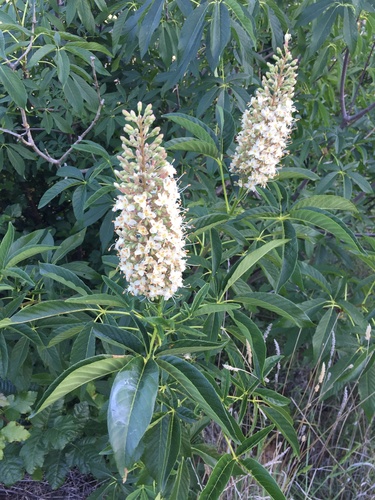
Aesculus californica
Californian Buckeye, Californian Horse-Chestnut, Berraco
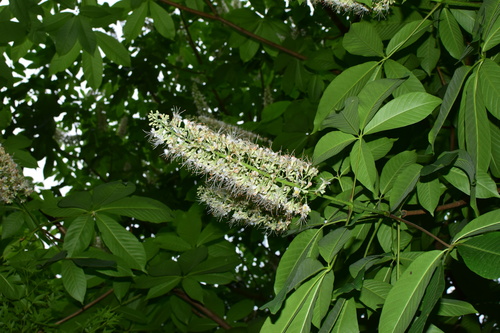
Aesculus chinensis
Chinese horse chestnut
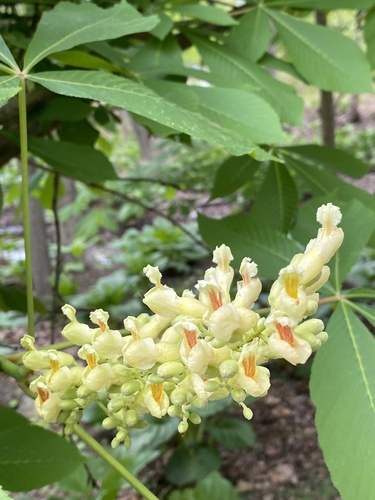
Aesculus flava
Sweet buckeye, Horse Chestnut, Yellow Buckeye
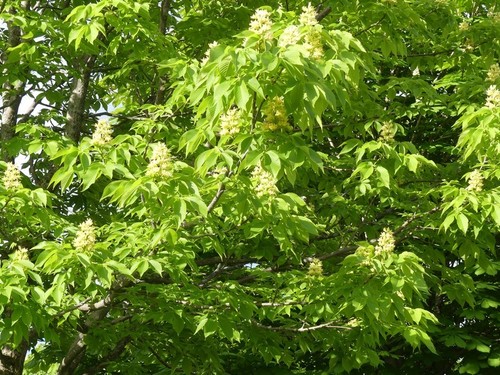
Aesculus glabra
Ohio buckeye, Fetid buckeye
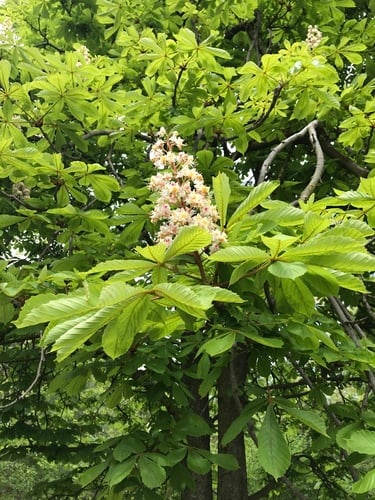
Aesculus hippocastanum
European horse chestnut
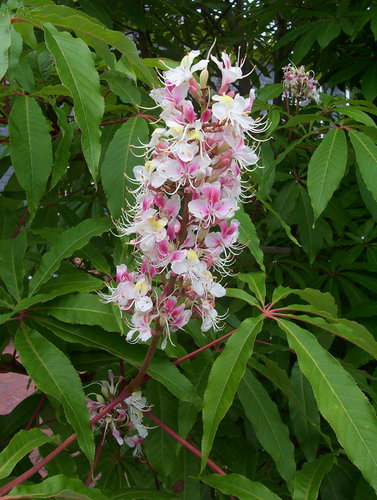
Aesculus indica
Indian chestnut, Indian horse chestnut