Artocarpus odoratissimus
Blanco
Terap
iNaturalist· cc-by-nc-sa
(c) Tony Rodd, some rights reserved (CC BY-NC-SA)
iNaturalist· cc-by-nc
(c) Rafidah Abdul Rahman, some rights reserved (CC BY-NC)
iNaturalist· cc-by-nc-sa
(c) Jason Crespo, some rights reserved (CC BY-NC-SA)
Summary
Source: WikipediaArtocarpus odoratissimus, commonly known as marang, tarap, terap or less common, johey oak, is a species of flowering plant in the Moraceae family. It is native to Borneo from where has been introduced to the Philippines. It is closely related to the jackfruit, cempedak, and breadfruit trees which all belong to the same genus, Artocarpus.
Description
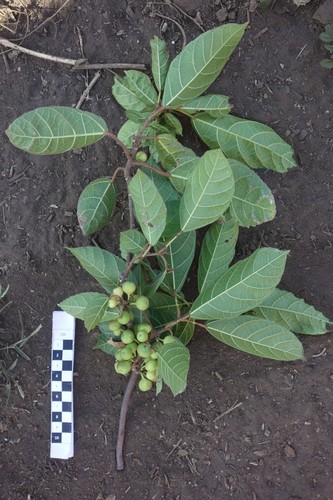
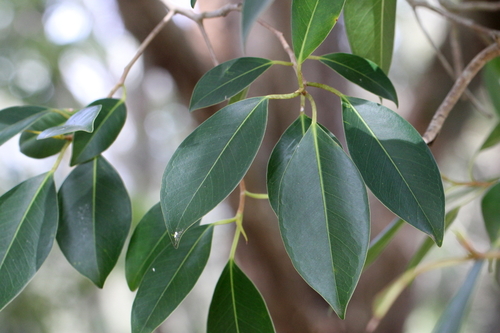
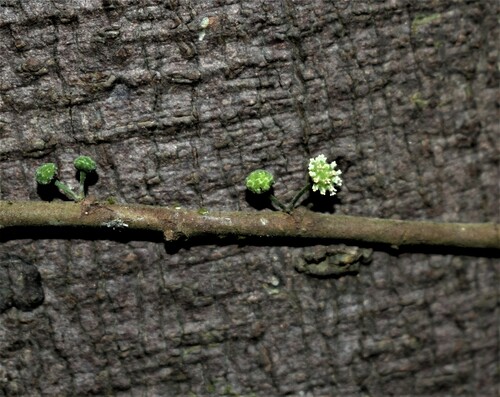
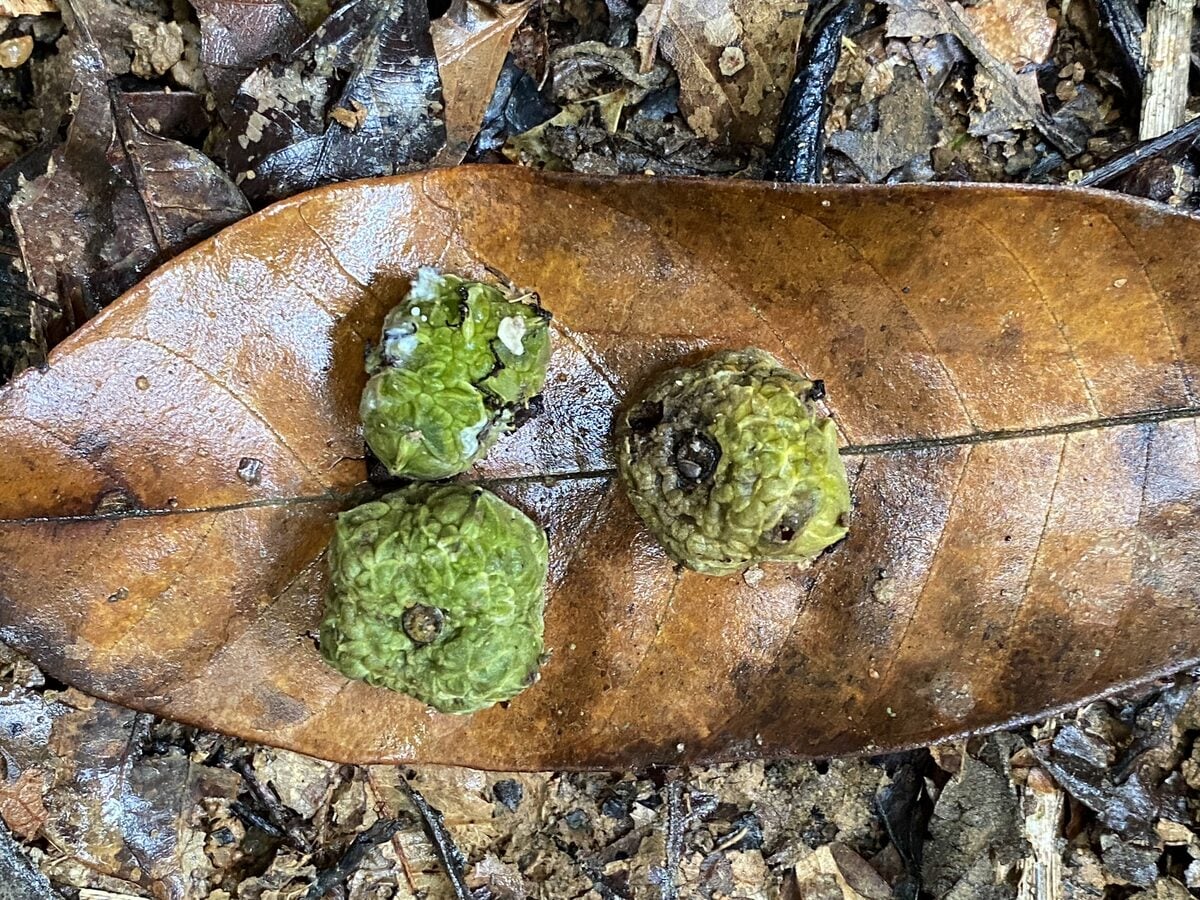
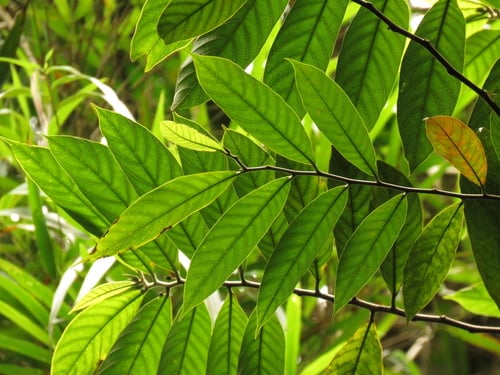
A large tree. It grows 12 to 25 m high. The trunk is 40 cm across. The bark is smooth and dark grey. The twigs are 4-10 mm thick. They have ring like scars. The leaves are very rough and large. They are leathery. They can be entire or lobed. They are 16-50 cm long by 11-28 cm wide. They are hairy on both sides. The edges can be wavy. There are 12-15 pairs of secondary veins which curve and disappear near the edge of the leaf. The flower heads are solitary in the axils of leaves. The male heads are long and 40-90 ,, long by 25-35 mm wide. The fruit are very large and oval. It is 16 cm long by 13 cm wide. They are covered with soft fleshy spines. The fruit is yellow-green. The flesh of the fruit is white and very juicy and sweet with a smell. The fruit stalk is 5.5-14 cm long. The seeds are oval and 12 mm long by 8 mm wide. The fruit are edible.
Edible Uses
Edible Parts: Fruit Seed Edible Uses: Edible portion: Fruit, Seeds, Nuts. The ripe fruits are fleshy, aromatic, sweet and juicy - similar to the jackfruit (A. heterophyllus) but of much better quality. Usually eaten as a dessert fruit, they are considered to be the finest fruit in Brunei. The unripe fruit can be eaten as a boiled vegetable. The roundish to oblong fruit is quite large, averaging about 16cm long and 13cm in diameter. The rind of the fruit is said to be edible. Thick and fleshy. Seed - roasted or boiled and eaten. Seeds boiled for 30 minutes in salty water have a delicious nutty flavour. Roasted seeds have a flavour similar to sweet chestnuts. The whitish seed is about 8 _ 15mm in size.
Traditional Uses
The fleshy portion of the fruit is eaten raw. It is sweet. The seeds are eaten roasted or boiled. The unripe fruit can be cooked as a vegetable.
This uses section is brief — help expand it
Medicinal Uses
None known
Distribution
A tropical tree. It suits the hot, wet tropical lowlands. It prefers a warm humid climate. It can be damaged by temperatures below 5°C. Occurs only in Mindoro, Mindanao and Basilan but apparently fairly common in Mindoro, Cotabato, Lanao, Davao, Zamboanga and Basilan in the Philippines. In Indonesia it grows in lowland forest and up to 1,000 m altitude. Brisbane Botanical Garden.
Where It Grows
Asia, Australia, Brazil, Brunei, Indonesia, Malaysia*, Mauritius, Myanmar, North America, Pacific, Philippines*, SE Asia, South America, USA,
Cultivation
A plant of lowland humid tropics, succeeding at elevations up to 1,000 metres, it grows best in regions with abundant and equally distributed rainfall. Prefers a deep, well-drained soil. Young plants need some shade, but need increasing light levels as they mature. Trees as young as 4 - 6 years can begin to bear fruit. Yields of 4 - 6 tonnes per hectare have been achieved. The fruits are borne at the end of long flexible branches and ripe fruits are heavy, fragile and difficult to reach for harvest. Mature fruits are usually harvested by hand with the help of a curved knife attached to the end of long bamboo pole. Getting at the heavy fruit at the end of slender twigs is hazardous. The delicate fruit really should be caught to break the fall, it has a very short shelf life. A tree produces about 180 fruit per season.
Propagation
Seed - it has a short viability and so is best sown as soon as it is ripe. The seed germinates best at a temperature of 24 - 27c. Germination is often 100% within 4 weeks. Plants are spaced 12-14 m apart. Root cuttings. Air layering. Plants can be grafted.
Other Uses
Other Uses: None known Special Uses Food Forest
Production
A tropical tree. Trees produce after about 4-6 years. The spines on the fruit snap when the fruit is ripe. The fruit have to be picked from the tree as it doesn't fall. A tree produces about 180 fruit per season.
Other Information
It is a cultivated food plant. The fruit is good tasting.
Notes
There are about 50 Artocarpus species. They are in the tropics and subtropics of Asia and the Pacific.
Nutrition
| Part | Moisture | kJ | kcal | Protein | Vit A | Vit C | Iron | Zinc |
|---|---|---|---|---|---|---|---|---|
| Seed | 48.5 | — | 232 | 2.6 | — | — | 0.6 | — |
| Fruit | 70.6 | — | 104 | 0.5 | — | — | 3.5 | — |
Synonyms
Also Known As
Beluli, Benturung, Jarap hutan, Keiran, Kian, Loloi, Lumok, Lumuk amat, Madang, Marang-banguhan, Marang, Morang, Muntorong, Pi-ien, Pingan, Tarap, Tekalong, Terap, Timadang
References (33)
- Arora, R. K., 2014, Diversity in Underutilized Plant Species - An Asia-Pacific Perspective. Bioversity International. p 59
- Bircher, A. G. & Bircher, W. H., 2000, Encyclopedia of Fruit Trees and Edible Flowering Plants in Egypt and the Subtropics. AUC Press. p 43
- Brown, W.H., 1920, Wild Food Plants of the Philippines. Bureau of Forestry Bulletin No. 21 Manila. p 44
- Burkill, I.H., 1966, A Dictionary of the Economic Products of the Malay Peninsula. Ministry of Agriculture and Cooperatives, Kuala Lumpur, Malaysia. Vol 1 (A-H) p 260
- Call, C. A., et al, 2004, Participatory Rural Appraisal in the Upland Ecosystem of Mt Malindang, Misamis Occidental, Philippines. Biodiversity Research Programme for Development in Mindanao. p 53
Show all 33 references Hide references
- Chai, P. P. K. (Ed), et al, 2000, A checklist of Flora, Fauna, Food and Medicinal Plants. Lanjak Entimau Wildlife Sanctuary, Sarawak. Forestry Malaysia & ITTO. p 168
- Coronel, R.E., 1982, Fruit Collections in the Philippines. IBPGR Newsletter p 6
- Darley, J.J., 1993, Know and Enjoy Tropical Fruit. P & S Publishers. p 52
- Facciola, S., 1998, Cornucopia 2: a Source Book of Edible Plants. Kampong Publications, p 154
- Fl. Filip. 671. 1837
- Flowerdew, B., 2000, Complete Fruit Book. Kyle Cathie Ltd., London. p 155
- Food Composition Tables for use in East Asia FAO http://www.fao.org/infoods/directory No. 915
- Hoare, A., 2003, Food use of the Lundayeh SW Sabah. Borneo Research Council.
- Lorenzi, H., Bacher, L., Lacerda, M. & Sartori, S., 2006, Brazilian Fruits & Cultivated Exotics. Sao Paulo, Instituto Plantarum de Estuados da Flora Ltda. p 438
- Lyle, S., 2006, Discovering fruit and nuts. Land Links. p 81
- Macmillan, H.F. (Revised Barlow, H.S., et al) 1991, Tropical Planting and Gardening. Sixth edition. Malayan Nature Society. Kuala Lumpur. p 293
- Martin, F. W., et al, 1987, Perennial Edible Fruits of the Tropics. USDA Handbook 642 p 37
- Menninger, E.A., 1977, Edible Nuts of the World. Horticultural Books. Florida p 73
- Milow, P., et al, 2013, Malaysian species of plants with edible fruits or seeds and their evaluation. International Journal of Fruit Science. 14:1, 1-27
- Monsalud, M.R., Tongacan, A.L., Lopez, F.R., & Lagrimas, M.Q., 1966, Edible Wild Plants in Philippine Forests. Philippine Journal of Science. p 501
- PROSEA (Plant Resources of South East Asia) handbook, Volume 2, 1991, Edible fruits and nut. p 94
- Septiani, Y. & Sidabutar, H., (Eds.) 2015, Biodiversity Survey. In the Sub Watershed Embaloh, Betung Kerihun National Park. ITTO p 82
- Shaffiq, A. M., A., et al, 2013, Marketable wild fruits of Sarawak, Borneo: Their mode of consumption, uses and sugar profiles. Indian Journal of Traditional Knowledge. Vol 12(2): 195-201
- Siong, K. H., 2003, Indigenous Fruits of Sarawak. Forest Department Sarawak. p 97
- Slik, F., www.asianplant.net
- Soepadmo, E. and Saw, L. G., 2000, Tree Flora of Sabah and Sarawak. Forestry Malaysia. Volume Three. p 205
- Sukarya, D. G., (Ed.) 2013, 3,500 Plant Species of the Botanic Gardens of Indonesia. LIPI p 139
- Tankard, G., 1990, Tropical fruit. An Australian Guide to Growing and using exotic fruit. Viking p 111
- Terra, G.J.A., 1973, Tropical Vegetables. Communication 54e Royal Tropical Institute, Amsterdam, p 26
- USDA, ARS, National Genetic Resources Program. Germplasm Resources Information Network - (GRIN). [Online Database] National Germplasm Resources Laboratory, Beltsville, Maryland. Available: www.ars-grin.gov/cgi-bin/npgs/html/econ.pl (10 April 2000)
- Wickens, G.E., 1995, Edible Nuts. FAO Non-wood forest products. FAO, Rome. p144
- Wiersema, J. H. & Leon, B., 2013, World Economic Plants. A Standard Reference CRC Press. 2nd Ed. p 74
- World Checklist of Useful Plant Species 2020. Royal Botanic Gardens, Kew