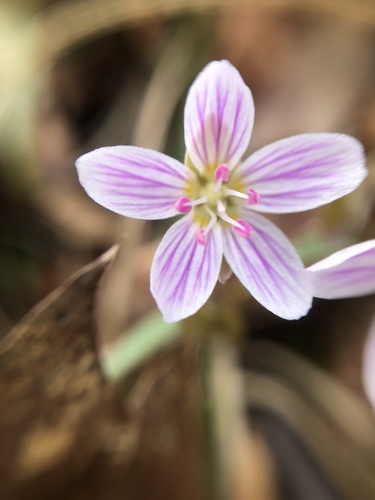
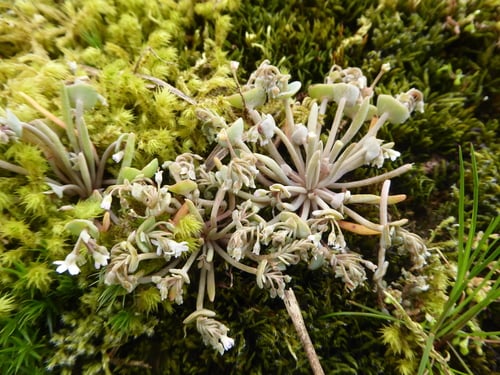
Calandrinia ciliata
(Ruiz. & Pav.) DC.
Redmaids, Purple calandrina
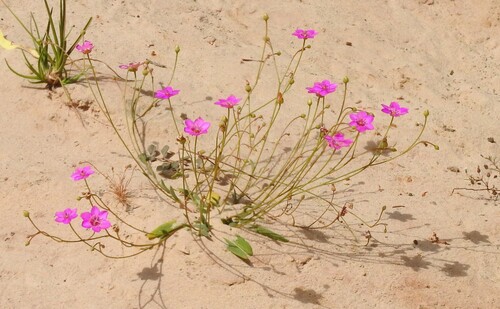
iNaturalist· cc-by-nc
(c) Ron Vanderhoff, some rights reserved (CC BY-NC)
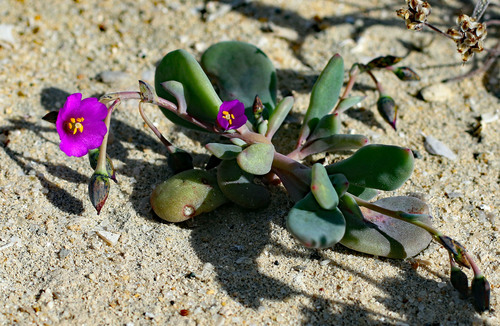
iNaturalist· cc-by-nc
(c) kqedquest, some rights reserved (CC BY-NC)
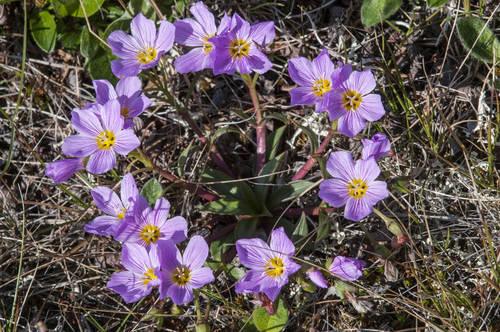
iNaturalist· cc-by-nc
(c) Eric Koberle, some rights reserved (CC BY-NC), uploaded by Eric Koberle
Summary
Source: WikipediaCalandrinia ciliata is a species of flowering plant known as fringed redmaids and red-maids. While formerly included in the Purslane family, it is now treated as a member of the family Montiaceae. It is native to western North America from British Columbia to New Mexico and Guatemala, where it is widespread and common. It can also be found in western and southern South America, from Venezuela and Colombia through the Andean countries to southern Argentina and Chile. It has been introduced to the Falkland Islands. In the Falkland Islands it is known by the synonym Calandrinia feltonii, and by the common name Felton's flower. It is named after Arthur Felton, a resident of the Falkland Islands, who sent specimens of the plant in 1910 to Swedish botanist Carl Skottsberg. It nearly became extinct in the wild on the islands through overgrazing.
Description
A succulent annual herb. It keeps growing from year to year. It usually lies along the ground. It grows 30 cm high and 50 cm wide. The stems can be 25 cm long. They are low and branching. The leaves are greyish-green and hairy. The flowers are purple fading to white. They are at the ends of branches. The seeds are black.
Edible Uses
Edible Parts: Leaves Seed Shoots Edible Uses: Leaves and young shoots - raw, cooked or used as a garnish. A tasty salad. The leaves contain oxalic acid and so some caution is advised, see the notes above on toxicity. Seed - raw or ground into a meal. The seed can also be cooked as a piñole. The seed is very small and fiddly to harvest, especially since it ripens intermittently over a period of several weeks. However, it is rich in oil and was often collected in large quantities by native North American Indian tribes. Edible Uses & Rating: The seeds of desert redmaids are the only part worth collecting for food. They can be eaten raw, toasted, or boiled, and were historically a staple wild grain for Indigenous peoples of California and the Great Basin. The seeds are high in oils and carbohydrates, providing valuable energy and storage stability. They can be ground into flour or meal and used much like chia or quinoa. The leaves and flowers, though technically edible, have an acrid, unpleasant taste and can irritate the mouth or throat if eaten in quantity. Boiling reduces but does not eliminate the bitterness [2-3]. The edibility rating for the seeds is 4/5 (excellent wild grain), while for the leaves and other parts, 1/5 (poor, acrid, and low food value). Taste, Processing & Kitchen Notes: Redmaid seeds are small but flavorful. Raw seeds taste neutral, with a pleasant crunch. Toasted seeds develop a delicate, nutty, popcorn-like aroma and flavor, while boiled seeds resemble cooked quinoa—soft, starchy, and faintly oily. The seeds lack mucilage, making them unsuitable for thickening soups but ideal for mixing into grain blends, porridges, or baked goods [2-3]. Harvesting and processing can be difficult because the seed capsules burst open when fully mature, scattering seeds across the ground. A practical method is to collect whole plants just before the capsules open, allow them to dry in a basket or sack, and then thresh and winnow the resulting material. Seeds cling to soil and chaff, so careful winnowing and rinsing improve quality. Once clean and dry, the seeds store well and retain flavor for years. Seasonality (Phenology): Desert redmaids germinate following winter or early spring rains, often from February to April, and flower shortly thereafter. Seed set occurs between April and July, depending on elevation and rainfall. As annuals, the plants complete their life cycle quickly—often within 6 to 8 weeks—dying back as summer heat intensifies. Seeds persist in the soil seed bank and germinate after the next adequate rainfall. Safety & Cautions (Food Use): All parts of the plant are safe to eat in small quantities, but the acrid taste of the foliage limits palatability. Boiling can reduce harshness but does not eliminate it entirely. The seeds are free from known toxins and safe for human consumption. As with all wild-gathered foods, ensure plants are collected from clean, uncontaminated areas. Harvest & Processing Workflow: The best harvesting strategy involves collecting whole plants before capsules burst, drying them in a breathable container to catch expelled seeds, then threshing and winnowing the material. Rubbing the dry plants over a screen or basket releases seeds efficiently. Once clean and dry, the seeds can be stored or lightly toasted for use. The bursting capsule mechanism complicates timing, so harvesting over several days increases yield. Look-Alikes & Confusion Risks: Desert redmaids may be confused with species of Cistanthe or Claytonia (also Montiaceae), especially Cistanthe ambigua (desert pussypaws). However, redmaids can be distinguished by their hairy sepals, three-valved capsules, and black shiny seeds. During vegetative stages, their reddish, succulent leaves may resemble small purslane (Portulaca spp.), but purslane lacks hairs and has mucilaginous sap. Traditional / Indigenous Use Summary: The seeds of desert redmaids were a traditional food source for many Indigenous groups of California, including the Pomo, Miwok, and Yokuts, who gathered them in large quantities. Seeds were parched, winnowed, and ground into a fine meal for mush or mixed with water into cakes. The seed’s high oil content made it especially valuable in desert diets, providing sustained energy. The plant was also occasionally used as a seasonal indicator—its flowering signifying the arrival of spring rains.
Traditional Uses
The leaves are used as a potherb.
This uses section is brief — help expand it
Medicinal Uses
None known
Known Hazards
The plant contains oxalic acid, so it should only be used in moderation. Oxalic acid can lock up certain of the nutrients in food and, if eaten in excess, can lead to nutritional deficiencies. It is, however, perfectly safe in small amounts and its acid taste adds a nice flavour to salads. Cooking the plant will reduce the quantity of oxalic acid. People with a tendency to rheumatism, arthritis, gout, kidney stones and hyperacidity should take especial caution if including this plant in their diet since it can aggravate their condition.
Distribution
It grows in tropical and subtropical places. It does best in a light, moist, rich soil. It needs a protected sunny position. It is drought and frost tender. In Argentina it grows from sea level to 3,500 m above sea level. Tasmania Herbarium.
Where It Grows
Argentina, Australia, Bolivia, Canada, Central America, Chile, Ecuador*, El Salvador, Mexico, North America, Peru*, South America, Tasmania, USA, Venezuela,
Cultivation
It can be grown from seed or by cuttings.
Propagation
Seed - best sown in situ in spring since it strongly resents root disturbance. Germination usually takes place within 1 - 3 weeks at 20°c. Cuttings.
Other Uses
The plant was also occasionally used as a seasonal indicator—its flowering signifying the arrival of spring rains. Though small and short-lived, its contributions to both traditional diets and native ecosystems are substantial. Ecology & Wildlife: Desert redmaids contribute to pollinator support in arid ecosystems. Their magenta flowers attract native bees, syrphid flies, and small solitary pollinators. The seeds are eaten by ground-feeding birds and rodents, while the plant provides limited foliage forage for small herbivores. Ecologically, it plays a role in early-spring nutrient cycling and soil stabilization. Special Uses
Notes
There are between 50-100 Calandrinia species. It has also been put in the family Portulacaceae.
Synonyms
Also Known As
Fringed redmaids
References (11)
- Anderson, M. K., 2012, Edible Seeds and Grains of California Tribes and the Klamath Tribe of Oregon in the Phoebe Apperson Hearst Museum of Anthropology Collections, University of California, Berkeley. USDA p 47
- Bodkin, F., 1991, Encyclopedia Botanica. Cornstalk publishing, p 188
- Ferns, Useful Tropical Plants.
- https://www.fireflyforest.com/flowers/category/edible-plants/ Edible Plants – Southeastern Arizona Wildflowers and Plants
- Kermath, B. M., et al, 2014, Food Plants in the Americas: A survey of the domesticated, cultivated and wild plants used for Human food in North, Central and South America and the Caribbean. On line draft. p 160
Show all 11 references Hide references
- Leon-Lobos, P., et al, 2022, Patterns of Traditional and Modern Uses of Wild Edible Native Plants of Chile: Challenges and Future Perspectives. Plants (Basel) v 11 (6) Table S1
- Paczkowska, G . & Chapman, A.R., 2000, The Western Australian Flora. A Descriptive Catalogue. Western Australian Herbarium. p 461
- Plants for a Future, The Field, Penpol, Lostwithiel, Cornwall, PL22 0NG, UK. http://www.scs.leeds.ac.uk/pfaf/
- Tasmanian Herbarium Vascular Plants list p 46
- Tozer, F., 2007, The Uses of Wild Plants. Green Man Publishing. p 50
- World Checklist of Useful Plant Species 2020. Royal Botanic Gardens, Kew