Rubia peregrina
L.
Wild madder
iNaturalist· cc-by-nc
(c) carla corazza, some rights reserved (CC BY-NC)
iNaturalist· cc-by-nc
(c) carla corazza, some rights reserved (CC BY-NC)
iNaturalist· cc-by-nc
(c) carla corazza, some rights reserved (CC BY-NC)
Summary
Source: WikipediaRubia peregrina, the common wild madder, is a herbaceous perennial plant species belonging to the bedstraw and coffee family Rubiaceae.
Description
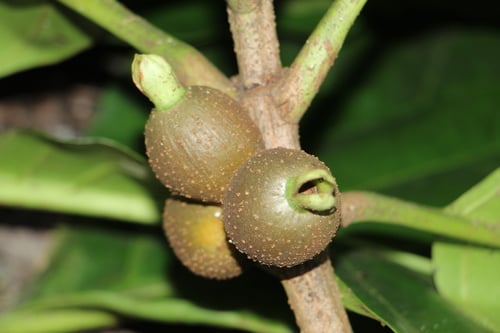
A climber. The stems is woody and square. They are 50-250 cm long. The leaves are shiny and do not have stalks. They are oval to sword shaped and there are teeth along the edge. The leaves are in rings with up to 5 leaves in a group. The flowers are small and with pale green to yellow petals. The fruit are fleshy and green and turn black when ripe. They are 5 mm across.
Edible Uses
None known
Traditional Uses
The fruit are eaten fresh and also made into jam. The roots are dried and used as a spice. The roots are also peeled and cut and crushed and cooked in recipes.
Medicinal Uses
The plant is abortifacient, aphrodisiac, diuretic, and emmenagogue.
Distribution
It is a Mediterranean climate plant. It grows from sea level to 1,000 m above sea level. It grows in dry soil and in hedges.
Where It Grows
Africa, Balkans, Britain, Europe, France, Greece, Italy, Macedonia, Mediterranean, Morocco, North Africa, Portugal, Sicily, Slovenia, Spain,
Cultivation
Prefers a loose moist leafy soil in some shade. Tolerates dry soils but quickly becomes scorched when growing in full sun. Plants grown in fertile well-limed soils produce more pigment in the root.
Propagation
Seed is best sown as soon as it is ripe in a cold frame, as stored seed can be very slow to germinate. Prick out seedlings when large enough to handle and grow on in light shade in the greenhouse for the first year, then plant out into permanent positions in early summer. Divide in spring or at any point during the growing season, keeping divisions well watered until established. Larger divisions can go straight into permanent positions; smaller ones are best potted up and grown on in a lightly shaded cold frame, then planted out once well established in summer.
Other Uses
A red dye is obtained from the roots.
Notes
It is used as a vegetable red dye.
Synonyms
Also Known As
Elfouwwa, Foua, Taroubia, Vednozeleni brošč
References (5)
- Ghanimi, R., et al, 2022, Ethnobotanical study on wild edible plants traditionally used by Messiwa people, Morocco. Journal of Ethnobiology and Ethnomedicine. 18:16
- http://www.botanic-gardens-ljubljana.com/en/plants
- Lentini, F. and Venza, F., 2007, Wild food plants of popular use in Sicily. J Ethnobiol Ethnomedicine. 3: 15
- Pasta, S., et al, 2020, An Updated Checklist of the Sicilian Native Edible Plants: Preserving the Traditional Ecological Knowledge of Century-Old Agro-Pastoral Landscapes. Frontiers in Plant Science. Volume 11|Article 388
- Tbatou, M, et al, 2016, Wild Edible Plants traditionally used in the countryside of El Jadida, Coastal Area in the Center of Morocco. Life Sciences Leaflets 75:28-48