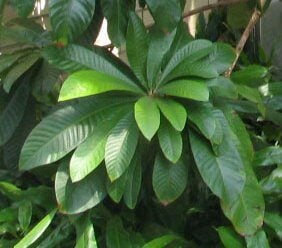
Mimusops obtusifolia
Lam.
Round-fruited red milkwood
iNaturalist· cc-by-nc
(c) Mark Hyde, Bart Wursten and Petra Ballings, some rights reserved (CC BY-NC)
iNaturalist· cc-by-nc
(c) Ehren, some rights reserved (CC BY-NC)
iNaturalist· cc-by-nc
(c) Ehren, some rights reserved (CC BY-NC)
Description
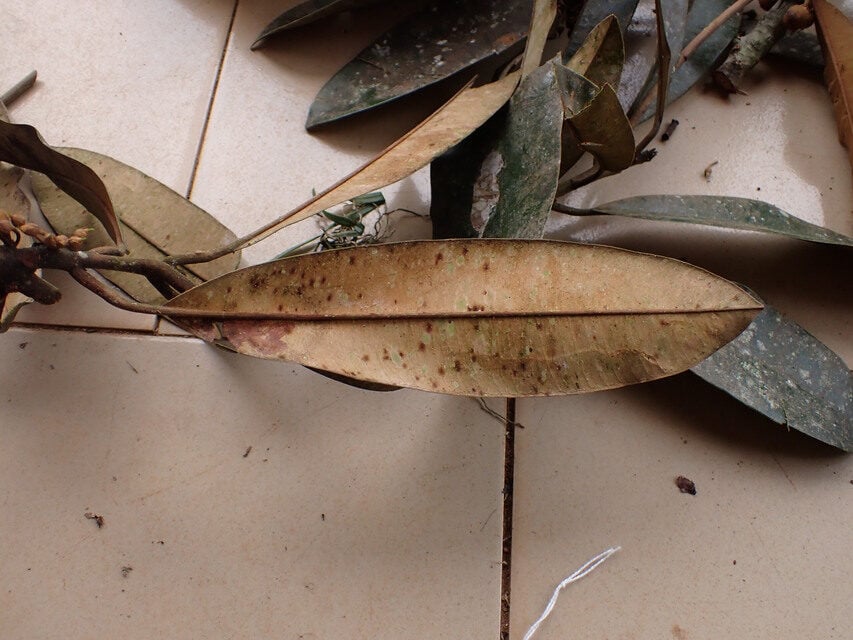
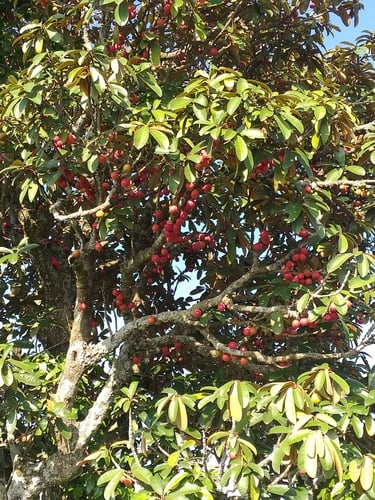
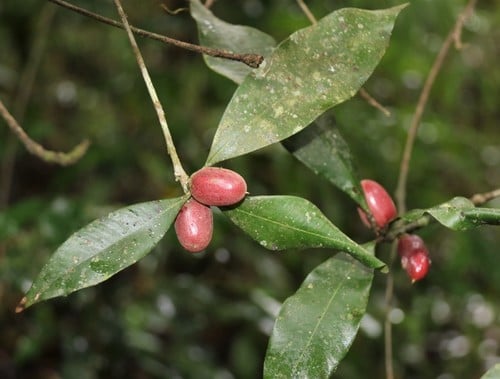
A shrub or tree. It has many stems. It can be 2-20 m tall. The bark is grey to blackish. It is rough and cracked. The leaves are oval or almost round. They are 4-10 cm long. They are softly leathery. They are dark green and shiny above and with grey hairs underneath. The young leaves and twigs have rusty brown hairs. The flowers are in small clusters in the axils of leaves. They are creamy-white. They are 1 cm across. The fruit is fleshy and almost round. It is 2.5 cm long ad orange-red when ripe.
Edible Uses
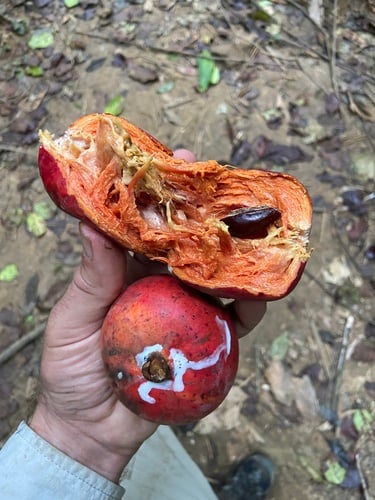
Fruit - raw. A sweet-tasting flesh, it is usually eaten as a snack and the seeds discarded. The fruit is a round, orange-red berry with a tough skin, up to 25mm in diameter containing 1 - 5 dark shiny seeds.
Traditional Uses
The ripe fruit are eaten raw as a snack. The seeds are discarded.
This uses section is brief — help expand it
Distribution
It is a tropical plant. It grows on coastal scrub, forests along rivers and on termite mounds. In Tanzania it grows from sea level to 800 m above sea level. In Kenya it grows in coastal areas in dry coastal forest. It is often near sand dunes.
Where It Grows
Africa, Angola, Botswana, Central Africa, Comoros, East Africa, Kenya, Madagascar, Malawi, Mozambique, South Africa, Southern Africa, Tanzania, Zambia, Zimbabwe,
Cultivation
Plants can be grown from seeds.
Other Uses
The wood is hard and heavy. It is used for poles, tool handles, spoons, dhow building, carvings, gunstocks, bedsteads and clogs. The wood is used for fuel. The tree provides good shade.
Production
In Tanzania the fruit are collected from November to January.
Synonyms
Also Known As
Chibabava, Mfuma, Mgama, Mghambo, Mugama-muho, Museaxadgi, Mussonco, Salazi, Tingole, Tututo
References (5)
- http://www.fao.org/forestry/25323-096344a3de335832e8f363c3ac5184a66.pdf
- Lemmens, R.H.M.J., 2005. Mimusops maxima (Poir.) R.E.Vaughan. [Internet] Record from Protabase. Louppe, D., Oteng-Amoako, A.A. & Brink, M. (Editors). PROTA (Plant Resources of Tropical Africa), Wageningen, Netherlands. < http://database.prota.org/search.htm>. Accessed 19 October 2009.
- Maundu, P. et al, 1999, Traditional Food Plants of Kenya. National Museum of Kenya. 288p (As Mimusops fruticosa)
- Mutie, F. M., et al, 2023, Important Medicinal and Food Taxa (Orders and Families) in Kenya, Based on Three Quantitative Approaches. Plants 2023, 12, 1145
- Pakia, M., 2000, Plant Ecology and Ethnobotany of two sacred forests (Kayas) at the Kenya Coast. M. Sc. Thesis.