Pradosia ptychandra
(Eyma) Pennington
Balata pomier, Kimboto
wikimedia· cc0
Wikimedia Commons - Jean-Baptiste-Christophe FUSÉE-AUBLET (1720-1778)
gbif· cc-by-sa
Vanessa Hequet
gbif· cc-by-sa
C. Geniez
Description
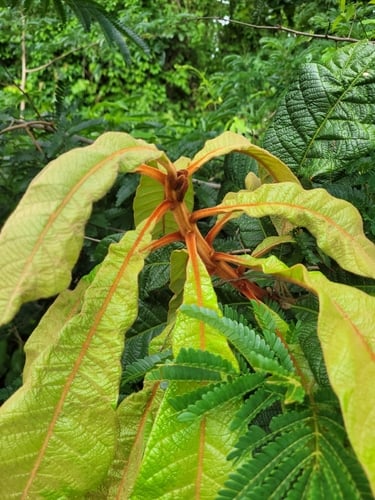
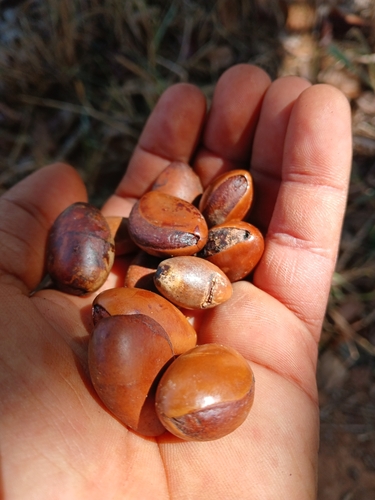
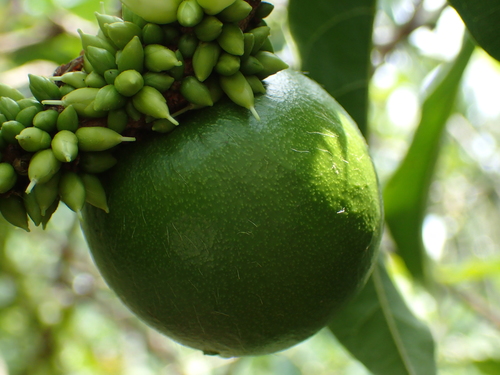
A tree. It grows 25 m high. The trunk is 55 cm across. The young shoots have soft flattened hairs. The leaves are clustered in spirals. They are 12-22 cm long by 5-8 cm wide. The flowers are in tufts on small twigs and on the trunk. The stalks are up to 2 cm long. They are brown and hairy. The fruit can occur singly or in groups. The fruit is a round or oval berry. It is 4 cm long by 3-5 cm wide. It is green and turns orange or yellow as it ripens. The pulp is pale yellow and edible. There are 1 or 2 large brown seeds. These are 2.5 cm long.
Edible Uses
Fruit - raw. The pale yellow pulp is about 7mm wide. The fruit is an ellipsoid to globose, green to orange-yellow berry around 40mm long and 28 - 50mm wide containing 1 - 2 large seeds.
Traditional Uses
The pulp of the fruit is eaten raw.
This uses section is brief — help expand it
Distribution
A tropical plant. It grows in semi-evergreen seasonal forest. It grows between 200-600 m altitude. It grows on clay or sand.
Where It Grows
Amazon, Brazil, French Guiana, Guianas, Guyana, South America, Suriname,
Other Uses
We do not have any information on the wood of this species, but a general description of the wood for members of this genus growing in northern S. America is as follows:- The heartwood is yellowish or grayish-brown with more or less reddish cast; it is not always distinct from the narrow band of yellowish or grayish sapwood. The texture is fine to medium, uniform; the grain usually straight, sometimes interlocked; lustre is low; there is no characteristic odour but the taste is sometimes bitter or astringent. Heartwood is rated as durable in test exposures to white-rot and brown-rot organisms, but it is not suggested for uses where high durability is required. Drying is rapid but may result in severe checking and moderate warp; a reduced drying rate may minimize degrade. The wood works easily and finishes to a smooth surface; it has good steam-bending properties. It is used for purposes such as general construction and heavy-duty flooring, whilst it has also been suggested for tight cooperage, tool handles.
Other Information
The fruit is enjoyed.
Synonyms
Also Known As
Graines kouata. Kimboto, Kouatabobi, Kwatabobi, Malobi-weti, Weti-malobi
References (6)
- Fouqué, A., 1972, Espèces fruitières d'Amérique tropicale. Institut français de recherches fruitierès outre-mer (ifac)
- Grandtner, M. M. & Chevrette, J., 2013, Dictionary of Trees, Volume 2: South America: Nomenclature, Taxonomy and Ecology. Academic Press p 324
- Kermath, B. M., et al, 2014, Food Plants in the Americas: A survey of the domesticated, cultivated and wild plants used for Human food in North, Central and South America and the Caribbean. On line draft. p 700
- Pennington, T.D., 1990, Sapotaceae in Flora Neotropica Monograph 52. New York Botanical Gardens. p 648 (Drawing)
- van Roosmalen, M.G.M., 1985, Fruits of the Guianan Flora. Utrecht Univ. & Wageningen Univ. p 408 (As Neopometia ptychandra)
Show all 6 references Hide references
- Van Roosmalen, M.G.M., & Garcia, O. M., 2000, Fruits of the Amazonian Forest. Part 2: Sapotaceae. Acta Amazonica 30(2): 187-290