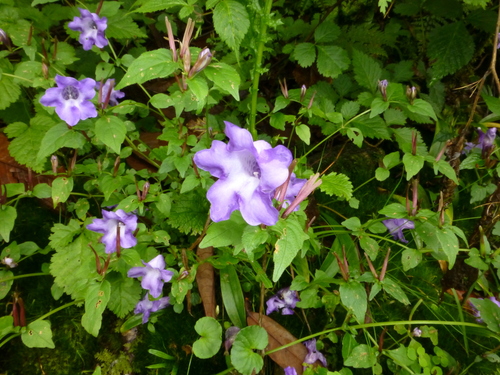
Justicia ladanoides
Lam.
Justicia
iNaturalist· cc-by-nc
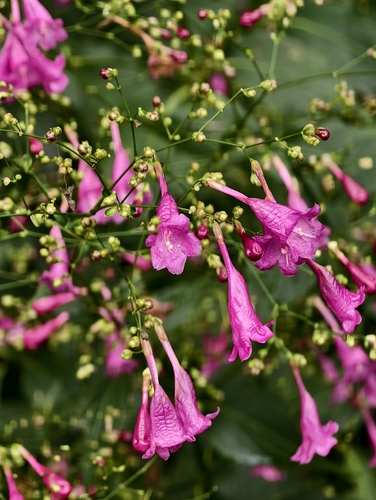
(c) Mitiku Muanenda, some rights reserved (CC BY-NC), uploaded by Mitiku Muanenda
iNaturalist· cc-by-nc
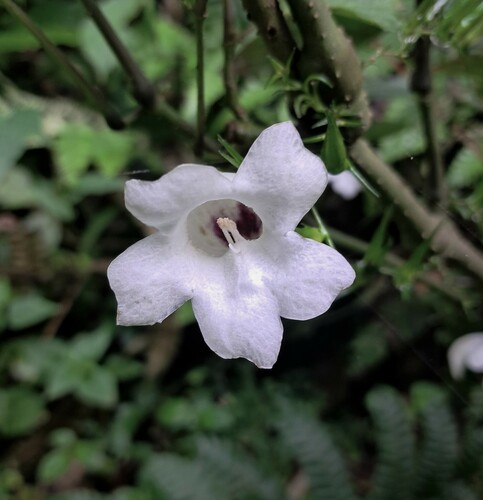
(c) Duncan McKenzie, some rights reserved (CC BY-NC), uploaded by Duncan McKenzie
iNaturalist· cc-by-nc-sa
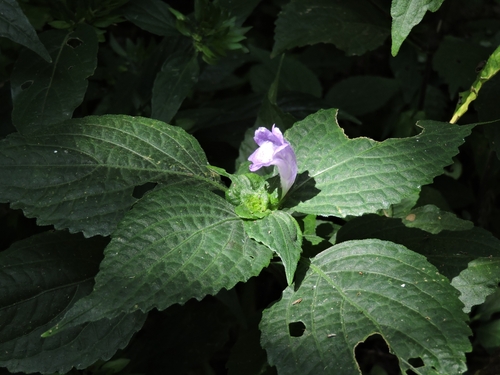
(c) Stefan Dressler, some rights reserved (CC BY-NC-SA)
Description
A herb. It grows for one or two years. It grows 2 m tall. It can be hairy. The base is often swollen and has aerial roots. The leaves are opposite and each pair is at right angles to the next. The leaf stalk is up to 6 cm long. The leaves are narrowly oval and 1-11 cm long by 1-5 cm wide. The flowers have both sexes. They are usually bright red. The fruit is an oval capsule. It is 10 mm long by 3 mm wide. It splits open with force. There are 4 seeds.
Edible Uses
The tender and slightly slimy leaves and shoots are an appreciated leafy vegetable. They are also cooked into soup or stew. Leaves of the sweet potato are sometimes added when preparing soup, rendering the preparation less gluey. The leaves are also added to groundnut soup.
Traditional Uses
The leaves are cooked and eaten as a vegetable. They are used in soups and stews.
This uses section is brief — help expand it
Medicinal Uses
The leaves, mixed with oil and salt, are eaten to treat cardiac disorders. A leaf decoction is given to children for the treatment of indigestion. The leaves are used externally for the treatment of wounds.
Distribution
It is a tropical plant. It grows well in places with temperatures between 20°-35°C. It is in areas with a rainfall of 1,000-2,000 mm per year. It can tolerate shade. It grows in savannah woodland.
Where It Grows
Africa, Benin, Burkina Faso, Cameroon, Central Africa, Central African Republic, CAR, Chad, Congo, Côte d'Ivoire, East Africa, Eritrea, Ethiopia, Gambia, Ghana, Guinea, Guinée, Guinea-Bissau, Ivory Coast, Kenya, Liberia, Nigeria, Senegal, Sierra Leone, Somalia, Sudan, Togo, Uganda, West Africa,
Cultivation
Plants can be grown by seeds or cuttings. Stem cuttings about 15 cm long are used. Plants need to be 30-40 cm apart. Because fruit split open the seeds get scattered so seed collection is difficult.
Propagation
Seed. The seed remains dormant during the dry season and germinates readily with the onset of rains. The seed may be drilled in rows spaced at 40 - 50 cm. Young seedlings are thinned, allowing 30 - 40 cm between plants in the rows. Spontaneous seedlings can be uprooted and transplanted on vegetable beds. Seed production is difficult because the seeds are scattered when the fruits split open. The fruits can be gathered immediately when the colour changes from green to white, or whole branches with infructescences are harvested and dried. In cultivation it is easiest to take rooted cuttings obtained from the basal parts of the stem. Stem cuttings about 15 cm long can also be planted 30 - 40 cm apart.
Other Uses
The boiled up leaves are used as a soap-substitute.
Production
It grows slowly. Plants can be harvested by pulling them out after 3-5 weeks of cut off the tips when plants are 20-25 cm high. Harvesting can be carried out at 10 day intervals.
Other Information
They are an appreciated leafy vegetable.
Notes
It is similar to Justicia whytei.
Nutrition
| Part | Moisture | kJ | kcal | Protein | Vit A | Vit C | Iron | Zinc |
|---|---|---|---|---|---|---|---|---|
| Leaves | 86.8 | 138 | 33 | 3.3 | — | — | — | — |
Synonyms
Also Known As
Aelangiya, D'ia, Kakim, Qira, Qirqira, Tettu
References (14)
- Addis, G., et al, 2013, Dietary values of wild and semi-wild edible plants in Southern Ethiopia. African Journal of Food, Agriculture, Nutrition and Development. 13(2) (Recalculated from dmb)
- Addis, G., Asfaw, Z & Woldu, Z., 2013, Ethnobotany of Wild and Semi-wild Edible Plants of Konso Ethnic Community, South Ethiopia. Ethnobotany Research and Applications. 11:121-141
- Addis, G., et al, 2013, The Role of Wild and Semi-wild Edible Plants in Household Food Sovereignty in Hamer and Konso Communities, South Ethiopia. Ethnobotany Research & Applications. 11:251-271
- Berihun, T., & Molla, E., 2017, Study on the Diversity and Use of Wild Edible Plants in Bullen District Northwest Ethiopia. Hindawi Journal of Botany.Article ID 8383468
- Denton, O.A., 2004. Justicia ladanoides Lam. [Internet] Record from Protabase. Grubben, G.J.H. & Denton, O.A. (Editors). PROTA (Plant Resources of Tropical Africa), Wageningen, Netherlands. < http://database.prota.org/search.htm>. Accessed 16 October 2009.
Show all 14 references Hide references
- Duguma, H. T., 2020, Wild Edible Plant Nutritional Contribution and Consumer Perception in Ethiopia. Hindawi International Journal of Food Science Volume 2020, Article ID 2958623, 16 pages
- Grubben, G. J. H. and Denton, O. A. (eds), 2004, Plant Resources of Tropical Africa 2. Vegetables. PROTA, Wageningen, Netherlands. p 340
- Jardin, C., 1970, List of Foods Used In Africa, FAO Nutrition Information Document Series No 2.p 85 (As Justicia rostellaria)
- Kidane, B., et al, 2014, Wild and semi-wild leafy vegetables used by the Maale and Ari ethnic communities in southern Ethiopia. Genetic Resour Crop Evol. Springer.
- Lulekal, E., et al, 2011, Wild edible plants in Ethiopia: a review on their potential to combat food insecurity. Afrika Focus - Vol. 24, No 2. pp 71-121
- Martin, F.W. & Ruberte, R.M., 1979, Edible Leaves of the Tropics. Antillian College Press, Mayaguez, Puerto Rico. p 171 (As Justicia galeopsis) and (As Justicia rostellaria)
- Mutie, F. M., et al, 2023, Important Medicinal and Food Taxa (Orders and Families) in Kenya, Based on Three Quantitative Approaches. Plants 2023, 12, 1145
- Terra, G.J.A., 1973, Tropical Vegetables. Communication 54e Royal Tropical Institute, Amsterdam, p 54 (As Justicia galeopsis) and (As Justicia rostellaria)
- World Checklist of Useful Plant Species 2020. Royal Botanic Gardens, Kew