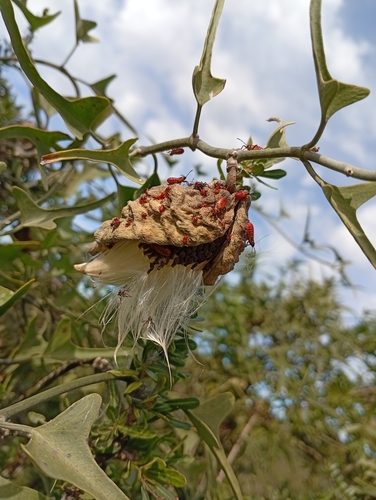
Hoodia alstonii
(N. E. Br.) Plowes
iNaturalist· cc-by-nc
(c) Jean Audissou, some rights reserved (CC BY-NC), uploaded by Jean Audissou
iNaturalist· cc-by-nc
(c) Karel du Toit (+2782 4928291), some rights reserved (CC BY-NC)
Summary
Source: WikipediaHoodia alstonii is a succulent plant native to Namibia and the Cape Province of South Africa. H. alstonii is also known commonly as ghaap, an Afrikaans name. It tends to grow in rocky, desert areas.
Description
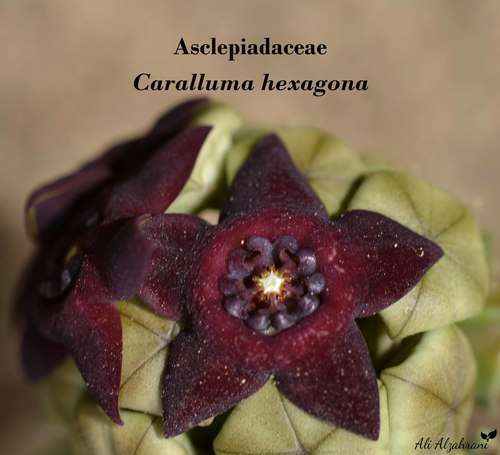
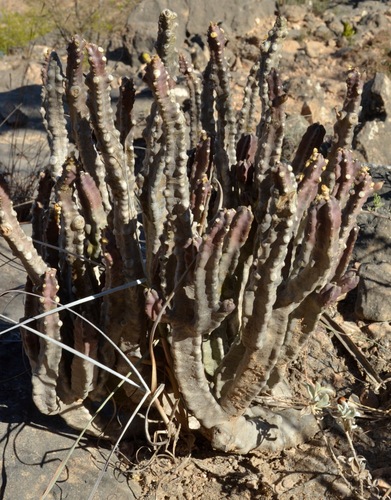
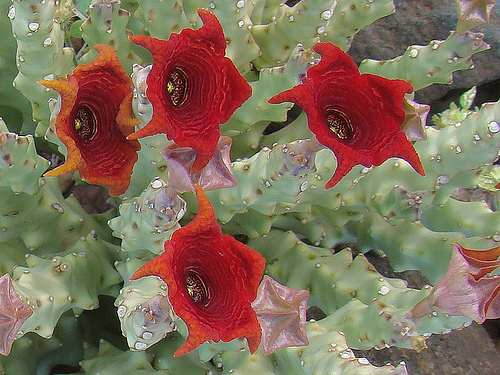
A shrub. It grows 1 m tall. It has several stems and forms a dense clump. It is spiny and succulent. The flowers occur as 1 to 8 in a clump near the ends of the branches.
Edible Uses
Hoodia alstonii has been harvested in the wild as a food source.
Traditional Uses
The stems are eaten as a snack.
This uses section is brief — help expand it
Medicinal Uses
Hoodia plants have been eaten by African tribesmen for thousands of years as a means of staving off hunger and thirst on long hunting trips. The active principle in the plant responsible for this appetite-suppressing effect has been identified and is now used as the basis of a slimming drug.
Distribution
It is a tropical and subtropical plant.
Where It Grows
Africa, Namibia, South Africa, Southern Africa,
Cultivation
Plants can be grown by seed. They can also be grown by cuttings.
Propagation
Seed - germinates easily.
Nutrition
| Part | Moisture | kJ | kcal | Protein | Vit A | Vit C | Iron | Zinc |
|---|---|---|---|---|---|---|---|---|
| Stems | 94.2 | 73 | 17 | 0.2 | — | 7.4 | 0.2 | 0.3 |
Synonyms
References (5)
- Grubben, G. J. H. and Denton, O. A. (eds), 2004, Plant Resources of Tropical Africa 2. Vegetables. PROTA, Wageningen, Netherlands. p 330
- Jansen, P.C.M., 2004. Hoodia currorii (Hook.) Decne. [Internet] Record from Protabase. Grubben, G.J.H. & Denton, O.A. (Editors). PROTA (Plant Resources of Tropical Africa), Wageningen, Netherlands. < http://database.prota.org/search.htm>. Accessed 16 October 2009.
- Ruiters-Welcome, A. K., 2019, Food plants of southern Africa. Ph.D. thesis. Univ. of Johannesburg p 24
- Wehmeyer, A. S, 1986, Edible Wild Plants of Southern Africa. Data on the Nutrient Contents of over 300 species. (As Trichocaulon alstonii)
- Welcome, A. K. & Van Wyk, B.-E., 2019, An inventory and analysis of the food plants of southern Africa. South African Journal of Botany 122 (2019) 136–179