Cyclea barbata
Miers
Cincau leaves
iNaturalist· cc-by-nc
(c) Young Chan, some rights reserved (CC BY-NC), uploaded by Young Chan
iNaturalist· cc-by
(c) Yj, some rights reserved (CC BY)
Summary
Source: WikipediaCyclea barbata is a species of flowering plants that was commonly used as a medicinal plant in Java. It is also used to produce Indonesian typical green grass jelly.
Description
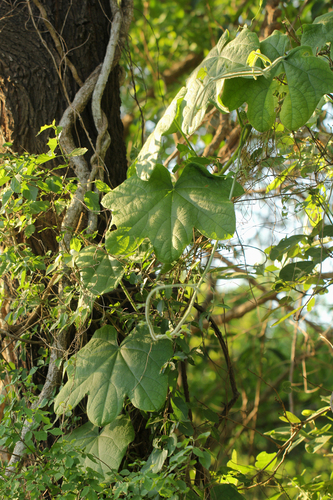
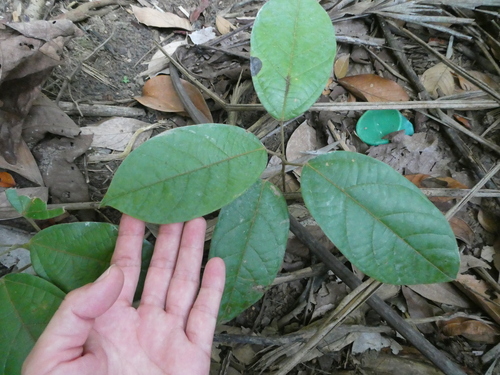
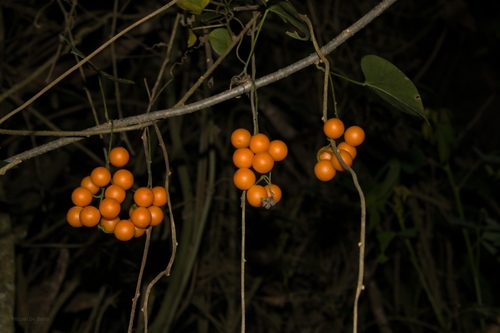
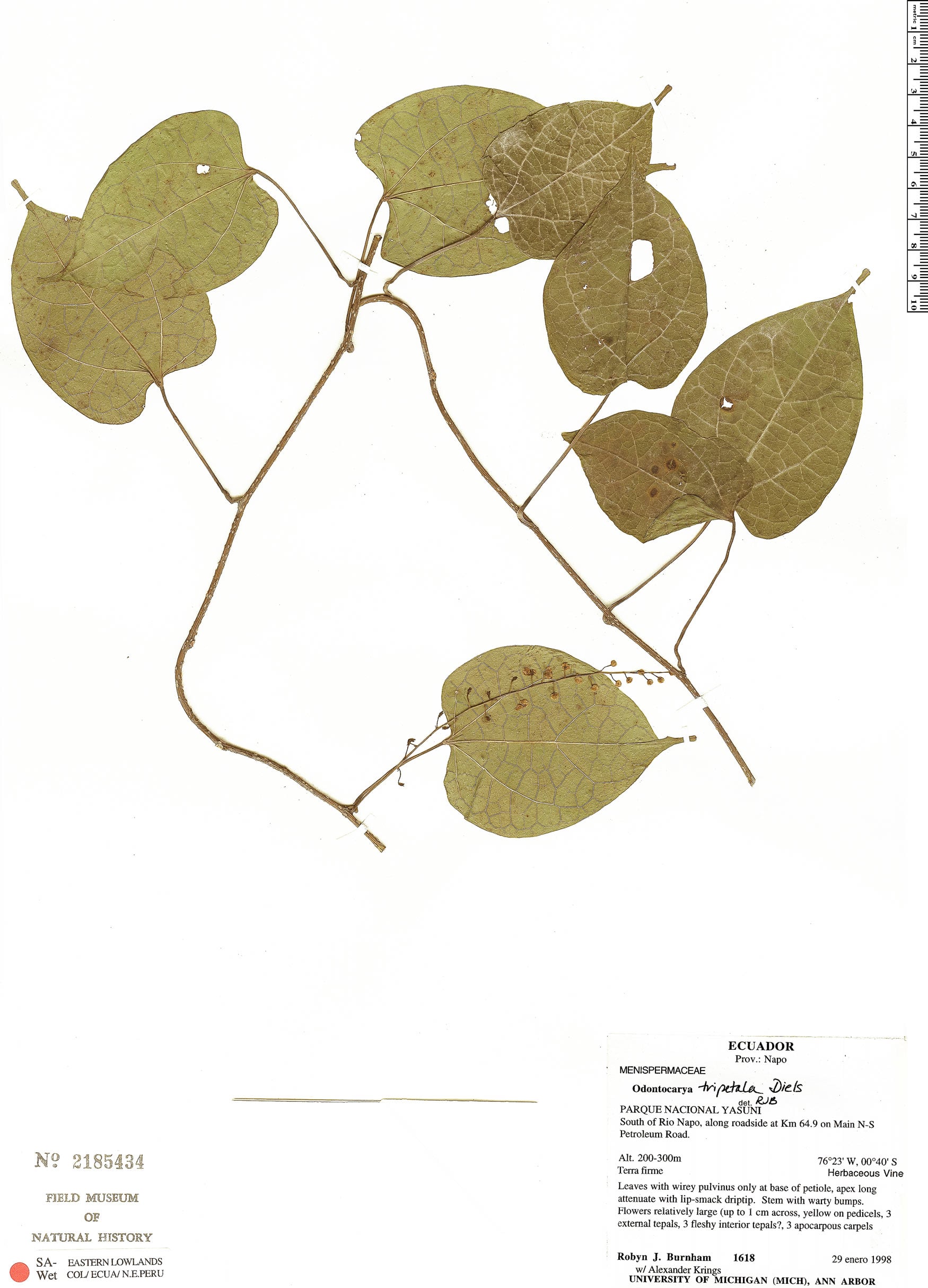
A slender climber or vine. It grows 5 m high. The roots are fleshy. The leaves are oval to triangle shaped. The leaf stalk joins the blade away from the edge. The leaves are 4-10 cm long by 3-8 cm wide. The fruit are fleshy and red.
Edible Uses
The leaves are used in Java to prepare a jelly called 'cincau' or 'cincau hijau' (green cincau), which is used as a refreshment and as a medicine against stomach complaints. The leaves are crushed in water and the mixture left to set. It is usually eaten with a sweet syrup. To make a good quality jelly only young well-developed leaves should be used. The shelf-life of the jelly at ambient temperature is around 1 - 2 days..
Traditional Uses
The leaves are crushed in water and eaten as a jelly with sweet syrup.
This uses section is brief — help expand it
Medicinal Uses
A decoction made of the roots is used in local medicine against fever. The very bitter taste is due to the alkaloid 'cycleine'. The roots have a high content of starch and around 10% fat. The leaves are used in Java to prepare a jelly called 'cincau' or 'cincau hijau' (green cincau), which is used as a refreshment and also as a medicine against stomach complaints.
Distribution
It is a tropical plant. It grows on the edges of forests and in shrubland. It grows up to 1,100 m above sea level.
Where It Grows
Asia, Cambodia, China, India, Indochina, Indonesia, Laos, Myanmar, SE Asia, Thailand, Vietnam,
Cultivation
Plants can be grown from seeds.
Synonyms
Also Known As
Cincau rambat, Mo noy, Sam nam, Vor phraskrong
References (7)
- Delang, C. O., 2007, Ecological Succession of Usable Plants in an Eleven-Year Fallow Cycle in North Lao P.D.R., Ethnobotany Research and Applications. Vol. 5:331-350
- Forman, 1984, Menispermaceae, Flora Malesiana Series 1 Vol 10 p 242
- Luczaj, L., et al, 2021, Wild food plants and fungi sold in the markets of Luang Prabang, Lao PDR. Journal of Ethnobiology and Ethnomedicine (2021) 17:6
- Sang, D. T., & Mizoue, K. O. N., 2012, Use of Edible Forest Plants among Indigenous Ethnic Minorities in Cat Tien Biosphere Reserve, Vietnam. Asian Journal of Biodiversity Vol. 3 (1), p 23-49
- Sukarya, D. G., (Ed.) 2013, 3,500 Plant Species of the Botanic Gardens of Indonesia. LIPI p 916
Show all 7 references Hide references
- Turreira Garcia, N., et al, 2017, Ethnobotanical knowledgeof the Kuy and Khmer people in Prey Lang, Cambodia. Cambodian Journal of Natural History 2017 (1): 76-101
- World Checklist of Useful Plant Species 2020. Royal Botanic Gardens, Kew