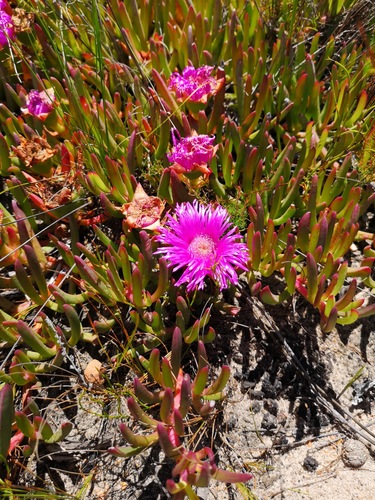
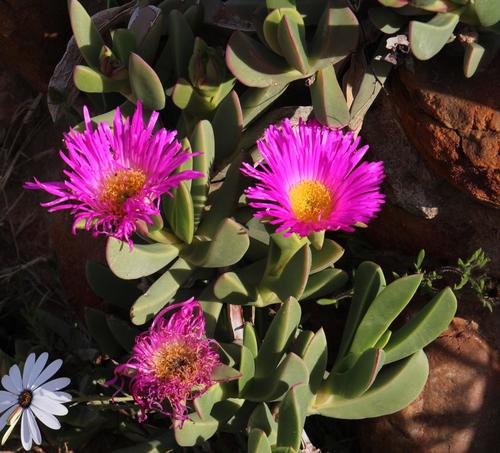
Mesembryanthemum nodiflorum
L.
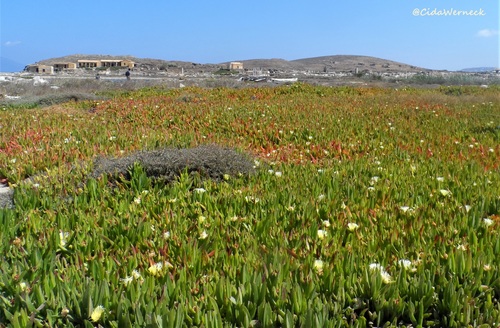
iNaturalist· cc-by-nc-sa
(c) randomtruth, some rights reserved (CC BY-NC-SA)
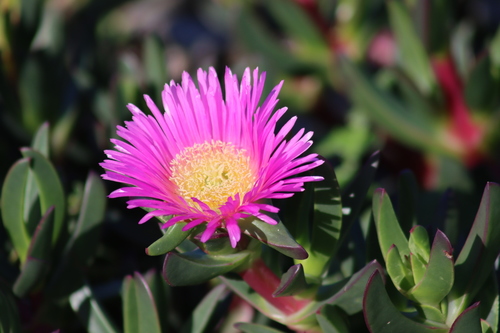
iNaturalist· cc-by-nc
(c) photogenie, some rights reserved (CC BY-NC), uploaded by photogenie
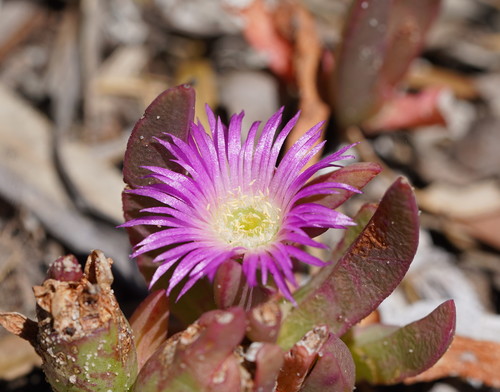
iNaturalist· cc-by-nc-sa
(c) Valter Jacinto, some rights reserved (CC BY-NC-SA)
Summary
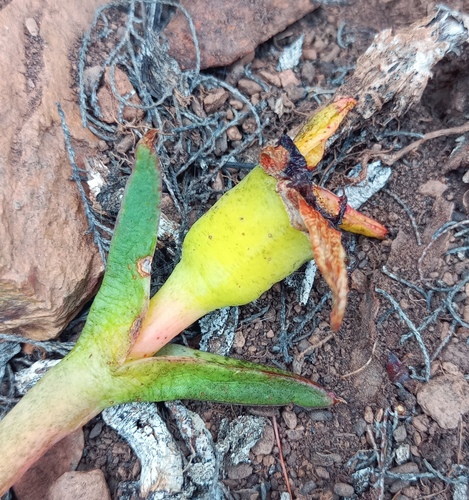
Source: WikipediaMesembryanthemum nodiflorum is a species of succulent plant in the genus Mesembryanthemum known by the common name slenderleaf iceplant. It is the type species for the genus. It is native to South Africa but can also be found in coastal areas of the Mediterranean Basin, Macaronesia, and Middle East. It is known in many other places as an introduced species and sometimes an invasive weed, including several regions of Australia, parts of the western United States and adjacent Mexico, and some Atlantic islands. M. nodiflorum is a usually annual herb forming a mostly prostrate clump or mat of stems up to a maximum of about 20 centimeters in length. The small stem branches are lined with knob-like cylindrical fleshy leaves up to 2 centimeters long. The herbage is green to bright red and visibly bumpy with shiny, bubble-like papillae. Flowers are solitary or borne in loose clusters. Each is about half a centimeter wide with many narrow to thready white or pale yellow petals. The fruit is a capsule which opens when it becomes wet, releasing seeds.
Description
A herb. It lies along the ground. It grows each year from seeds. It is succulent.
This description is brief — help expand it
Edible Uses
The seeds are the only part reliably reported as edible, though they are tiny and difficult to harvest in useful quantities. One report suggests the whole plant is consumed as a cereal, which seems unlikely given its highly succulent nature — this may refer to the fruit or the small seed. The foliage is covered with minute ice-crystal structures similar to those of common iceplant, and while the leaves taste like ordinary vegetables with a hint of strawberries and a strong salty edge, their edibility has not been confirmed beyond the seeds. Because of their small size, the seeds have limited food value but are technically usable. The plant typically blooms from March to May, producing seeds in spring.
Medicinal Uses
None known.
Distribution
It is a Mediterranean plant. It can grow in salty soils. It can grow in arid places.
Where It Grows
Africa, Argentina, Chile, Egypt, Europe, France, Greece, Israel, Italy, Mediterranean, Middle East, North Africa, Portugal, Saudi Arabia, Sinai, South America, Spain, Western Sahara,
Cultivation
An annual or subshrub and grows primarily in the subtropical biome. Requires a sunny position. Easily grown in ordinary well-drained garden soil. Succeeds in any well-drained low-fertility soil. This species uses the 'Crassulacean Acid Metabolism' (CAM) pathway to photosynthesis, a mechanism which aids in conserving moisture. The plant keeps its stomata closed during the day, opening them during the night when it takes in carbon dioxide and stores it in compounds such as malic acid. It then utilizes this carbon dioxide when photosynthesizing during the day. This type of mechanism is used by a range of mainly succulent plants, including cacti and Euphorbia species. Slenderleaf iceplant thrives in mild, dry climates with winter lows down to around 10 °F, placing it broadly within USDA Hardiness Zones 8–11. It has become naturalized and is regarded as invasive in some parts of California and other regions outside its native range, where it can spread aggressively in disturbed, salty, or coastal soils.
Propagation
Sow seed in spring in a greenhouse, barely covering it. Prick seedlings into individual pots once large enough to handle and plant out after the last expected frosts. Seedlings are prone to damping off and should not be overwatered; keep them in a very sunny, well-ventilated position.
Other Uses
Due to its ability to accumulate salt, this species has been used for the desalination of soil, and it has been suggested it could serve a role in bioremediation projects.
Notes
Also put in the family Mesembryanthemaceae.
Synonyms
Also Known As
Shnin
References (6)
- Bailey, C. and Danin, A., 1981, Bedouin Plant Utilization in Sinai and the Negev. Economic Botany 35(2): 145-162
- Bidak, L. M., et al, 2015, Goods and services provided by native plants in desert ecosystems: Examples from the northwestern coastal desert of Egypt. Global Ecology and Conservation 3 (2015) 433–447
- Jardin, C., 1970, List of Foods Used In Africa, FAO Nutrition Information Document Series No 2.p 46, 151 (As Cryophytum gibbosum)
- Mandaville, J. P., 2004, Bedouin ethnobotany: Plant concepts and plant use in a desert pastoral world. PhD thesis University of Arizona. p 165
- Nassif, F., & Tanji, A., 2013, Gathered food plants in Morocco: The long forgotten species in Ethnobotanical Research. Life Science Leaflets 3:17-54
Show all 6 references Hide references
- Royal Botanic Gardens, Kew (1999). Survey of Economic Plants for Arid and Semi-Arid Lands (SEPASAL) database. Published on the Internet; http://www.rbgkew.org.uk/ceb/sepasal/internet [Accessed 24th March 2011]