Begonia manicata
Cels.
Manicata begonia
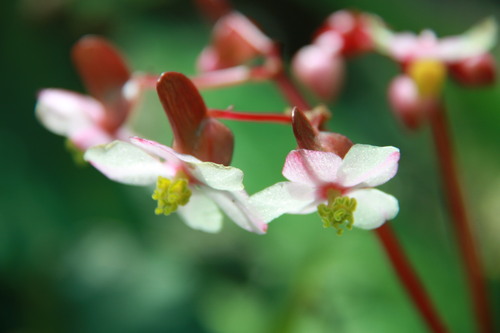
iNaturalist· cc-by-nc
(c) Sune Holt, some rights reserved (CC BY-NC), uploaded by Sune Holt
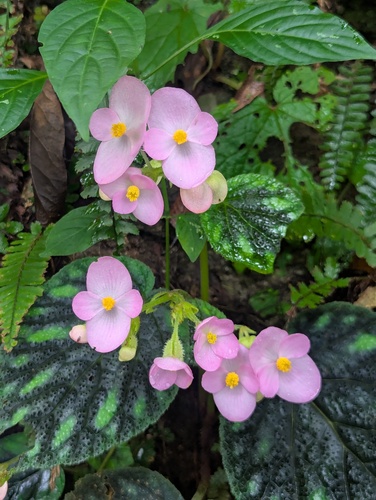
iNaturalist· cc-by-nc
(c) Sarahí Díaz, some rights reserved (CC BY-NC), uploaded by Sarahí Díaz
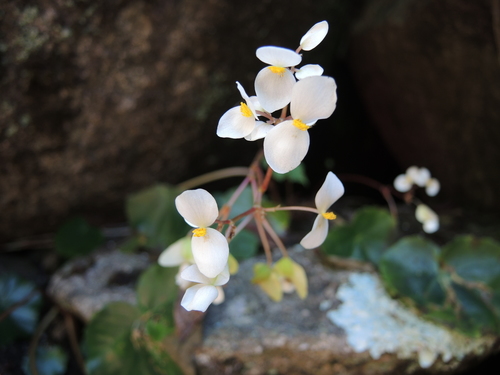
iNaturalist· cc-by-nc
(c) Sarahí Díaz, some rights reserved (CC BY-NC), uploaded by Sarahí Díaz
Summary
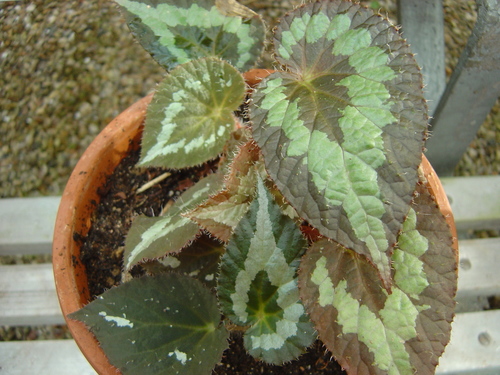
Source: WikipediaBegonia manicata is a species of flowering plant in the family Begoniaceae, native to Mexico and Central America. It was collected from the Veracruz moist forests by Jean Jules Linden, and later described in 1842. The variety 'Aureo-maculata' has cream variegations in the foliage, and is called the leopard begonia. Though it's an upright rhizomatous Begonia, so the rhizome grows upwards instead of along the ground. When fill grown, the leaves can grow to 7 or more inches across. The flowers, which can be pink or white, appear in the winter. The specific epithet manicata means "cuff," and refers to the bands of red hairs at the end of each petiole. In the varietal cognomen, aureo is from aureus, which means "golden," and maculata means "spotted." Begonia manicata has been used extensively in hybridization. In particular, it is the male parent of the cultivar B. 'Erythrophylla,' (the Beefsteak Begonia) and the female parent of the cultivar B. 'Verschaffeltii.'
Description
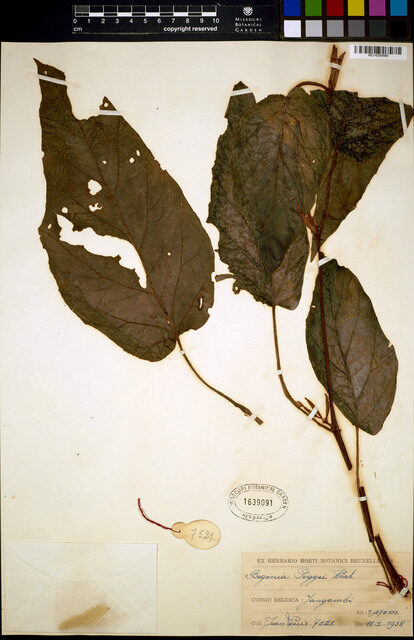
A herb. It grows 60 cm tall. It has a rhizome. The stems and short and fleshy. The leaves are oval and unequal on opposite sides. They are 8-25 cm long by 5-13 cm wide. They are oblique heart shaped at the base. There are teeth along the edge. They are shiny light green above and reddish-green underneath.
Edible Uses
The leaf stalks are eaten and sold in local markets.
Distribution
It is a tropical plant. In Mexico it grows between 800-1,000 m altitude.
Where It Grows
Asia, Central America*, Guatemala, Honduras, Indonesia, Mexico, Nicaragua, North America, SE Asia,
Cultivation
Plants can be grown from seeds or by leaf or stem cuttings.
Other Information
The leaf stalks are sold in local markets.
Also Known As
Begonia manikata, Comida de danto, Mantecaxocoyolli, Parona, Pavana, Sakil, Tecosxcoyolli
References (5)
- Basurti-Pena, F., et al, 2003, Edible Begonias from the North of Puebla, Mexico. Economic Botany, Vol. 57, No. 1, pp. 48-53
- Kermath, B. M., et al, 2014, Food Plants in the Americas: A survey of the domesticated, cultivated and wild plants used for Human food in North, Central and South America and the Caribbean. On line draft. p 124
- Mapes, C. & Basurto, F., 2016, Biodiversity and Edible Plants of Mexico. Chapter 5 in R. Lira, et al. (eds.), Ethnobotany of Mexico, Ethnobiology, Springer. p 114
- Pena, F. B., et al, 1998, Los quelites de la Sierra Norte de Puebla, Mexico: Inventory Y Formas de Preparacion. Bol. Soc. Bot. Mexico 62:49-62
- Sukarya, D. G., (Ed.) 2013, 3,500 Plant Species of the Botanic Gardens of Indonesia. LIPI p 1078