Burckella obovata
(Forster. f.) Pierre
Bukubuk, Red silkwood tree
iNaturalist· cc-by-nc
(c) cassandre_fernandez, some rights reserved (CC BY-NC)
iNaturalist· cc-by-nc
(c) cassandre_fernandez, some rights reserved (CC BY-NC)
Description
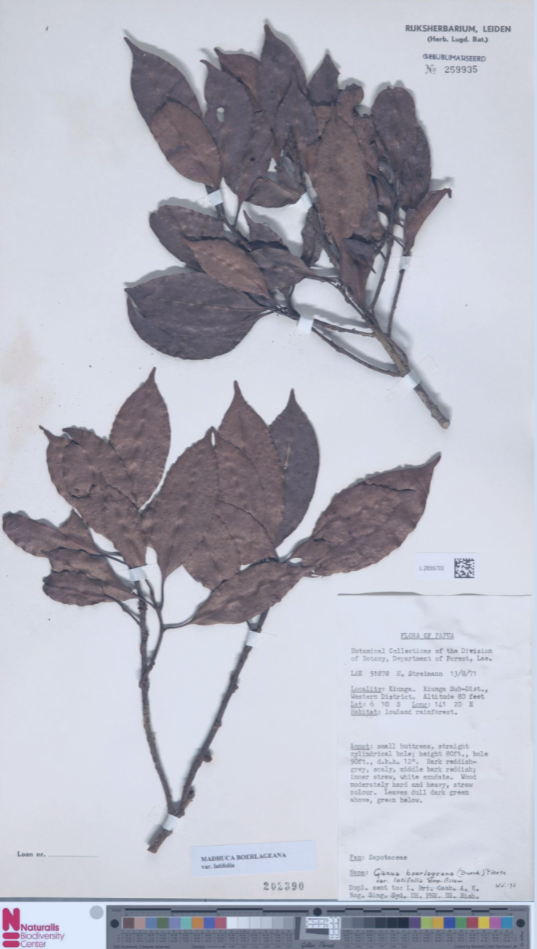
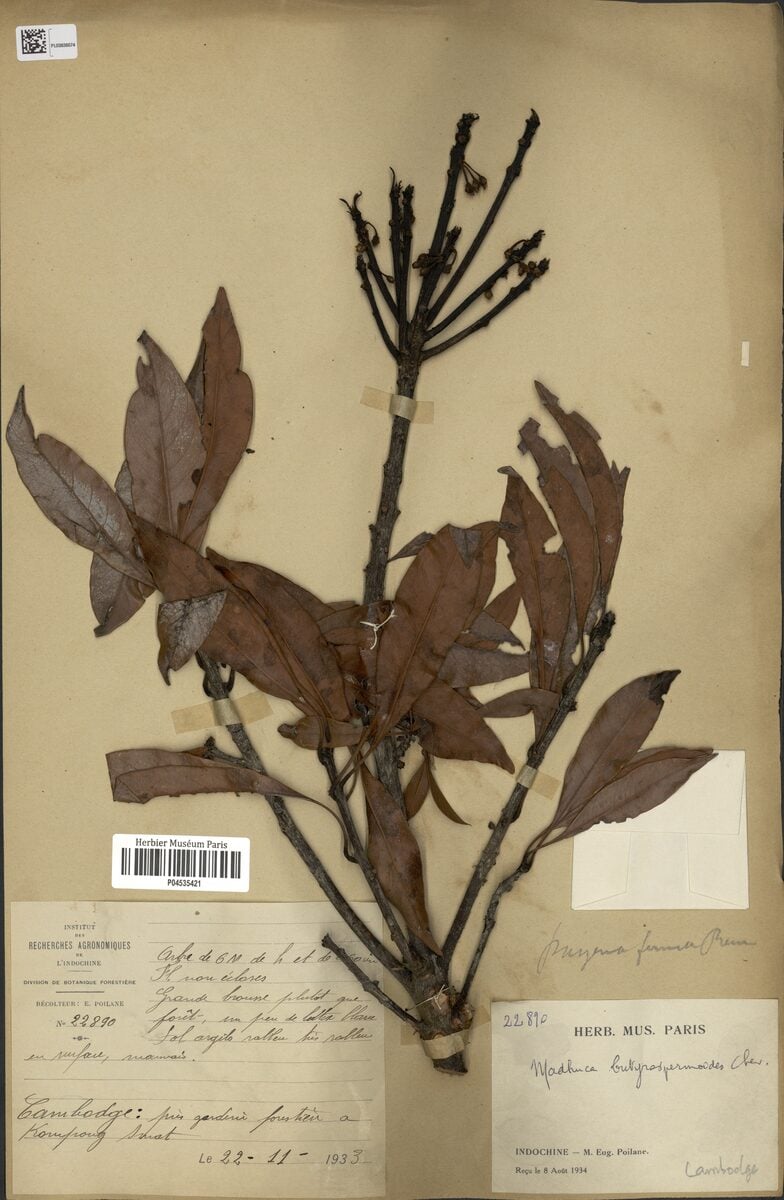
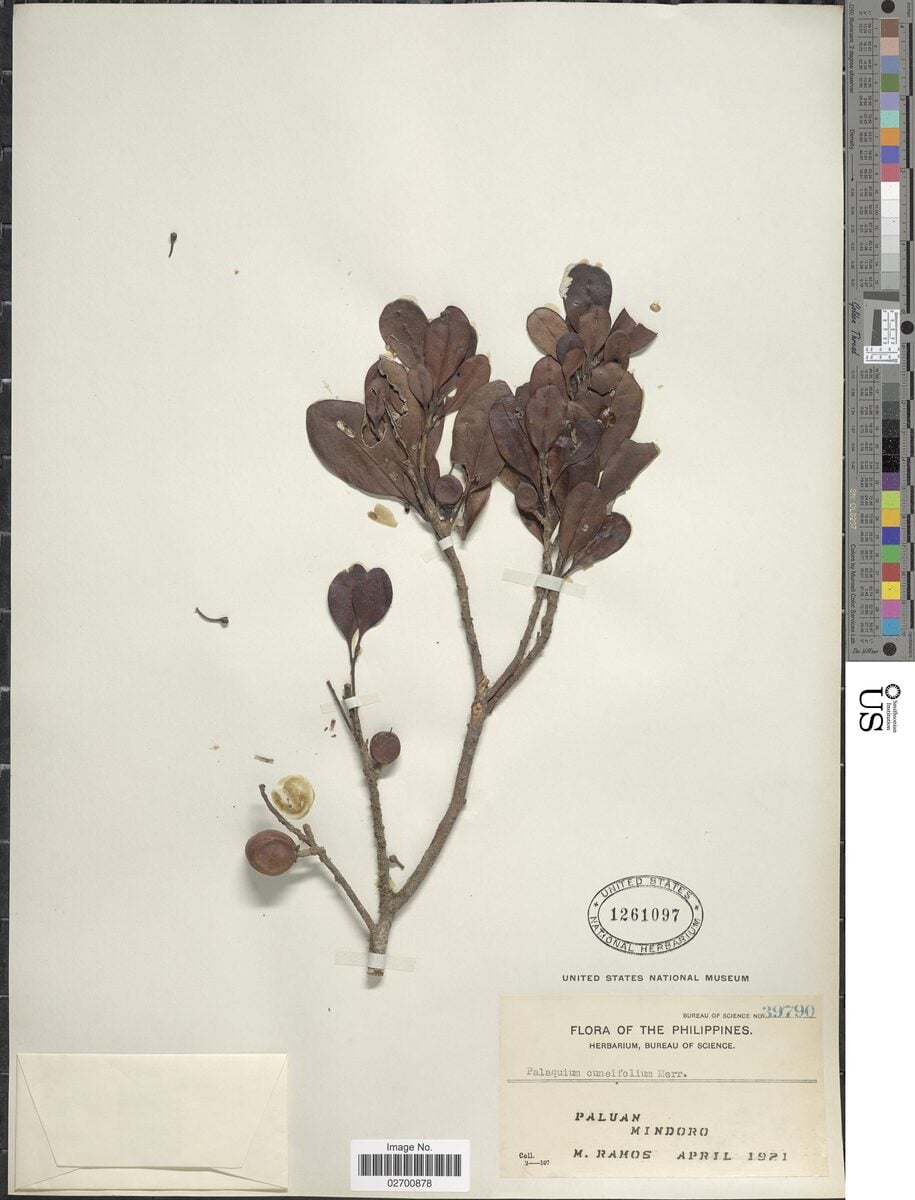
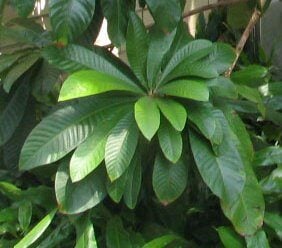
A tree which can be up to 30 m tall and with buttresses. The trunk can be 3 m across. A white sticky sap is produced from the broken ends of twigs and leaves, which is typical of this family of trees. Leaves tend to be clustered near the ends of branches. Leaves are simple and shiny. The leaf tip is tapered to a point and the base is wedge shaped. The leaf stalk is 1-4 cm long. The flowers occur 20-50 together without flower stalks and in a cluster near the ends of branches. The fruit is large (9 cm across) and green. It has a very thin skin. The flesh is white. Fruit normally have 4 or 5 furrows around it. The fruit has 3-5 cells but often only one or two seeds mature. The seed is oval shaped and about 4 cm long. Fruit shape can vary; some being more round and others more elongated. The fruit are carried near the ends of the branches. The fruit has a sweet smell. Fruit quality varies significantly in size and edibility throughout the regions where the tree occurs. Good fruit have a texture like an avocado and a taste like a sweetsop but less sweet.
Edible Uses
Fruit - raw or roasted. Somewhat variable, though the best forms are delicious. The light-green fruit is a globose to obovoid berry 7 - 10cm long and 5 - 8cm in diameter, containing a single, large seed. Two main types of this fruit are found in Vanuatu - one elongate and the other rounded, of which the latter may sometimes be very large. The former are commoner than the latter, and have the reputation of being sweeter.
Traditional Uses
The fruit is eaten raw. Occasionally the fruit is baked.
This uses section is brief — help expand it
Medicinal Uses
Juice extracted from the grated bark is used in the treatment of asthma. The leaves are used in the treatment of sick people. They are crushed and then heated; the person applying the treatment then puts the leaf mixture in their mouth and spits it forcibly on to the body of the patient.
Distribution
A tropical plant. Trees grow wild in coastal areas of Papua New Guinea. They are also planted. It usually grows from sea level to 500 m above sea level. It will probably grow up to about 1100 metres altitude. It occurs in Papua New Guinea, the Solomon Islands and Vanuatu. It has been introduced to Fiji.
Where It Grows
Asia, Australia, Bougainville, Fiji, Indonesia, Malesia*, Pacific, Papua New Guinea, PNG, SE Asia, Solomon Islands, Vanuatu,
Cultivation
Trees are grown from seed. There is normally only one fertile seed in each fruit. Both domesticated and wild trees occur. Trees grow wild in coastal areas. They are also planted.
Propagation
Seed - best sown as soon as it is ripe.
Other Uses
All parts of the plant contain a latex. The latex is used for 'setting' or fixing the colour and design of tattoos. The leaves are used for rendering earth ovens watertight. A dye is obtained from the flesh of the fruit. The wood is used in house construction, the cross-beams of canoes and for paddles. A good timber for all sorts of constructional work and for making of canoes.
Production
Fruiting is not seasonal although two main seasons may occur in a year. Fruit bruises easily so is hard to transport. It needs to be stored in soft containers lined with leaves or packaging. To avoid fruit damage, fruit are often harvested while not quite ripe. It can be stored for a short time if baked and is also stored in pits where it is fermented.
Other Information
In Papua New Guinea, it is a popular fruit in the Gazelle and occurs in a number of coastal islands
Notes
Bukubuk Burckella obovata What is a Bukubuk like ? A bukubuk fruit is a soft green fruit up to 15 cm across. The outside of the fruit has five or so large fleshy lobes. Inside there is a hard pointed seed. The flesh of the fruit is white. It has a texture and taste something like cantaloupe. The fruit grows on a large tree which can be 36 metres high and have a trunk 2 m through. The tree often has buttresses. The branches have lots of twigs on them and the leaves aren often crowded at the tips of these small branches. The leaves are simple, produced one after another alternatively along the branch, and they are shiny. A white sticky sap is produced from the broken ends of twigs and leaves. The flowers are in groups just back from the ends of the twigs. The flowers are small and white. They have 4 sepals and a corolla with 8 lobes. Where do bukubuk’s grow ? They are truly tropical trees which mostly grow in the lowland rainforest. They occur as occasional trees scattered through the rainforest, and are also planted. These fruit trees occur on islands such as Manus, New Britain and North Solomons, and also in other South Pacific countries such as Vanuatu. How did it get its name? The name Bukubuk is a Tolai word used by the people of the Gazelle Peninsula at Rabaul. As the fruit are sold in the Rabaul market, this name is also known by a number of other people. Bukubuk means lumpy, because the fruit has bumps on it. The fruit also grows in other areas of PNG and has other Tok ples names. Scientists have given it a Latin name Burckella obovata. This is the same in all languages of the world. It belongs to a family of plants called Sapotaceae. These plants have milky sap in them. Tok Ples names Papua New Guinea Province Language Tok ples name Manus Nanat New Ireland Natu New Britain Kuanua Bukubuk North Solomons Solomon Islands Malaita Guadalcanal New Georgia
Synonyms
Also Known As
Chovuku, Duldule, Gona, Gono, Hovaka, Koko, Kona, Nasu, Natu, Noneu, Nyinou, Nyiu, Pohon natu, Pohon sawo seberang, Sawo seberang, Wanet
References (26)
- References Bukubuk
- Altschul, S.V.R., 1973, Drugs and Foods from Little-known Plants. Notes in Harvard University Herbaria. Harvard Univ. Press. Massachusetts. no. 3236, 3237 (Madhuca obovata and Burckella cocco)
- Baehni, 1938, Candollea 7:424
- Blench, R., 2004, Fruits and Arboriculture in the Indo-Pacific Region. Indo-Pacific Prehistory Association Bulletin 24. (Taipei Papers Volume 2) p 35
- Cabalion, P. and Morat, P., 1983, Introduction le vegetation, la flore et aux noms vernaculaires de l'ile de Pentcoste (Vanuatu), In: Journal d'agriculture traditionnelle et de botanique appliquee JATBA Vol. 30, 3-4
Show all 26 references Hide references
- Foreman, D. B., 1971, A checklist of the Vascular Plants of Bougainville with Descriptions of some Common Forest Trees. Botany Bulletin No. 5. Department of Botany. p 78
- French, B.R., 1986, Food Plants of Papua New Guinea, A Compendium. Asia Pacific Science Foundation p 208
- French, B.R., 2010, Food Plants of Solomon Islands. A Compendium. Food Plants International Inc. p 206
- Gowers,S.,1976, Some Common Trees of the New Hebrides and their vernacular names. Forestry Section, Dept of Ag., Port Vila, New Hebrides.
- Gillaumin, R., 1954, Les Plantes utiles des Nouvelles-Hebrides (fin et complement) In: Journal d'agriculture tropicale et de botanique appliquee Vol. 1, No. 10-12 pp 453-460 (As Bassia obovata)
- Henderson, C.P. and I.R.Hancock, 1988, A Guide to the Useful Plants of the Solomon Islands. Res. Dept. Min of Ag. & Lands. Honiara, Solomon Islands. p 54
- Lam, 1942, Wild Pacific Sapotaceae. Blumea 6(1):1-46.
- Lam,H.J. & P Van Royen, 1952, Burckella. Pierre. Blumea VI :580-593
- Lebot, V. & Sam, C., Green desert or ‘all you can eat’? How diverse and edible was the flora of Vanuatu before human introductions?. Terra australis 52
- Lepofsky, D., 1992, Arboriculture in the Mussau Islands, Bismarck Archipelago. Economic Botany, Vol 46, No. 2, pp. 192-211
- May, R.J., 1984, Kaikai Aniani. A Guide to Bush Foods Markets and Culinary Arts of Papua New Guinea. Robert Brown and Associates. p 77
- McClatchey, W. C., 2012, Wild food plants of Remote Oceania. Acta Societatis Botanicorum Poloniae 81(4) 371-380
- Peekel, P.G., 1984, (Translation E.E.Henty), Flora of the Bismarck Archipelago for Naturalists, Division of Botany, Lae, PNG. p 431, 430
- Smith, A.C., 1981, Flora Vitiensis Nova: A New flora of Fiji, Hawai Botanical Gardens, USA Vol 2 p 771
- Sukarya, D. G., (Ed.) 2013, 3,500 Plant Species of the Botanic Gardens of Indonesia. LIPI p 166
- Verheij, E. W. M. and Coronel, R.E., (Eds.), 1991, Plant Resources of South-East Asia. PROSEA No 2. Edible fruits and nuts. Pudoc Wageningen. p 320
- Walker, 1948, Forests of Brit. Sol. Isl. Prot. 169
- Walter, A. & Sam C., 2002, Fruits of Oceania. ACIAR Monograph No. 85. Canberra. p 123
- White, 1950, Plants from the Solomon Islands. Journ. Arnold Arbor. , p104.
- World Checklist of Useful Plant Species 2020. Royal Botanic Gardens, Kew
- Yen, D. E.,1974, Arboriculture in the Subsistence of Santa Cruz, Solomon Islands. Economic Botany, 28:247-281