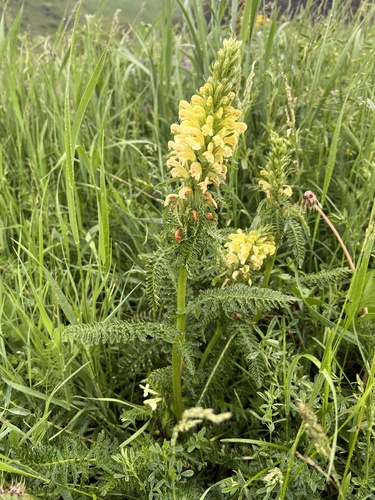
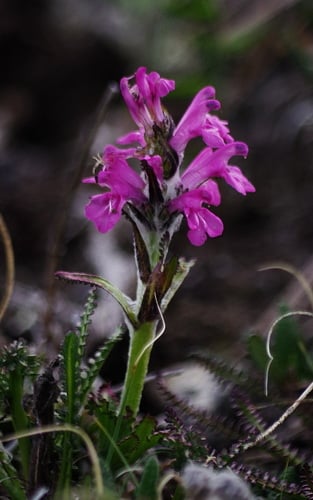
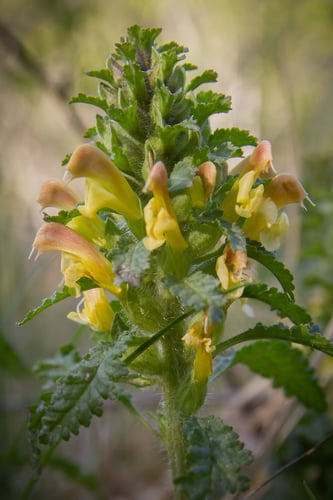
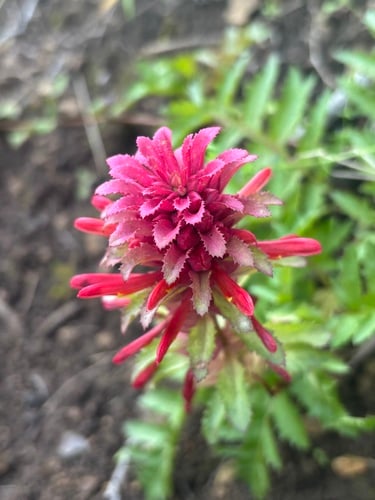
Orobanche crenata
Forsskal
Broomrape
iNaturalist· cc-by-sa
(c) maarten sepp, some rights reserved (CC BY-SA)
iNaturalist· cc-by-nc
(c) Динасафина, some rights reserved (CC BY-NC)
iNaturalist· cc-by-nc
(c) Динасафина, some rights reserved (CC BY-NC)
Summary
Source: WikipediaOrobanche crenata is a species of broomrape, commonly known as bean broomrape. It is a common parasite of the faba bean, Vicia faba. It is native to the Mediterranean basin in Europe and North Africa, the Arabian Peninsula, and Western Asia through to Iran. It has been introduced elsewhere, including Ethiopia. It has no chlorophyll, and gets its carbohydrates from the host's phloem, and water and minerals from the host's xylem. It is a constant threat to legume production. In the Apulia region of southern Italy, the stems of Orobanche crenata are gathered and eaten.
Description
An annual herb growing rapidly to 1.2 m (4 ft) tall and 0.3 m (1 ft) wide. Hardy to UK zone 7. Grows in light sandy, medium loamy, or heavy clay soils, including nutritionally poor soil. Tolerates mildly acidic, neutral, or basic pH levels. Requires full sun and adapts to either dry or moist soil conditions.
Edible Uses
None known.
Traditional Uses
The young shoots are used in omelettes, or fried or boiled with oil and vinegar.
This uses section is brief — help expand it
Medicinal Uses
Orobanche crenata is used in folk medicine for its anti-inflammatory, antimicrobial, and cicatrizing properties.
Distribution
It is a temperate plant.
Where It Grows
Europe, Italy, Mediterranean, Sicily,
Cultivation
A holoparasitic annual or perennial. It has no chlorophyll and gets its carbohydrates from the host's phloem and water and minerals from the host's xylem. A weed found in hot and semi-dry areas and grows well in irrigated fields. It is a parasitic weed of faba bean, lentil, chickpea and vetch. It is widely spread in the Mediterranean zones, the Near East, and parts of Asia. One of the scented broomrapes.
Propagation
Seed.
Other Uses
Extracts from this plant have shown significant antifungal activity against common postharvest fungi in research studies, notably reducing conidial germination across all tested fungi, though with slightly less effectiveness than Sanguisorba minor in some cases. When applied to wounded fruit, the extract strongly reduced grey mold on table grapes, brown rot on apricots and nectarines, and green mold on oranges. Further research led to the isolation of two active phenolic compounds — verbascoside and isoverbascoside — from the extract, both of which demonstrated strong in vitro antifungal activity against the same postharvest pathogens, confirming the plant's potential as a natural antifungal agent.
Other Information
It is a commercially cultivated vegetable.
Synonyms
Also Known As
Sborchie, Sporchia
References (4)
- Biscotti, N. et al, 2018, The traditional food use of wild vegetables in Apulia (Italy) in the light of Italian ethnobotanical literature. Italian Botanist 5:1-24
- Kays, S. J., and Dias, J. C. S., 1995, Common Names of Commercially Cultivated Vegetables of the World in 15 languages. Economic Botany, Vol. 49, No. 2, pp. 115-152
- Licata, M., et al, 2016, A survey of wild plant species for food use in Sicily (Italy) – results of a 3-year study in four Regional Parks. Journal of Ethnobiology and Ethnomedicine 12:12
- Pasta, S., et al, 2020, An Updated Checklist of the Sicilian Native Edible Plants: Preserving the Traditional Ecological Knowledge of Century-Old Agro-Pastoral Landscapes. Frontiers in Plant Science. Volume 11|Article 388