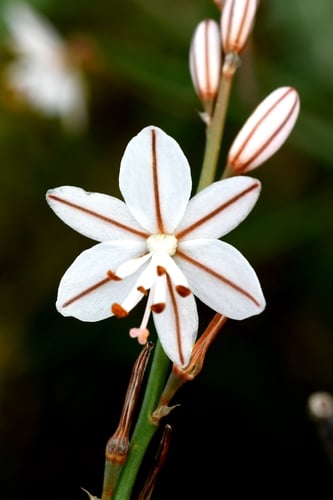
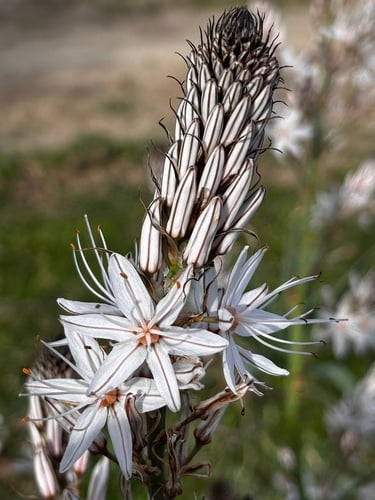
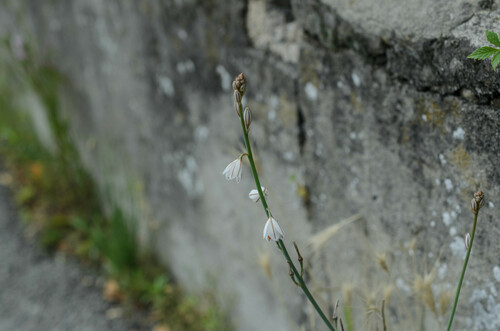
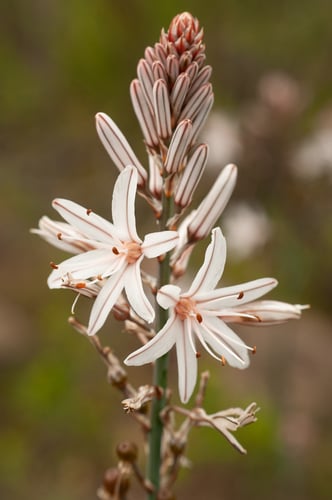
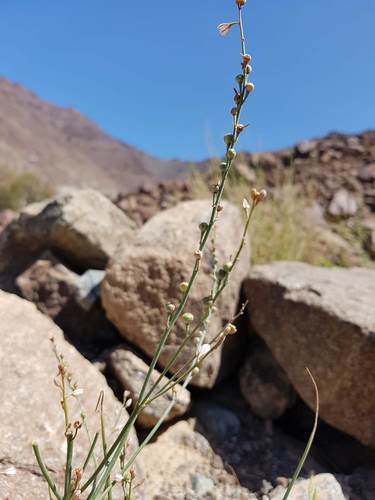
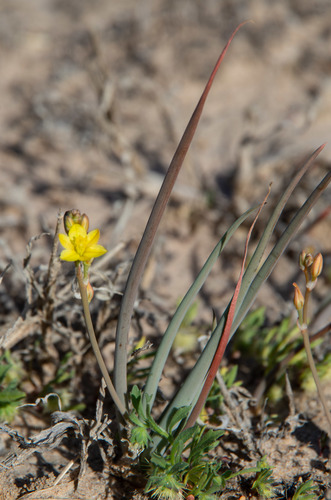
Bulbine bulbosa
(R. Br.) Haw.
Native leek, Golden lily, Golden bulbine-lily
iNaturalist· cc-by
(c) Harry Rose, some rights reserved (CC BY)
iNaturalist· cc-by-nc
(c) Matthew Johnson, some rights reserved (CC BY-NC), uploaded by Matthew Johnson
iNaturalist· cc-by
(c) Rolf Lawrenz, some rights reserved (CC BY), uploaded by Rolf Lawrenz
Summary
Source: WikipediaBulbine bulbosa, commonly known as bulbine lily, native leek, golden lily, or native onion, is a species of flowering plant in the family Asphodelaceae and is endemic to Australia. It is a perennial herb with thick roots, channelled leaves, and yellow flowers with hairy stamen filaments.
Description
A lily plant. It is a herb which keeps growing from year to year. It grows 45 cm high and spreads 30 cm across. It has a bulb shaped tuber. The leaves are onion like. There are 3-10 leaves up to 25 cm long. The flowers occur in a yellow spike. The flower spikes can be 60 cm tall and each flower 3 cm across. The fruit is about 5 mm across. It contains many black seeds.
Edible Uses
The corm or bulb is cooked and eaten, typically roasted. It can be a significant food source.
Traditional Uses
The corm or bulb is cooked and eaten. It is roasted.
This uses section is brief — help expand it
Known Hazards
The plant is said to cause scouring if eaten by sheep or cattle.
Distribution
It grows in temperate places but can also grow in warmer places. It grows in rocky places. It needs well drained soil. It can grow in full sunlight or in part shade. It can stand heavy frosts.
Where It Grows
Australia*, Tasmania*,
Cultivation
It can be grown from seed. They can also be grown by division of the clump.
Propagation
Seed - Division as the plants come into growth. Pot the divisions up and grow them on until they are established then plant them out.
Other Information
It can be a significant food.
Notes
There are 30 Bulbine species. Possibly also Bulbine glauca See Gilfedder, L et al, 2003, The Nature of the Midlands. Midlands Bushweb. PO Box 156 Longford, Tasmania. p 89. It had been put in the Liliaceae. Also put in the family Asphodelaceae.
Nutrition
| Part | Moisture | kJ | kcal | Protein | Vit A | Vit C | Iron | Zinc |
|---|---|---|---|---|---|---|---|---|
| Bulb | 80.4 | 251 | 60 | 2.1 | — | — | 9.2 | 0.7 |
Synonyms
Also Known As
Bulbine Lily, Parm, Pike, Puewan, Wild Onion
References (31)
- Blomberry, A.M., 1979, Australian Native Plants. Angus and Robertson p 126
- Bodkin, F., 1991, Encyclopedia Botanica. Cornstalk publishing, p 175
- Cameron, M., (Ed.) 1981, A Guide to Flowers & Plants of Tasmania. Reed p 88
- Cherikoff V. & Isaacs, J., The Bush Food Handbook. How to gather, grow, process and cook Australian Wild Foods. Ti Tree Press, Australia p 152, 189, 194
- Clarke, P. A., 2013, The Aboriginal Ethnobotany of the Adelaide Region, South Australia. Transactions of the Royal Society of South Australia. (2013), 137(1): 97-126
Show all 31 references Hide references
- Collier, P., 1993, Woodland Wild flowers of Tasmania. Plant Identikit. Society for growing Australian Plants Tasmania Region. Hobart. p 53
- Cribb, A.B. & J.W., 1976, Wild Food in Australia, Fontana. p 147
- Cronin, L., 1989, The Concise Australian Flora. Reed. p 101
- Curtis, W.M., & Morris, D.I., 1994, The Student's Flora of Tasmania. Part 4B St David's Park Publishing, Tasmania, p 383
- Dashorst, G.R.M., and Jessop, J.P., 1998, Plants of the Adelaide Plains & Hills. Botanic Gardens of Adelaide and State Herbarium. p 158
- Elliot, W.R., & Jones, D.L., 1982, Encyclopedia of Australian Plants suitable for cultivation. Vol 2. Lothian. p 386
- Fern, Plants for a Future (As Bulbinopsis bulbosa)
- Gilfedder, L et al, 2003, The Nature of the Midlands. Midlands Bushweb. PO Box 156 Longford, Tasmania. p 89
- Gott, B & Conran, J., 1991, Victorian Koorie Plants. PO Box 666 Hamilton, Victoria 3300, Australia. p 12
- Harris, S., Buchanan, A., Connolly, A., 2001, One Hundred Islands: The Flora of the Outer Furneaux. Tas Govt. p 122
- Hastings Advance Community College, 2017, Uses for Native Plants of the Mornington Peninsula. 86pp. p 26
- Hunter, J. T. & Sheringham, P., 2006, Vegetation and Floristics of Melville Range Nature Reserve. A Report to the New South Wales Parks and Wildlife Service. p 165
- Lazarides, M. & Hince, B., 1993, Handbook of Economic Plants of Australia, CSIRO. p 40
- Lim, T. K., 2015, Edible Medicinal and Non Medicinal Plants. Volume 9, Modified Stems, Roots, Bulbs. Springer p 18
- Low, T., 1991, Wild Food Plants of Australia. Australian Nature FieldGuide, Angus & Robertson. p 103
- Low, T., 1992, Bush Tucker. Australia’s Wild Food Harvest. Angus & Robertson. p 4, 115
- McKerney, M. & White, H., 2011, Bush Tucker, Boomerangs & Bandages. Border River-Gwyder Catchment Management Authority p 173
- Molyneux, B & Forrester, S., 1997, The Austraflora A-Z of Australian Plants. Reed. p 58
- Morley, B.D., & Toelken, H.R., (Eds), 1983, Flowering Plants in Australia. Rigby. p 326
- Plants for a Future database, The Field, Penpol, Lostwithiel, Cornwall, PL22 0NG, UK. http://www.scs.leeds.ac.uk/pfaf/ (As Bulbinopsis bulbosa)
- Saxifrag. enum. 2:33. 1821 (Revis. pl. succ.)
- Steenbeeke, Greg as part of the Plants Directory project. List of plant species from northern NSW that may be used as food plants p 12
- Tasmanian Herbarium Vascular Plants list p 69
- Whiting, J. et al, 2004, Tasmania's Natural Flora. Tasmania's Natural Flora Editorial Committee PO Box 194, Ulverstone, Tasmania, Australia 7315 p 348
- Williams A. & Sides, T., 2008, Wiradjuri Plant Use in the Murrumbidgee Catchment. Murrumbidgee Catchment Management Authority. Wagga Wagga, p 71
- Zola, N., & Gott, B., 1992, Koorie Plants Koorie People. Koorie Heritage Trust. p 43