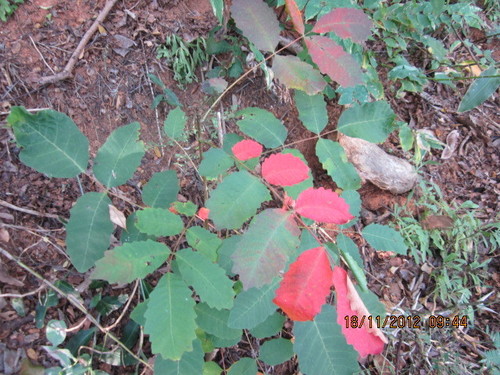
Buchanania sessilifolia
Blume
Otak hudang, Bentangur otak hudang
wikimedia· pd
Wikimedia Commons (via Wikimedia Commons)
Summary
Source: WikipediaBuchanania sessilifolia is a tree in the family Anacardiaceae. The specific epithet sessilifolia is from the Latin meaning 'leaf without stalk', referring to the sessile leaves.
Description
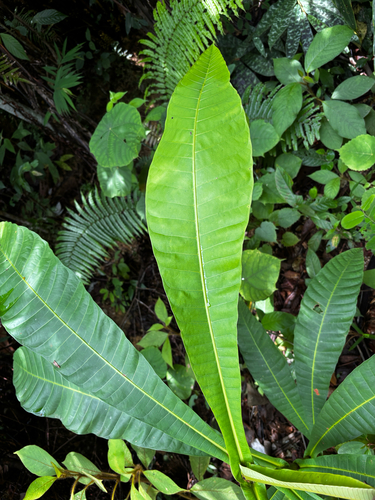
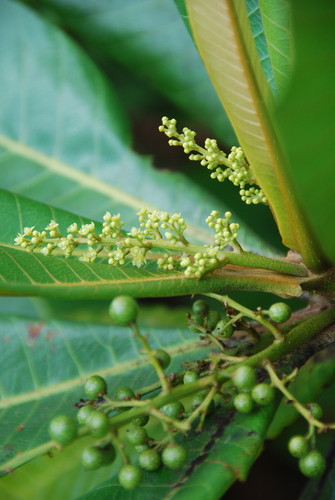
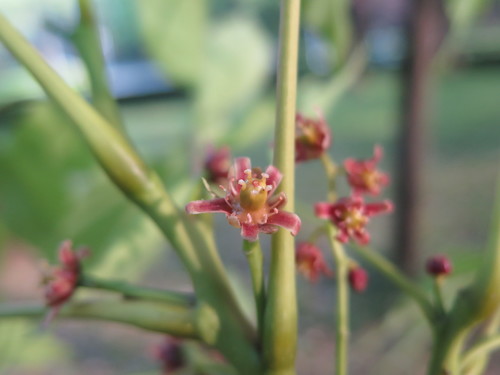
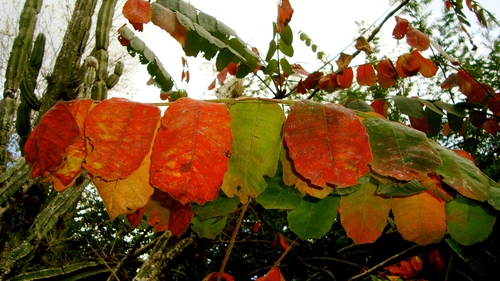
A large tree. It grows 20-42 m tall. The trunk is 30-80 cm across. Sometimes it has buttresses. The bark is grey brown and smooth. The leaves can have some reddish-brown hairs underneath. The leaves are broadly oval and vary in size. They can be 9-35 cm long by 3-10 cm wide. There are 12-24 pairs of side veins. The flowers are white and hairy. The fruit are an unequal heart shape and 10-13 mm long by 8-11 mm wide.
Edible Uses
The sour fruit is eaten.
Traditional Uses
The sour fruit is eaten.
This uses section is brief — help expand it
Distribution
A tropical plant. It mostly grows on dry land near river banks but can be in freshwater swamps. Usually it is below 1,000 m altitude.
Where It Grows
Asia, Brunei, Indochina, Indonesia, Laos, Malaysia, Myanmar, Philippines, SE Asia, Thailand,
Notes
There are about 25 Buchanania species.
Synonyms
Also Known As
Berjagong, Katak hudang, Keretak hudang, Medang hudang, Pauh hutan, Pauh pipit, Rengas ayam, Rengas bukit, Sempedu burong, Sumpah biawak, Sumpah tupai
References (9)
- Bircher, A. G. & Bircher, W. H., 2000, Encyclopedia of Fruit Trees and Edible Flowering Plants in Egypt and the Subtropics. AUC Press. p 68
- Burkill, I.H., 1966, A Dictionary of the Economic Products of the Malay Peninsula. Ministry of Agriculture and Cooperatives, Kuala Lumpur, Malaysia. Vol 1 (A-H) p 382
- Chayamarit, K., 1994, Preliminary Checklist of the Family Anacardiaceae in Thailand. Thai For. Bull. 22:1-25
- Ding Hou, 1978, Anacardiaceae, in Flora Malesiana Ser 1 Vol 8(3) p 418
- Kebler, P. J. A., & Kidiyasa, 1994, Trees of the Balikpapan-Samarinda area of East Kalimantan, Indonesia. The Tropenbos Foundation, Wageningen, The Netherlands. p 39
Show all 9 references Hide references
- Milow, P., et al, 2013, Malaysian species of plants with edible fruits or seeds and their evaluation. International Journal of Fruit Science. 14:1, 1-27
- Slik, F., www.asianplant.net
- Soepadmo, E. and Wong, K. M. and Saw, L. G., 1996, Tree Flora of Sabah and Sarawak. Forestry Malaysia. Volume Two. p 12
- World Checklist of Useful Plant Species 2020. Royal Botanic Gardens, Kew