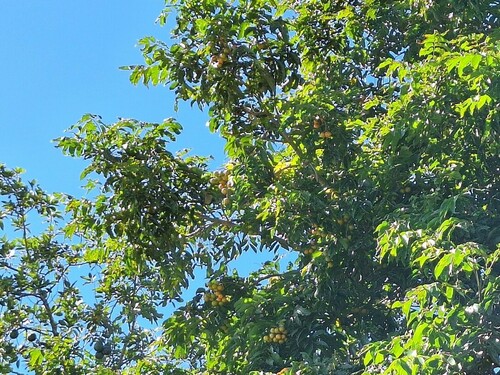
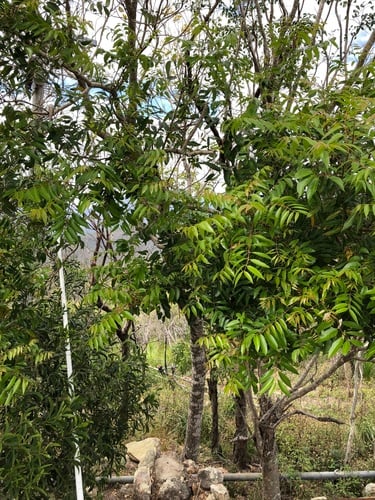
Buchanania obovata
Engl.
Wild plum, Green plum
iNaturalist· cc-by
(c) coenobita, some rights reserved (CC BY), uploaded by coenobita
iNaturalist· cc-by
(c) coenobita, some rights reserved (CC BY), uploaded by coenobita
iNaturalist· cc-by-nc-nd
(c) Zig Madycki, some rights reserved (CC BY-NC-ND), uploaded by Zig Madycki
Summary
Source: WikipediaBuchanania obovata is a small to medium-sized understorey tree in woodlands native to northern Australia, in particular in Arnhem Land in the Northern Territory. Common names include green plum and wild mango. Leaves are smooth, thick, leathery, broadly oblong, 5–25 centimetres (2.0–9.8 in) long and 1.5–10 centimetres (0.59–3.94 in) wide. Flowers are small, cream-coloured and 0.5 centimetres (0.20 in) across. The fruit is smooth, fleshy, lens-shaped, 1–1.7 centimetres (0.39–0.67 in) long. The species was formally described in 1883 based on plant material collected from Escape Cliffs in the Northern Territory by C. Hull.
Description
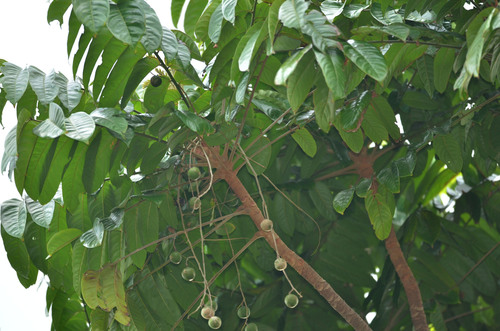
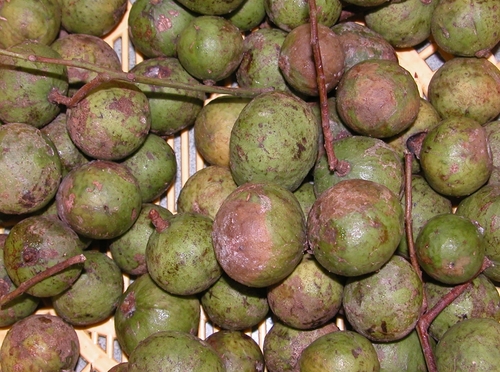
A small tree. It grows 4-10 m high. The young branches are softly hairy. It loses its leaves during the year. The leaves are thick and leathery. They vary in shape but are oblong and taper to the base. The blade is 5-25 cm long by 1.5-10 cm wide. They are a dull grey-green and have a prominent raised midrib. The flowers are small and cream. They are about 05. cm across. They occur in a group at the end of branches. The fruit is a smooth fleshy lens-shaped fruit with a stone inside. They are about 1-1.7 cm long by 1-1.5 cm wide. There is a single hard shelled seed. The fruit are edible.
Edible Uses
The fruit is traditionally eaten by Aboriginal people, as a bushfood. The plant also has traditional medicinal uses. In 2020, researchers at the University of Queensland were researching the fruit. Eaten for more than 53,000 years but previously little-known among non-Indigenous people, the scientists learnt about the plum from people at the remote community of Yirrkala. It is harvested some time after the Kakadu plum harvests. Nutritional analysis showed high levels of protein, dietary fibre and the minerals potassium, phosphorus and magnesium. In addition, the folate level is among the highest of commercially available fruits. Its potential as a commercial crop for Indigenous communities is being investigated.
Traditional Uses
The fruit are eaten raw. Roots may be eaten after roasting and pounding.
This uses section is brief — help expand it
Medicinal Uses
Minced leaves have been placed in tooth cavities to prevent pain. An infusion of the inner bark and sapwood is gargled (but not swallowed) as a treatment for toothache. The pure infusion can also bu used to bathe sore eyes.
Distribution
It is a tropical plant. An understorey tree in open forest. It grows on well-drained soils. It often grows along streams in dry areas. It is very frost sensitive. It grows best in humus rich, moist soils.
Where It Grows
Australia*,
Cultivation
Plants are grown from fresh seed. It can also be grown by cuttings.
Notes
There are about 25 Buchanania species.
Nutrition
| Part | Moisture | kJ | kcal | Protein | Vit A | Vit C | Iron | Zinc |
|---|---|---|---|---|---|---|---|---|
| Fruit | 77.8 | 318 | 76 | 1.5 | — | 38 | 1.7 | 0.4 |
| Roots | — | — | — | — | — | — | — | — |
Synonyms
Also Known As
Bigigee, Dhurrpinda, Glai, Gorola, Gurumal, Kanmakhal, Mangkarrba, Mulugi, Munydjutj, Mgari-ngari, Wurrngin, Yulwandi
References (31)
- Bindon, P., 1996, Useful Bush Plants. Western Australian Museum. p 60.
- Bodkin, F., 1991, Encyclopedia Botanica. Cornstalk publishing, p 174
- Brock, J., 1993, Native Plants of Northern Australia, Reed. p 104
- Checklist of NT Vascular Plant Species. January 2003.
- Cherikoff V. & Isaacs, J., The Bush Food Handbook. How to gather, grow, process and cook Australian Wild Foods. Ti Tree Press, Australia p 198
Show all 31 references Hide references
- Crawford, I. M., 1982, Traditional Aboriginal Plant Resources in the Kalumburu Area: Aspects in Ethno-economics. Records of the Western Australian Museum Supplement No. 15
- Cribb, A.B. & J.W., 1976, Wild Food in Australia, Fontana. p 24
- Elliot, W.R., & Jones, D.L., 1982, Encyclopedia of Australian Plants suitable for cultivation. Vol 2. Lothian. p 385
- Hardwick, G., 2001, Economically Useful Plants for Northern Australia: Master Species List. Crusader eBooks.
- Hiddins, L., 1999, Explore Wild Australia with the Bush Tucker Man. Penguin Books/ABC Books. p 144
- Isaacs, J., 1987, Bush Food, Aboriginal Food and Herbal Medicine. Weldons. p 62
- Kenneally, K.E., Edinger, D. C., and Willing T., 1996, Broome and Beyond, Plants and People of the Dampier Peninsula, Kimberley, Western Australia. Department of Conservation and Land Management. p 59
- Lazarides, M. & Hince, B., 1993, Handbook of Economic Plants of Australia, CSIRO. p 40
- Levitt, D., 1981, Plants and people. Aboriginal uses of plants on Groote Eylandt, Australian Institute of Aboriginal Studies, Canberra. p 80
- Low, T., 1991, Wild Food Plants of Australia. Australian Nature FieldGuide, Angus & Robertson. p 150
- Morley, B.D., & Toelken, H.R., (Eds), 1983, Flowering Plants in Australia. Rigby. p 190
- Norrington, L., & Campbell, C., 2001, Tropical Food Gardens. Bloomings Books. p 89, 103
- Paczkowska, G. & Chapman, A.R., 2000, The Western Australian Flora. A Descriptive Catalogue. Western Australian Herbarium. p 137
- Petheram, R. J. and Kok, B., 2003, Plants of the Kimberley Region of Western Australia. UWA Press p 389
- Smith, M & Kalotas, A. C., 1985, Bardi Plants: An Annotated List of Plants and Their Use by the Bardi Aborigines of Dampierland, in North-western Australia. Rec. West Aust. Mus. 1985, 12(3): 317-359
- Smith, N and Wightman, G.M., 1990, Ethnobotanical Notes from Belyuen Northern Territory Australia. Northern Territory Botanical Bulletin No 10. Parks and Wildlife Commission of the Northern Territory. p7, 8.
- Smith, N. M., 1991, Ethnobotanical Field Notes from the Northern Territory, Australia, J. Adelaide Bot. Gard. 14(1): 1-65
- Smith, Nicholas et al. 1993, Ngarinyman Ethnobotany: Aboriginal Plant Use from the Victoria River Area Northern Australia. Northern Territory Botanical Bulletin No 16. Parks and Wildlife Commission of the Northern Territory. p 12, 11.
- Tiwi Plants and Animals. 2001, Aboriginal flora and fauna knowledge from Bathurst and Melville Islands, northern Australia. Northern Territory Botanical Bulletin; No. 24 p 32
- Vigilante, T., et al, 2013, Island country: Aboriginal connections, values and knowledge of the Western Kimberley islands in the context of an island biological survey. Records of the Western Australian Museum Supplement 81: 145-182 (As oblongifolia)
- Wheeler, J.R.(ed.), 1992, Flora of the Kimberley Region. CALM, Western Australian Herbarium, p 658
- Wightman, Glenn et al. 1991. Alawa Ethnobotany: Aboriginal Plant Use from Minyerri, Northern Australia. Northern Territory Botanical Bulletin No 11. Parks and Wildlife Commission of the Northern Territory. p 6, 7.
- Wightman, G. & Andrews, M., 1991, Bush Tucker Identikit. Common Native Food Plants of Australia’s top end. Conservation Commission Northern Territory. p 6
- Wightman, Glenn et al. 1992, Mangarrayi Ethnobotany: Aboriginal Plant Use from the Elsey Area Northern Australia. Northern Territory Botanical Bulletin No 15. Parks and Wildlife Commission of the Northern Territory. p 12, 11.
- Wightman, G. & Brown, J., 1994, Jawoyn Plant Identikit, Common Useful Plants in the Katherine Area of Northern Australia. Concervation Commission Northern Territory. p 16
- Yunupinu Banjgul, Laklak Yunupinu-Marika, et al. 1995, Rirratjinu Ethnobotany: Aboriginal Plant Use from Yirrkala, Arnhem Land, Australia. Northern Territory Botanical Bulletin No 21. Parks and Wildlife Commission of the Northern Territory. p 24.