Buchanania arborescens
(Blume) Blume
Little Gooseberry tree, Beach Berry
iNaturalist· cc0
no rights reserved, uploaded by 葉子
iNaturalist· cc0
no rights reserved, uploaded by 葉子
iNaturalist· cc-by-nc
(c) Russell Cumming, some rights reserved (CC BY-NC), uploaded by Russell Cumming
Summary
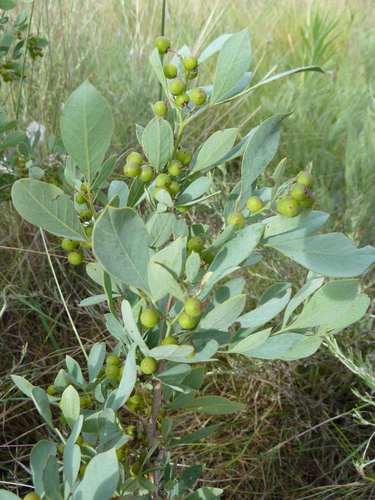
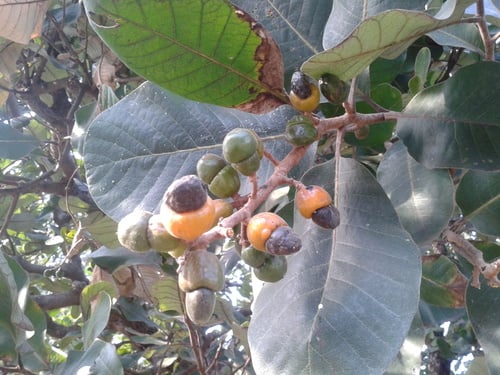
Source: WikipediaBuchanania arborescens, commonly known as the little gooseberry tree or sparrow's mango, is a small and slender tree native to seasonal tropical forests of northern Australia, Southeast Asia, and the Solomon Islands. The leaves are spirally arranged, smooth, leathery, elongated oblong, 5–26 cm long. The flowers are very small cream to yellowish white. The edible fruit are globular, small (1 cm long), reddish to purple-black. Torresian imperial pigeons and other birds eat these. The species was formally described in 1826 by botanist Carl Ludwig Blume based on plant specimens collected from Java. Initially naming it Coniogeton arborescens, Blume transferred the species to the genus Buchanania in 1850. In Australia the species occurs naturally across the northern extremities of the continent from Western Australia and across the Northern Territory to Queensland where it extends down the east coast as far south as Hinchinbrook Island.
Description
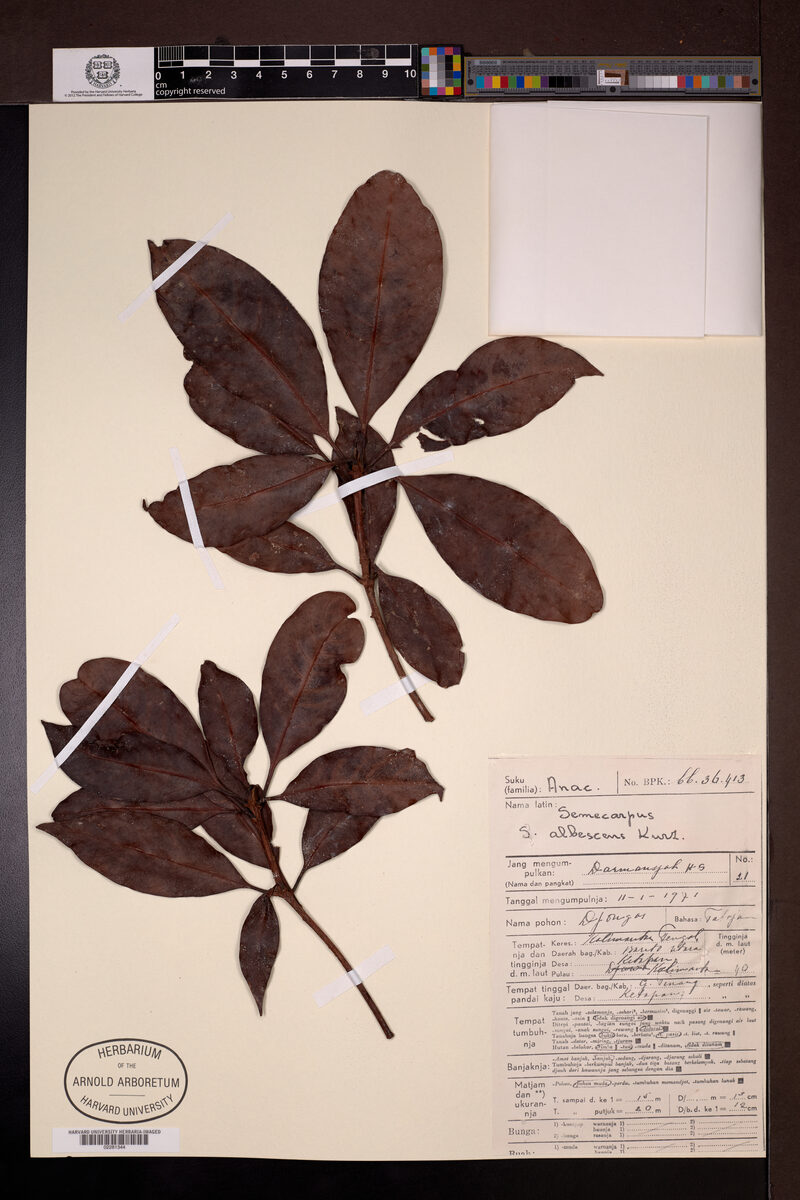
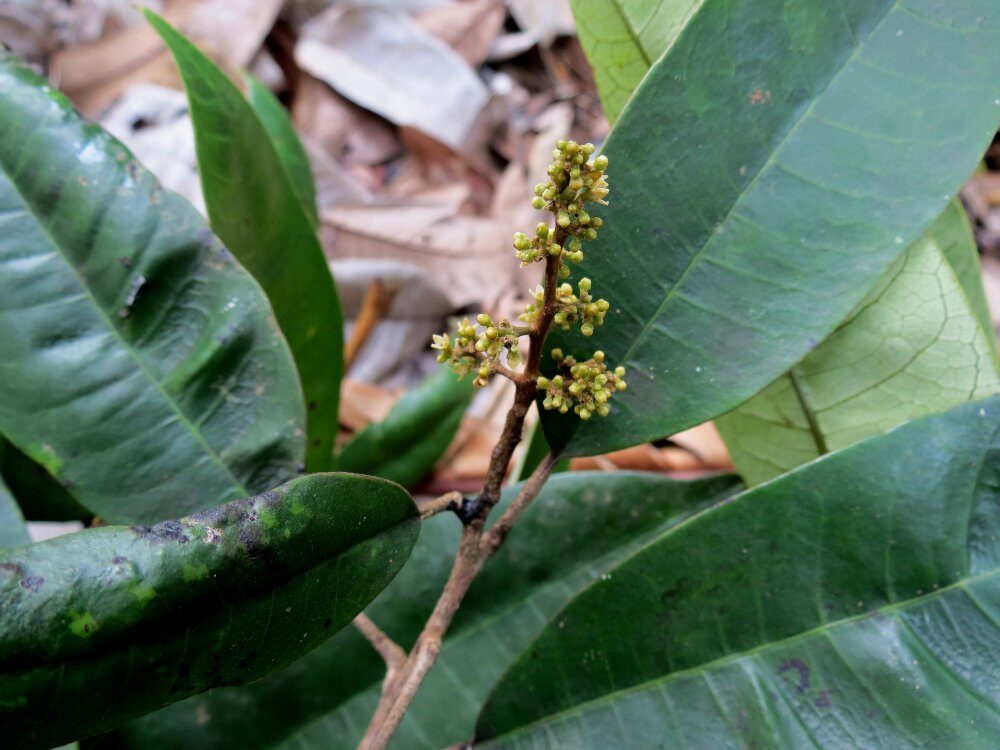
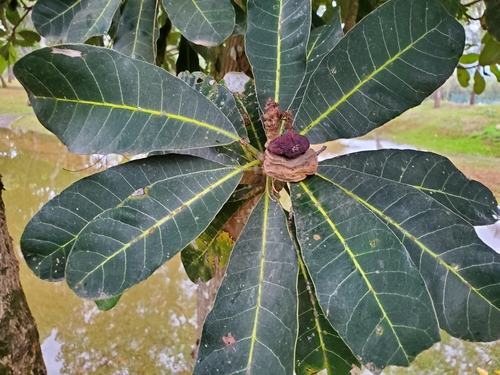
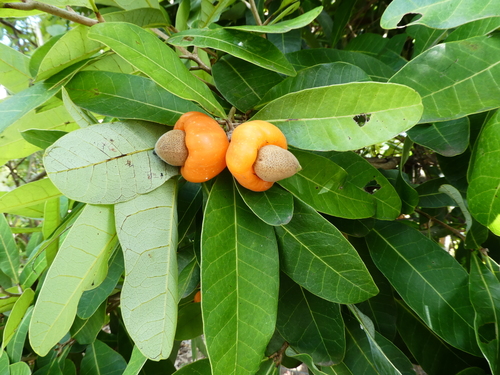
A medium sized evergreen tree. It grows 10-15 m high and with a spread of 3 m. The tree shape is like a cone, not an umbrella. It has round branches and a smooth tip. The leaves come one after the other around the branch and are crowded near the ends of branches. The young shoots are covered with silky hairs. New growth is bronze red. The leaves are darker green on the upper surface. They are shiny and stiff and look like mango leaves. The leaves are 5-26 cm long by 2-7 cm wide. The veins and mid rib show up clearly. The leaf stalk is 4-6 cm long. The flowers are dull white to cream and very small (0.2-0.4 cm long) in long flowering branches. These flowering branches occur on the ends of branches or in the angles of upper leaves. At flowering time the whole tree has a white display of flowers. The flowers have a sweet smell. Only one of the five female flower parts is fertile producing fruit. The fruit are berries (drupes) and on short stalks. They are hard, smooth and dull red or purple. They are about 1 cm across and flattish. It is an attractive ornamental and shade producing tree.
Edible Uses
Fruit - raw or cooked. The unripe fruits, when boiled, impart an agreeable acidity to the water, and when thus prepared, taste tolerably well. When fully ripe, they become sweet and pulpy, like gooseberries, although their rind is not very thick.
Traditional Uses
The fruit are eaten raw. They are sweet. The fruit can be used to make drinks.
This uses section is brief — help expand it
Medicinal Uses
Aboriginal people eat the fruit raw. The plant is also used as a traditional medicine in Australia and Malaysia. The 1889 book 'The Useful Native Plants of Australia' records that "The unripe fruits of this plant were gathered, and, when boiled, imparted an agreeable acidity to the water, and when thus prepared, tasted tolerably well. When ripe, they become sweet and pulpy, like gooseberries, although their rind is not very thick. This resemblance induced us to call the tree 'the little gooseberry'tree" quoted from Leichhardt: Overland journey to Port Essington, p. 479.
Distribution
A tropical plant. They are found throughout the islands of the Philippines in the lower wooded regions. It is also native to Australia occurring in the northern tip regions. It prefers rich, moist, well drained soils in a sunny position but often occurs on sandstone hills. Often trees are found near monsoon forest beside freshwater streams. It gets damaged by both drought and frost. It is very frost sensitive. In north Thailand it grows below 1,200 m above sea level. It can be in mangrove swamps and coastal thickets.
Where It Grows
Andaman Islands, Asia, Australia, Brunei, Cambodia, China, East Timor, India, Indochina, Indonesia, Laos, Malaysia, Myanmar, Pacific, Papua New Guinea, PNG, Philippines, SE Asia, Singapore, Solomon Islands, Taiwan, Thailand, Timor-Leste, Torres Strait, Vietnam,
Cultivation
It can be grown from seed or by cuttings. Seeds should be planted in well drained soil. It needs to be kept well watered.
Other Uses
The bark is a source of tannins. The heartwood is pinkish brown, often with a grey tinge, it is not clearly defined from the lighter-coloured sapwood. The texture is rather fine and even, with straight or slightly interlocked grain. The wood is soft to moderately hard and light to moderately heavy, it is non-durable when exposed to the weather and is reported to be rather weak. It is reputed to work easily and planes to a smooth finish. Sawdust may cause dermatitis. The timber seasons well, though boards containing tension wood may distort badly. Shrinkage is moderate to high. The small size of the tree precludes any extensive utilisation of this timber, which has been used for light temporary construction, plywood, match boxes and cheap cigar boxes. Other uses include furniture, light framing, turneries and blockboards. Buchanania arborescens is common and widespread across a wide range of forest types, and it regenerates easily on disturbed sites. This makes it a good candidate for use as a pioneer in reforestation projects in areas within its native range.
Production
Flowering in the southern hemisphere occurs August to October and fruiting follows November to December being ready to harvest in January.
Other Information
It is appreciated in some communities.
Notes
There are about 25 Buchanania species. The first part of the scientific name is after Claudius Buchanan a Scottish chaplain to the East India Company in the 1800’s.
Synonyms
Also Known As
Balinghasai, Chaa muang, Dumangkarrkba, Jam jam, Jilara, Jungle plum, Kampinh doong, Khuan kung, Kra uam, Kreet, Lightwood tree, Mon, Ngauwingai, Pohon getasan, Satinwood tree, Taninthayi, Ya thum, Yawuriama yankumwani
References (40)
- Beasley, J., 2011, Plants of Tropical North Queensland - the compact guide. Footloose publications. p 171
- Bodkin, F., 1991, Encyclopedia Botanica. Cornstalk publishing, p 174
- Brock, J., 1993, Native Plants of Northern Australia, Reed. p 104
- Carig, Elizabeth T. 2020, Guidebook on Native Trees within the Quirino Forest Landscape. Plaridel, Bulacan, St. Andrew Publishing House. p 30
- Chayamarit, K., 1994, Preliminary Checklist of the Family Anacardiaceae in Thailand. Thai For. Bull. 22:1-25
Show all 40 references Hide references
- Checklist of NT Vascular Plant Species. January 2003.
- Cherikoff V. & Isaacs, J., The Bush Food Handbook. How to gather, grow, process and cook Australian Wild Foods. Ti Tree Press, Australia p 198
- Cooper, W. and Cooper, W., 2004, Fruits of the Australian Tropical Rainforest. Nokomis Editions, Victoria, Australia. p 17
- Cowie, I, 2006, A Survey of Flora and vegetation of the proposed Jaco-Tutuala-Lore National Park. Timor-Lests (East Timor) www.territorystories.nt/gov.au p 42(As Buchanania florida)
- Crawford, I. M., 1982, Traditional Aboriginal Plant Resources in the Kalumburu Area: Aspects in Ethno-economics. Records of the Western Australian Museum Supplement No. 15
- Cribb, A.B. & J.W., 1976, Wild Food in Australia, Fontana. p 23
- Djunbunji Newsletter Edition 2 2011. p 5
- Elliot, W.R., & Jones, D.L., 1982, Encyclopedia of Australian Plants suitable for cultivation. Vol 2. Lothian. p 384 (Also as Buchanania muelleri)
- Fell, D.G. & Stanton, D.J., 2015: The vegetation and flora of Mabuyag, Torres Strait, Queensland. Memoirs of the Queensland Museum – Culture 8(1):1-33. Brisbane. ISSN 1440-4788.
- Foreman, D. B., 1971, A checklist of the Vascular Plants of Bougainville with Descriptions of some Common Forest Trees. Botany Bulletin No. 5. Department of Botany. p 76
- French, B.R., 2010, Food Plants of Solomon Islands. A Compendium. Food Plants International Inc. p 303
- Gardner, S., et al, 2000, A Field Guide to Forest Trees of Northern Thailand, Kobfai Publishing Project. p 146
- Habitat Management Profile – Saibai Island. Appendix C. Preliminary List of Useful Plants for Saibai Island. p 118
- Hardwick, G., 2001, Economically Useful Plants for Northern Australia: Master Species List. Crusader eBooks.
- Hiddins, L., 1999, Explore Wild Australia with the Bush Tucker Man. Penguin Books/ABC Books. p 149
- Jackes, B.R., 2001, Plants of the Tropics. Rainforest to Heath. An Identification Guide. James Cook University. p 39
- Jones D, L, 1986, Ornamental Rainforest Plants in Australia, Reed Books, p 199, 214, 340
- Kiple, K.F. & Ornelas, K.C., (eds), 2000, The Cambridge World History of Food. CUP p 1803
- Lazarides, M. & Hince, B., 1993, Handbook of Economic Plants of Australia, CSIRO. p 40
- Levitt, D., 1981, Plants and people. Aboriginal uses of plants on Groote Eylandt, Australian Institute of Aboriginal Studies, Canberra. p 81
- Low, T., 1991, Wild Food Plants of Australia. Australian Nature FieldGuide, Angus & Robertson. p 150
- Maiden, J. H., 1889, The Useful Native Plants of Australia (including Tasmania). The Technology Museum of NSW, Sydney. p 11
- Mohd, N. G. et al, 2014, A Preliminary Flora Survey in Gunung Kajang, Pulau Tioman, Pahang Darul Makmur, Malaysia. Malays. Appl. Biol. 43(2): 17-23
- Monsalud, M.R., Tongacan, A.L., Lopez, F.R., & Lagrimas, M.Q., 1966, Edible Wild Plants in Philippine Forests. Philippine Journal of Science. p 438
- Mua Bioversity Profile, 2013, Profile for Management of the Habitats and Related Ecological and Cultural Resources of Mua Island. Torres Strait Regional Authority Land & Sea Management Unit. p 142
- Paczkowska, G. & Chapman, A.R., 2000, The Western Australian Flora. A Descriptive Catalogue. Western Australian Herbarium. p 137
- Peekel, P.G., 1984, (Translation E.E.Henty), Flora of the Bismarck Archipelago for Naturalists, Division of Botany, Lae, PNG. p 324, 325
- Phon, P., 2000, Plants used in Cambodia. © Pauline Dy Phon, Phnom Penh, Cambodia. p 106
- Scarth-Johnson, V., 2000, National Treasures. Flowering Plants of Cooktown and Northern Australia. Vera Scarth-Johnson Gallery Association. Cooktown, Australia. p 75
- Slik, F., www.asianplant.net
- Soepadmo, E. and Wong, K. M. and Saw, L. G., 1996, Tree Flora of Sabah and Sarawak. Forestry Malaysia. Volume Two. p 10
- Sukarya, D. G., (Ed.) 2013, 3,500 Plant Species of the Botanic Gardens of Indonesia. LIPI p 165
- Tiwi Plants and Animals. 2001, Aboriginal flora and fauna knowledge from Bathurst and Melville Islands, northern Australia. Northern Territory Botanical Bulletin; No. 24 p 31
- Townsend, K., 1994, Across the Top. Gardening with Australian Plants in the tropics. Society for Growing Australian Plants, Townsville Branch Inc. p 107
- World Checklist of Useful Plant Species 2020. Royal Botanic Gardens, Kew