Calamus guruba
Buch.Ham. ex Mart.
gbif· cc-by
The New York Botanical Garden
gbif· cc-by
The New York Botanical Garden
gbif· cc-by
The New York Botanical Garden
Description
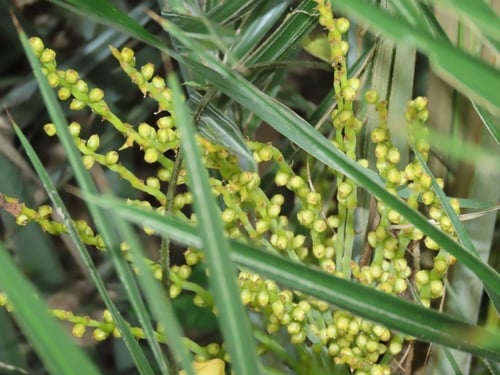
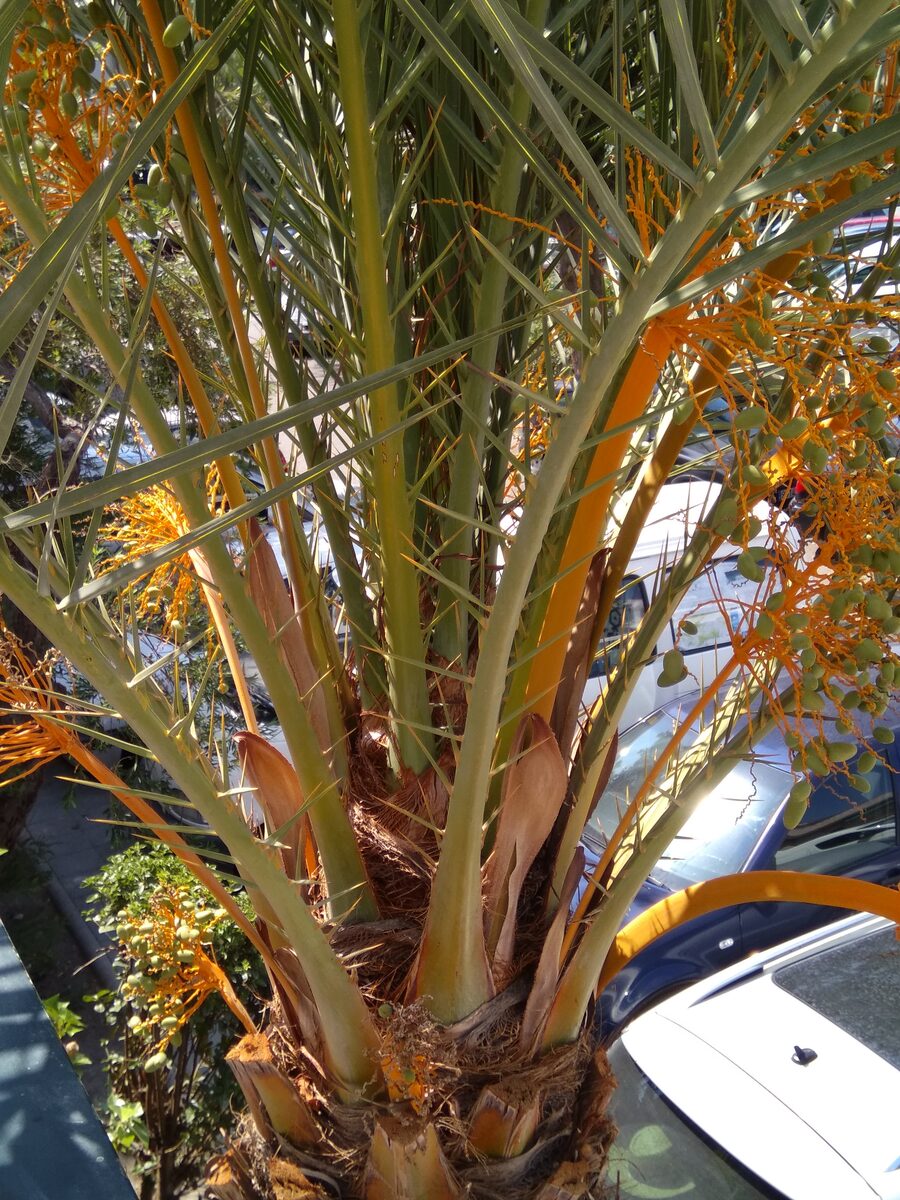
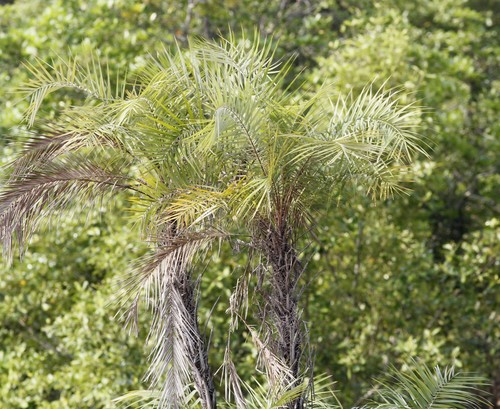
A rattan. It can be climbing or form thickets. The stems are in clusters. The canes can be 20 m long and 3 cm across. The leaf sheath is dull green. It has light brown hairs. It has spines 3.5 cm long that point upwards. The leaf shoots are 1.3 m long and there are 30-65 narrow leaflets on each side. They are arranged regularly. The flowering shoots are 3 m long. The fruit are round and 0.8 cm across. They are yellow or brown.
Edible Uses
The young pith is cooked with shrimp after removing the spiny stem. The pulp of ripe fruit is eaten raw.
Traditional Uses
The spiny stem is removed and the young pith cooked with shrimp. The pulp of the ripe fruit is eaten.
This uses section is brief — help expand it
Distribution
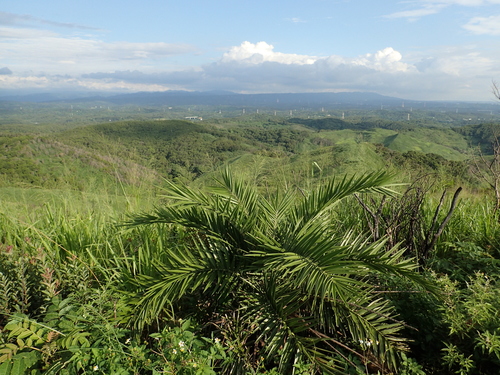
It is a tropical plant. In Laos it grows in scrub forest often near rivers. It grows between 100-750 m altitude. It can be up to 1,200 m above sea level. It grows in lowland rain forest and in dry forest. In Yunnan.
Where It Grows
Asia, Bangladesh, Bhutan, Cambodia, China, Himalayas, India, Indochina, Laos, Malaysia, Myanmar, Nepal, Northeastern India, SE Asia, Thailand, Vietnam,
Cultivation
A plant of high rainfall areas at low elevations in the tropics. Most species in this genus are more or less vigorous climbing plants in rainforests. Leaves of young plants are normally damaged if exposed to too much light, though leaves of older plants will usually tolerate full sun. In general, plants are likely to grow best with their roots in the shade but with enough gap in the canopy to encourage their stems to grow up towards the light. They are also likely to grow best in a humus-rich soil. Many of the species require fairly moist conditions for good growth, in fact several of them grow in wet soils or in areas with seasonal inundation - where we have the information it will be included under the plant’s habitat. Overhead shade should be manipulated at about 6-monthly intervals for the first 2 - 3 years of a young plant’s life to ensure they receive sufficient light to grow vigorously. About 40 - 50% light penetration is generally considered to be ideal for promoting stem growth. Little care is needed once the seedlings are established. It is important, however, to weed the area surrounding the seedlings occasionally until the plants are more than 2 metres tall. A dioecious species, both male and female forms need to be grown if fruit and seed are required.
Propagation
Seed - it has a fairly short viability and is best sown as soon as it is ripe.
Other Uses
The stems are woven into baskets and used for making chair bottoms. The cane is 5 - 20mm in diameter, it has a soft core so is usually split into 4 pieces and used for weaving and tying. The long and slender stems of Calamus species are put to various uses according to their size, length, flexibility, elasticity and toughness. The most slender canes are employed entire for binding purposes, and in making chairs, blinds, mats, wicker or basketwork, fishing implements, etc. Twisted together, they make very strong cables. The largest and more resistent canes are used entire as cables, the framework of wicker chairs etc. Usually, however, for many purposes the stems are split throughout their length into 2 - 4 or more strips from which the inner soft brittle and spongy portion is removed by means of a knife or same other instrument, so as to leave the external portion, which is hard, tough, flexible, elastic and has its outer surface very clean and smooth as if it had been varnished. Strips vary in width according to the use to which they are to be put. Those for delicate work, such as the network of furniture, small bags, hats, etc, are from 1 - 3mm wide; those employed as lashings in native housebuilding or in fastening the removable head of the Malay axe to its handle are from 5-6 mm wide. Collecting and preparing the stems is very simple. The stem is cut near the ground and detached from the trees by taking a strong hold of its base and thus pulling down the entire plant with its leaves. The most recent growth at the top of the plant is removed and then, handling it from the upper end, the stem is forcibly drawn in the opposite direction between two pieces of wood, thus removing the spiny coverings. It is then cut into lengths of about 5 metres, each piece is bent into two equal parts and the stems are fastened into bundles ready for market. The most valued stems are not thicker than a man's little finger and have a fine polished straw-yellow glassy surface.
Production
In India fruit are produced March to December.
Notes
There are 375-400 Calamus species. There are 175 species in tropical Asia. The cane is used for baskets and furniture.
Synonyms
Also Known As
Chikan bet, Dute bet, Jali bet, Kanta beta, Kyaing ni, Kyein-ne, Kyein-ni, Sundi bet, Teeta bet, Wai deng, Wai kikai
References (5)
- Dransfield, J., et al, 2004, A preliminary checklist to Thai Palms. Thai For. Bull. (Bot.) 32:32-72
- Evans, T. D., et al, 2002, A Synopsis of the Rattans (Arecaceae: Calamoideae) of Laos and Neighbouring Parts of Indochina. Kew Bulletin, Vol. 57, No. 1 (2002), pp. 1-84
- Henderson, A., 2009, Palms of Southern Asia. Princeton Field Guides.
- Misra S. & Misra M., 2016, Ethnobotanical and Nutritional Evaluation of Some Edible Fruit Plants of Southern Odisha, India. International Journal of Advances in Agricultural Science and Technology, Vol.3 Issue.1, March- 2016, pg. 1-30
- Misra, S., 2020, Survey of edible plants for human consumption in south Odisha, India. Journal of Emerging Technologies and Innovative Research (JETIR) Vol. 7, Issue 12 p 278