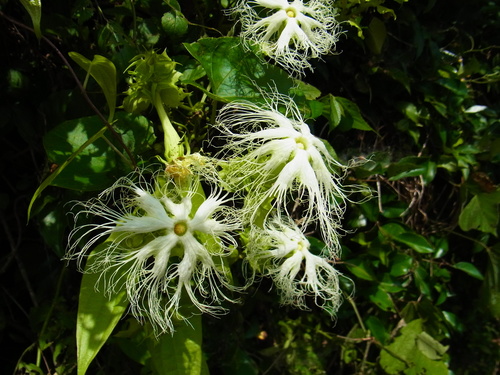
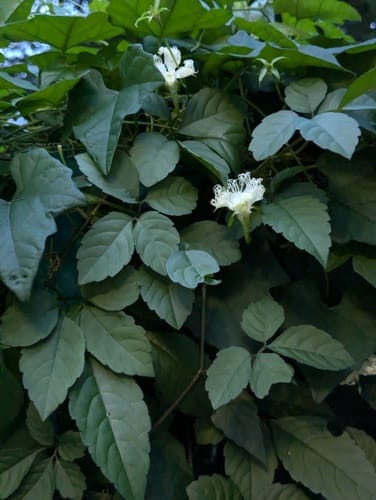
Bryonia alba
(L.) Bull.
White Bryony, Tetterberry, Wild hops
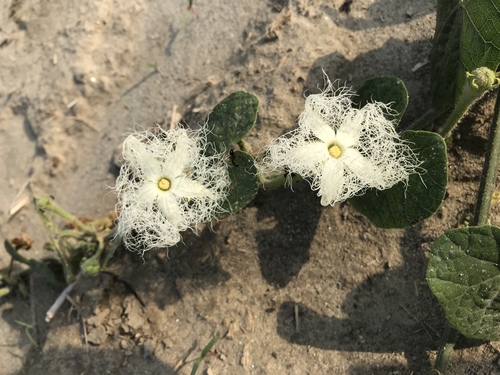
iNaturalist· cc-by-nc
(c) Eduard Garin, some rights reserved (CC BY-NC), uploaded by Eduard Garin
iNaturalist· cc-by-nc
(c) Eli Loftis, some rights reserved (CC BY-NC), uploaded by Eli Loftis
iNaturalist· cc-by-nc
(c) eugenezakharov, some rights reserved (CC BY-NC), uploaded by eugenezakharov
Summary
Source: WikipediaBryonia alba (also known as white bryony or wild hop) is a vigorous vine in the family Cucurbitaceae, found in Europe and Northern Iran. It has a growth habit similar to kudzu, which gives it a highly destructive potential outside its native range as a noxious weed. Other common names include false mandrake, English mandrake, wild vine, and wild hops, wild nep, tamus, ladies' seal, and tetterbury.
Description
A pumpkin family plant. It is a vine that keeps growing from year to year. It grows 2 m high and spreads 2 m wide. The rootstock is large and fleshy. The stem is weak and climbing. It has prickly spiral tendrils. These are opposite the leaves. The leaves are rough and have 5 leaflets like fingers on a hand. They are heart shaped. The flowers are green, white or yellow. They are small and of one sex. They are in the axils of leaves. The fruit are small, round berries.
Edible Uses
Edible Parts: Leaves Shoots Edible Uses: One report says that the young shoots are edible, though caution is advised. See the notes above on toxicity. The starch of the root is a famine food for extending bread flour after removing the acrid element. The young shoots are eaten. Caution: It is probably very poisonous [1b].
Traditional Uses
The starch of the root is a famine food for extending bread flour after removing the acrid element. The young shoots are eaten. They are boiled and then fried. Caution: It is probably very poisonous.
Medicinal Uses
Antirheumatic Homeopathy Urinary The root is cathartic, hydrogogue, irritant, pectoral and purgative. The root is harvested in the autumn and can be used either fresh or dried. It should be used with great caution, see notes above on toxicity. The fresh root, gathered before the plant comes into flower, is made into a homeopathic remedy. This is used in the treatment of a wide range of complaints. It is said to be one of the best diuretics and an excellent remedy for gravel as well as all other obstructions and disorders of the urinary passage.
Known Hazards
All parts of Bryonia alba contain bryonin which is poisonous and may cause illness or death. Livestock may also be poisoned by consuming the fruit and leaves. Forty berries constitutes a lethal dose for adult humans.
Distribution
It is a Mediterranean plant. It is best in a moist, rich soil. It needs an open sunny position. It is resistant to drought and frost.
Where It Grows
Armenia, Australia, Balkans, Caucasus, Europe*, France, Iran, Macedonia, Mediterranean, Middle East, Turkey, Türkiye,
Cultivation
A rapid grower, it is of easy cultivation succeeding in most soils that are well drained, avoiding acid soils in the wild. A climbing plant, attaching itself to other plants by means of tendrils. Plants can be easily encouraged by scattering ripe seed at the base of hedgerows. Plants in the north of their range are monoecious, but those growing in the south are dioecious. Where necessary, male and female plants must be grown if seed is required.
Propagation
Seed - best sown as soon as it is ripe in a cold frame. Sow stored seed in late winter in a cold frame. When large enough to handle, prick the seedlings out into individual pots and grow them on in the greenhouse for at least their first winter, planting them out into their permanent positions in late spring or early summer, after the last expected frosts. Division in early spring.
Other Uses
None known Special Uses
Other Information
The root is a famine food. It is sold in local markets.
Notes
There are about 10 Bryonia species. It is used in medicine.
Synonyms
Also Known As
Arjakhaghogh, Loshtak, Xezirvik, Xezrowik
References (8)
- Bircher, A. G. & Bircher, W. H., 2000, Encyclopedia of Fruit Trees and Edible Flowering Plants in Egypt and the Subtropics. AUC Press. p 68
- Bodkin, F., 1991, Encyclopedia Botanica. Cornstalk publishing, p 174
- Hedrick, U.P., 1919, (Ed.), Sturtevant's edible plants of the world. p 138
- Lim, T. K., 2015, Edible Medicinal and Non Medicinal Plants. Volume 9, Modified Stems, Roots, Bulbs. Springer p 18
- Nanagulyan, S., et al, 2020, Wild plants and fungi sold in the markets of Yerevan (Armenia). Journal of Ethnobiology and Ethnomedicine 16:26
Show all 8 references Hide references
- PARMENTIER
- Plants for a Future database, The Field, Penpol, Lostwithiel, Cornwall, PL22 0NG, UK. http://www.scs.leeds.ac.uk/pfaf/
- Yesil, Y., et al, 2019, Traditional knowledge of wild edible plants in Hasankeyf (Batman Province, Turkey). Acta Societatis Botanicorum Poloniae. 88(3):3633