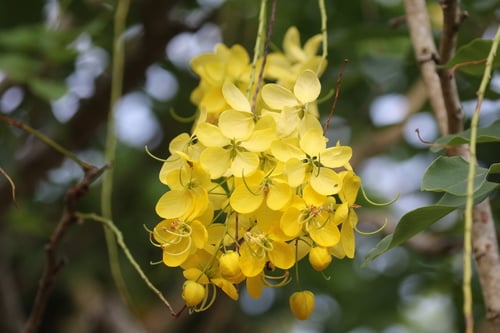
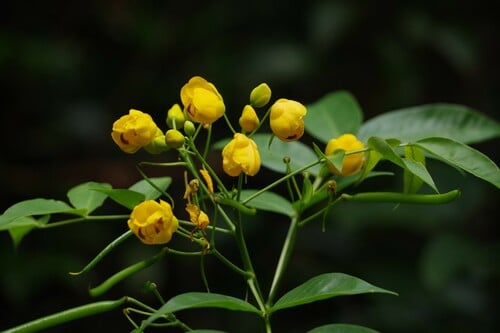
Psophocarpus grandiflorus
R. Wilczek
gbif· cc-by
Meise Botanic Garden
gbif· cc-by
Royal Botanic Gardens, Kew
gbif· cc-by-nc-sa
MBG
Description
A herb. It is a climbing plant that keeps growing from year to year. It grows 5 m long. It may have tuberous roots. The stems have flattened hairs. The leaves have 3 broad leaflets. The flowers are large and purple or pale blue. The pods have wings. The seeds are large.
Edible Uses
Young leaves - cooked and eaten as a vegetable. Young seedpods - cooked and eaten as a vegetable. The seedpods are around 40 - 90mm long and 7 - 15mm wide. Mature seeds - cooked. The seeds are roasted and used as a nutritious snack. The oblong-ellipsoid seeds are 7 - 9mm long and 6 - 8mm wide.
Traditional Uses
The leaves and pods are boiled in water or milk then eaten. The mature seeds are roasted and eaten.
This uses section is brief — help expand it
Medicinal Uses
The strong, twining shoots are used as a tourniquet to constrict blood flow following injury/
Distribution
It is a tropical plant. In Congo it grows between 1,600-2,300 m altitude.
Where It Grows
Africa, Burundi, Central Africa, Congo DR, East Africa, Ethiopia, Kenya, Uganda,
Cultivation
Species in this genus generally require a sunny position, growing best in a moist but well-drained, slightly acid loamy soil. Plants do not flower if growing in the shade (unless the higher shoots grow into the sun) or in high nutrient soils. This species has a symbiotic relationship with certain soil bacteria, these bacteria form nodules on the roots and fix atmospheric nitrogen. Some of this nitrogen is utilized by the growing plant but some can also be used by other plants growing nearby.
Propagation
Seed - requires pre-treatment. Pre-soaking for 12 - 24 hours in warm water should soften the hard seedcoat and allow the seed to swell. If it does not swell, then making a small nick in the seedcoat (being careful not to damage the embryo) should allow the seed to take up water.
Other Uses
The leaves are used to darken statuary and other artifacts. Freshly carved wood is rubbed with the leaves, then wrapped in more leaves and finally placed in a muddy area such as a marsh. The wood becomes darker and looks more like an antique than a new carving. The strong, twining shoots are used to tie loads for carrying.
Other Information
It is occasionally cultivated.
Notes
There are 9 Psophocarpus species. It can get the rust fungus (Synchytrium psophocarpi)
Synonyms
Also Known As
Mgoraorwe, Muhululatu
References (4)
- Grubben, G. J. H. and Denton, O. A. (eds), 2004, Plant Resources of Tropical Africa 2. Vegetables. PROTA, Wageningen, Netherlands. p 434
- Harder, D., Lolema, O. P. M. & Tshisand, M., 1990, Use, Nutritional Composition and Ecogeography of Four Species of Psophocarpus (Fabaceae, Phaseoleae) in Zaire. Economic Botany, Vol. 44, No. 3 pp. 391-409
- ILDIS Legumes of the World http:www:ildis.org/Legume/Web
- Kew Plants of the World On line