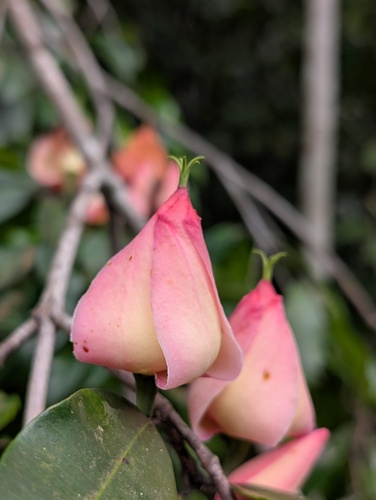
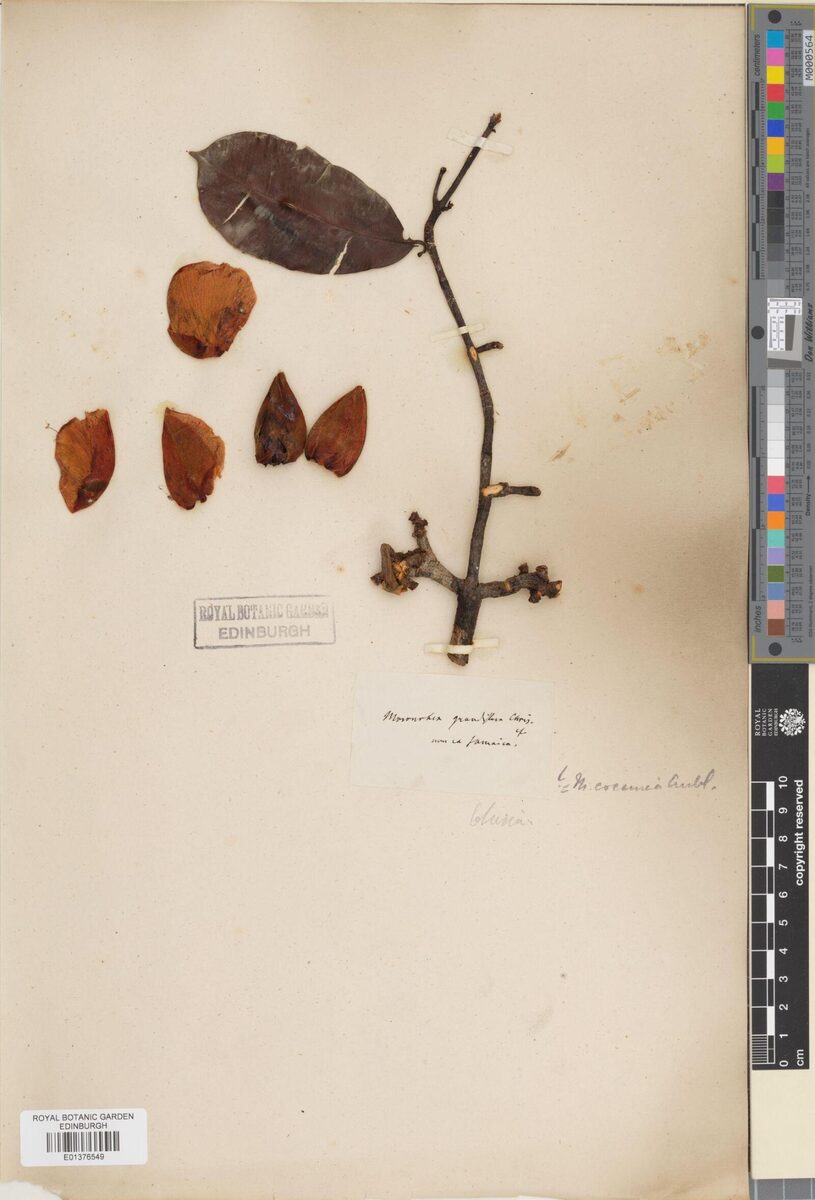
Symphonia globulifera
L. f.
Boar wood, Hog gum tree
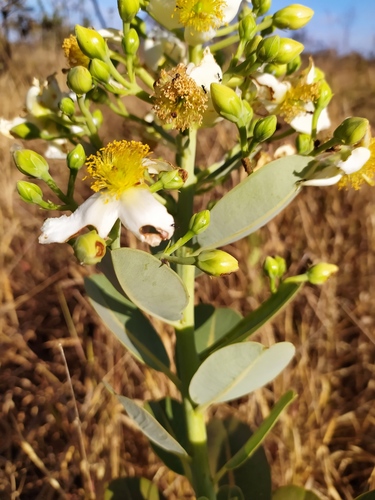
iNaturalist· cc-by
(c) Eduardo Chacón Madrigal, some rights reserved (CC BY), uploaded by Eduardo Chacón Madrigal
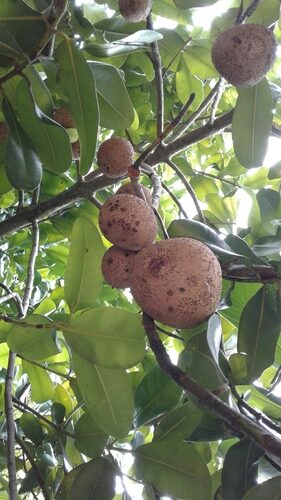
iNaturalist· cc-by-nc
(c) Paul Foster, some rights reserved (CC BY-NC)
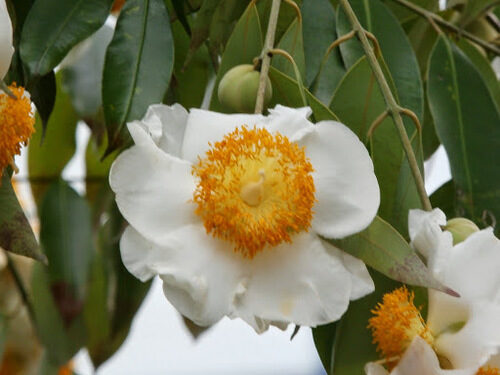
iNaturalist· cc-by-nc
(c) Paul Foster, some rights reserved (CC BY-NC)
Summary
Source: WikipediaSymphonia globulifera, commonly known as boarwood, is a timber tree abundant in Central America, the Caribbean, South America and Africa. This plant is also used as a medicinal plant and ornamental plant.
Description
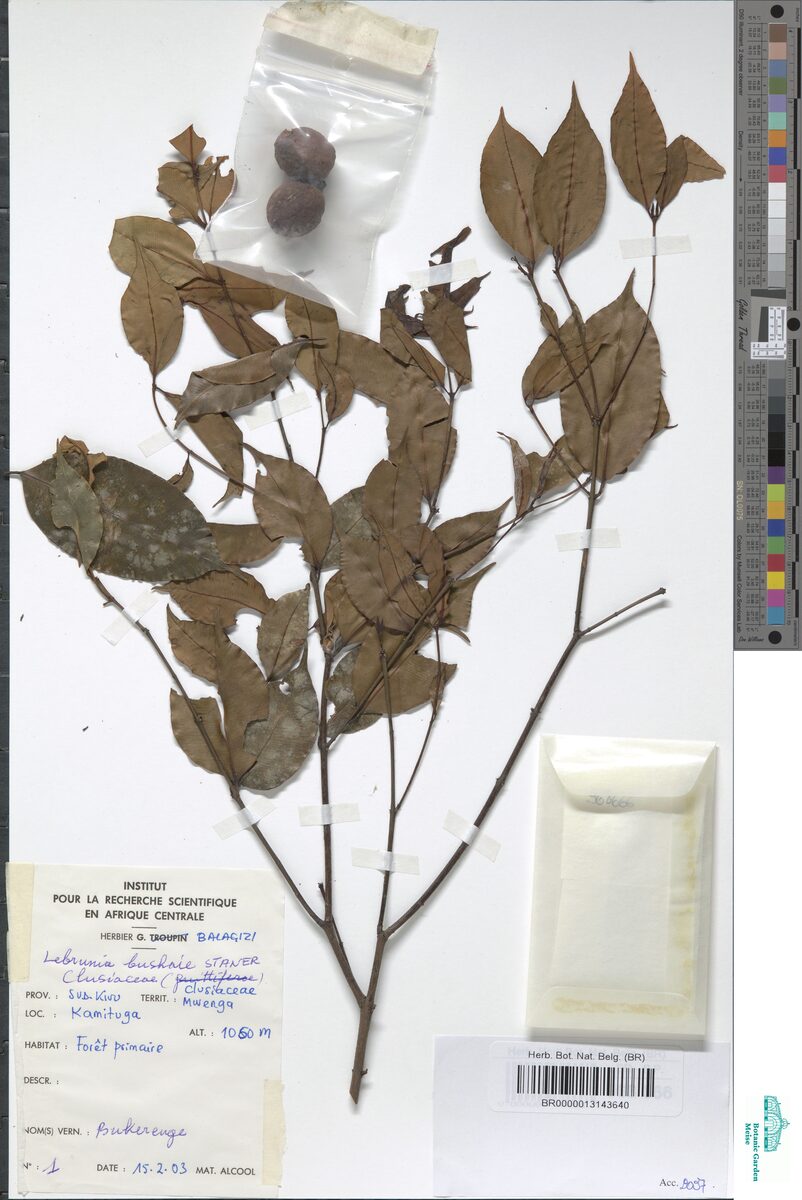
A tree. It grows 15-30 m tall. The trunk is straight. The crown has short horizontal branches. The bark is smooth and dark brown. The branches have grooves along them. The leaves are leathery. The leaf blade is 5-12 cm long by 2-4 cm wide. It tapers to the tip and is wedge shaped at the base. Leaves are paler underneath. The flowers occur as many together. They are at the ends of short branches. The petals are bright red or yellow. The fruit is a berry 15-35 mm across. It is red but turns brown. It has 1-2 seeds. The seeds are 15-20 mm long and flattened.
Edible Uses
Fruit - raw. A fleshy, acidulous, pleasantly tasting pericarp. The fruits, which are filled with a yellow resin, are the size of a pigeon's egg.
Medicinal Uses
The bark is taken as an appetizer, gentle laxative, stomachic and tonic. An extract of the bark is used to treat river blindness; coughs in children. The bark is used as an emetic to treat chest complaints. It is used as a gentle laxative for pregnant women. The boiled bark and roots are used as a wash to treat itch. An infusion of the bark is used to bathe ulcers. The resin is diuretic. It is taken internally to treat gonorrhoea. The resin is used externally to treat wounds; prevent skin infections and treat scabies. The latex is applied in a wrap on various dermatoses, particularly eczematous ones. When burned to ashes and then applied to recalcitrant ulcers of the abdomen and legs, the resinous latex is very effective in rapidly drying the infection. Sap from the leaves is sniffed up the nose to stop it bleeding.
Distribution
It is a tropical plant. It grows in muddy forest swamps. It is along rivers and on the edges of forests. In Nigeria it is recorded at 600-1,800 m above sea level.
Where It Grows
Africa, Angola, Belize, Bolivia, Brazil, Burundi, Cabinda, Cameroon, Central Africa, Central America*, Chad, Colombia, Congo DR, Congo R, Costa Rica, East Africa, Ecuador, El Salvador, Equatorial Guinea, Gabon, Guatemala, French Guiana, Guianas, Guinea-Bissau, Guyana, Haiti*, Honduras, Ivory Coast, Jamaica, Lesser Antilles, Liberia, Mexico, Nicaragua, Nigeria, North America, Panama, Peru, Rwanda, Sao Tome and Principe, Sierra Leone, South America*, Suriname, Tanzania, Trinidad-Tobago, Uganda, Venezuela, West Africa, West Indies*, Zambia,
Cultivation
Plants can be grown from seeds. They are put in hot water that is then allowed to cool and they are soaked overnight. The seeds can be planted directly or put in a nursery and transplanted.
Propagation
Seed - best sown as soon as it is ripe, when it germinates in less than 30 days in natural conditions at temperatures around 25 - 30°c. The seed requires shade for germination, and in closed forest propagation is by seed only; in open areas propagation is exclusively by root suckers. Young seedlings are shade tolerant, but require more light to grow and develop as they grow larger. The seed dies quickly upon dehydration, and all seeds die at temperatures below 12°c. Germinated seeds can be stored at 15°c under humid conditions for about a year and seedlings kept at this temperature develop slowly but resume normal growth when transferred to 25°c.
Other Uses
The bark and fruit contain a yellowish resin that becomes black and pitch-like upon exposure to air. It is used in some regions for caulking boats. The resin is used for making candles and torches. A cotton cord, well soaked into the freshly extracted resin and dried, is used as a torch which burns with a bright yellow light. A latex obtained from the bark is used as wax. The resin yields an ammonia-soluble khaki dye. The latex is hardened, burnt and the ash is used as paint The heartwood is yellowish, greyish, or greenish brown, with a somewhat mealy appearance; it is clearly demarcated from the 4 - 8cm wide band of whitish sapwood. The texture is medium; the grain straight or irregular; lustre medium to high; when freshly cut, the wood has a 'tarry' odour, but seasoned wood is free of any distinctive odour or taste. The wood is moderately hard and moderately heavy; it is moderately durable in the soil and has good durability in water, though it is susceptible to termites. The wood seasons at a normal rate, but with a high risk of checking and distortion; once dry it is poorly stable in service. It is very easy to work, hardly dulling cutting edges, although it is somewhat harsh and splintery; in general it may be sawed, planed, turned, shaped, and bored without difficulty; it takes a high polish; nailing and screwing are good, but require pre-boring; gluing is correct. It is used for construction, flooring, panelling, carpentry, crates and boxes, railway sleepers etc. The wood is used for fuel.
Synonyms
Also Known As
Aopo, Barillo, Beek, Ccoqqui quini'cco, Cerillo, Cero, Kisongi, Machaachi, Mangle jaune, Mulungu, Muzimba, Nsongi, Ntadia ngombo, Omando te'ta, Punkara kaspi, Umushishi
References (15)
- Bendezu, Y. F., 2018, Arboles nativos de lad Region Ucayali. Instituto Nacional de Innovacion Agraria. p 96
- Chapman, J. D. & Chapman, H. M., 2001, The Forest Flora of Taraba and Andamawa States, Nigeria. WWF & University of Canterbury. p 178
- Condit, R., et al, 2011, Trees of Panama and Costa Rica. Princeton Field Guides. p 136
- Flora Zambesiaca. http://apps.kew.org/efloras
- Flores, Y., 2018, Arboles nativos de la Region Ucayili. Estacion Experimental Agragia Pucallpa. Pucallpa Peru, 375 p. p 95
Show all 15 references Hide references
- Fowler, D. G., 2007, Zambian Plants: Their Vernacular Names and Uses. Kew. p 18
- Grandtner, M. M., 2008, World Dictionary of Trees. Wood and Forest Science Department. Laval University, Quebec, Qc Canada. (Internet database http://www.wdt.qc.ca)
- Grandtner, M. M. & Chevrette, J., 2013, Dictionary of Trees, Volume 2: South America: Nomenclature, Taxonomy and Ecology. Academic Press p 642
- Kermath, B. M., et al, 2014, Food Plants in the Americas: A survey of the domesticated, cultivated and wild plants used for Human food in North, Central and South America and the Caribbean. On line draft. p 845
- Kew Plants of the World Online
- Latham, P., 2004, Useful Plants of Bas-Congo province. Salvation Army & DFID p 268
- Lopez-Diago, D. & Garcia, N., 2021, Wild edible fruits of Colombia. Biota ColomBiana 22 (2) p 35
- Mangambu Mokoso Jean De Dieu, et al, 2015, Etudes ethnobotanique et ethnolinguistique des ressources forestieres ligneuses utilisees par la population du coulour Ecologique du Parc National de Kahuzi-biega (R. D. Congo). European Journal of Scientific Research May 2015.
- Plants of Haiti Smithsonian Institute http://botany.si.edu/antilles/West Indies
- Torre, de la, L., et al, 2008, Enciclopedia de las Plantas Útiles del Ecuador. Herbario QCA. Pontificia Universidad Católica del Ecuador. p 287