Ficus citrifolia
Mill.
Short leaf fig
iNaturalist· cc-by-nc
(c) Juan Gabriel, some rights reserved (CC BY-NC), uploaded by Juan Gabriel
iNaturalist· cc-by-nc
(c) Juan Gabriel, some rights reserved (CC BY-NC), uploaded by Juan Gabriel
Summary
Source: WikipediaFicus citrifolia, also known as the shortleaf fig, giant bearded fig, Jagüey, wild banyantree and Wimba tree, is a species of banyan native to southern Florida, the Caribbean, Mexico, Central America, and northern South America south to Paraguay. It is distinguished from the closely related Florida strangler fig (Ficus aurea) mainly by the finer veining in the leaves.
Description
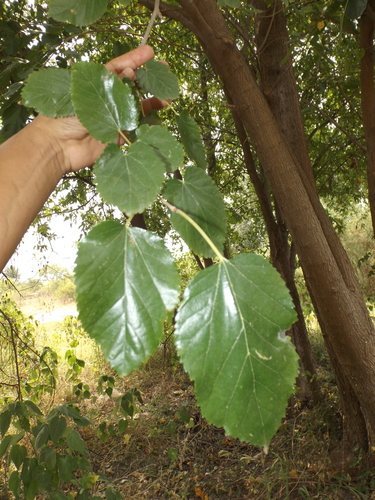
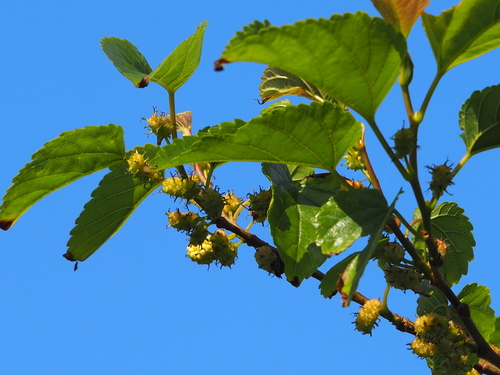
A fig. It is a straggling tree. It grows 15 m tall. It can spread over a wide area with aerial roots. The leaves are dark green. They are oval shaped with a rounded base and pointed tip. The flowers are small and enclosed in the open ended fruit. The fruit are on the end of long stalks from the axils of leaves. They are round or oval and 6-12 mm long. The fruit turn yellow to dark red when ripe. The fruit is sweet.
Edible Uses
Fruit - raw. Fleshy, but with very little flavour. The roundish fruit is greenish, often brown dotted, turning reddish and brownish at maturity, about 10mm in diameter.
Traditional Uses
The fruit are eaten raw. They have little taste.
This uses section is brief — help expand it
Distribution
It is a tropical plant. In Argentina it grows from sea level to 1,500 m above sea level.
Where It Grows
Anguilla, Antigua and Barbuda, Argentina, Bahamas, Belize, Bolivia, Brazil, Central America, Chad, Colombia, Costa Rica, Cuba, Dominican Republic, El Salvador, Guadeloupe, Guatemala, Haiti, Honduras, Lesser Antilles, Mexico*, Nicaragua, Nigeria, North America, Panama, Paraguay, Puerto Rico, South America*, St. Kitts and Nevis, USA, West Indies*,
Cultivation
Plants can be grown from cuttings.
Other Uses
The sapwood is whitish, and the heartwood light brown. The wood is fairly light in weight, soft, yet tough and strong for its weight. Nevertheless, it is not durable and is very susceptible to attack by dry-wood termites. The rate of air-seasoning is slow, and amount of degrade is minor.Machining characteristics are as follows: planing and sanding are good; shaping, turning, boring, and mortising are poor; and resistance to screw splitting is excellent. It is used for making guitars and is suitable for boxes, crates, interior construction, and light carpentry. The wood is used for fuel. The plants make excellent live fences because they root so readily from cuttings.
Synonyms
Also Known As
Ateniu, Guapoi, Jaguey blanco
References (11)
- Carretero, A. L., 2005, Useful Plants and traditional knowledge in the Tucumano-Boliviano Forest. M. Sc. Thesis Institute of Biological Science University of Aarhus, Denmark p 54 (As Ficus aff. guaranitica)
- Fouqué, A. 1972. Espèces fruitières d'Amérique tropicale. Institut français de recherches fruitierès outre-mer
- Garba, A., Useful Plants in the Chad region of North-East Nigeria. p 116 (As Ficus syringifolia)
- Grandtner, M. M. & Chevrette, J., 2013, Dictionary of Trees, Volume 2: South America: Nomenclature, Taxonomy and Ecology. Academic Press p 252
- Kermath, B. M., et al, 2014, Food Plants in the Americas: A survey of the domesticated, cultivated and wild plants used for Human food in North, Central and South America and the Caribbean. On line draft. p 370
Show all 11 references Hide references
- Little, E. L. & Wadsworth, F. H., 1964, Common Trees of Puerto Rico and the Virgin Islands. USDA Agriculture Handbook No. 249
- Piedra-Malagon, E. M., et al, 2006, El Genero Ficus (Moraceae) en al estado de Morelos, Mexico. Acta Botanica Mexicana 75:45-75
- Plants of Haiti Smithsonian Institute http://botany.si.edu/antilles/West Indies
- Reis, S. V. and Lipp, F. L., 1982, New Plant Sources for Drugs and Foods from the New York Botanical Garden herbarium. Harvard. p 41
- Roa, J. A. G. & Boada, D. S. G., 2018, Fundación para el Fortalecimiento de la Fruticultura y Plantas Alimenticias no Convencionales en Colombia.
- www.colecionandofrutas.org