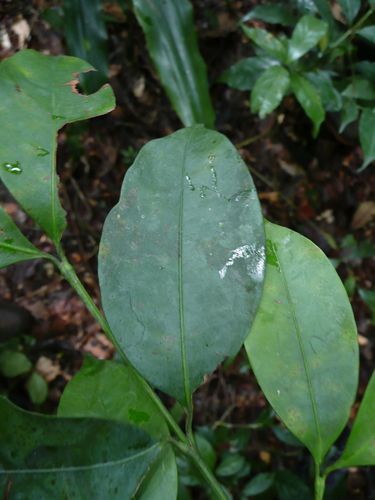
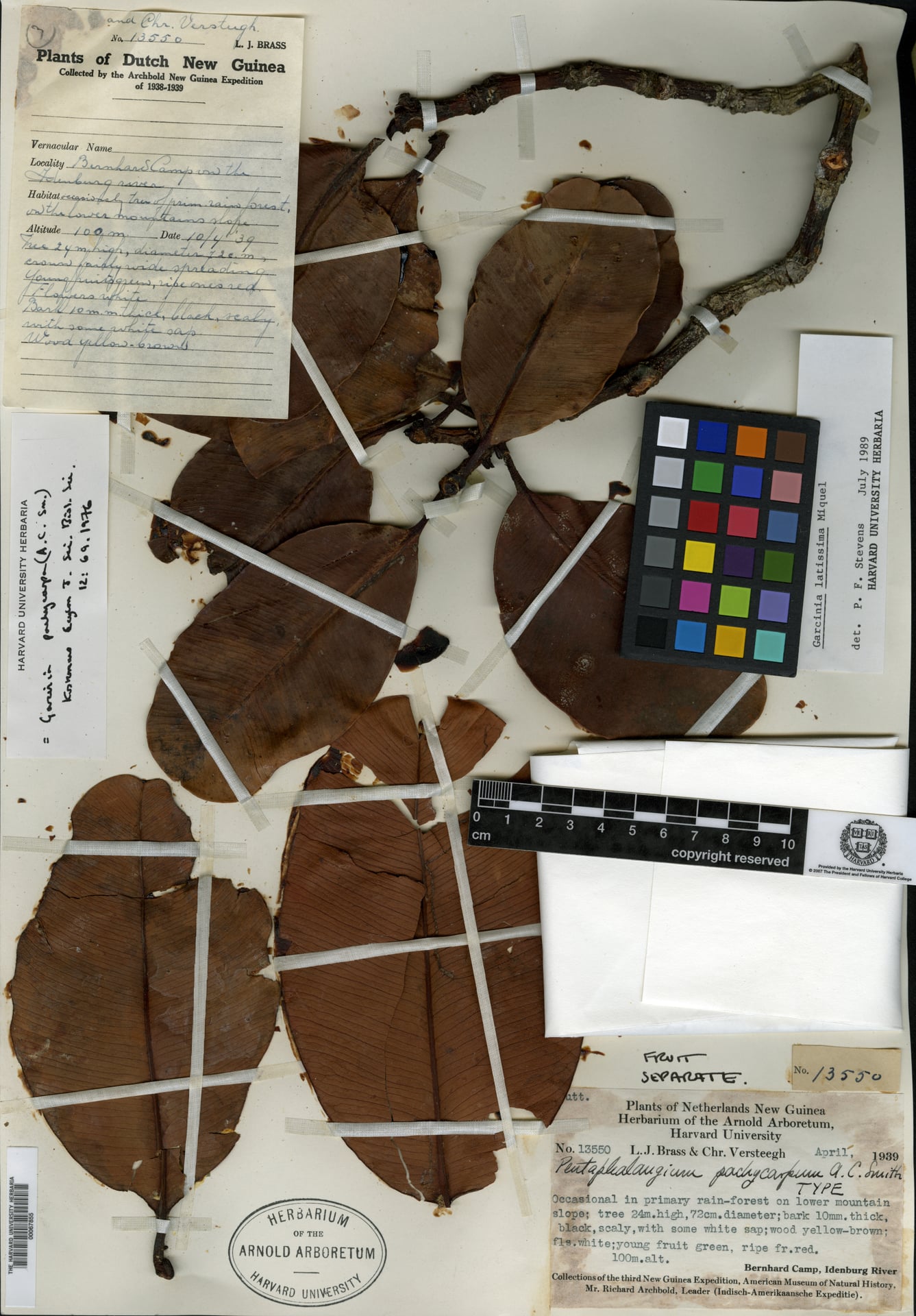
Calophyllum brasiliense
Cambess
Brazil beauty leaf
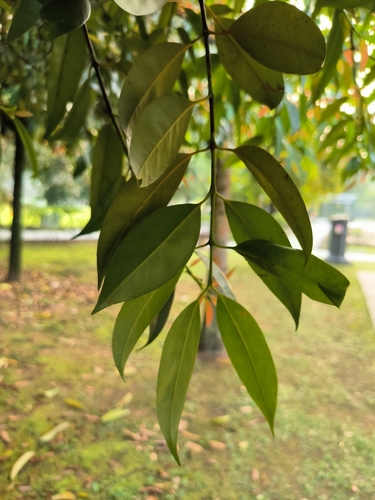
iNaturalist· cc-by-nc
(c) Marcus Athaydes, some rights reserved (CC BY-NC), uploaded by Marcus Athaydes
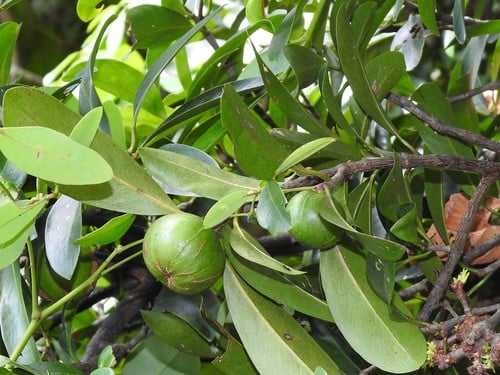
iNaturalist· cc-by-nc-sa
(c) David Kidwell, some rights reserved (CC BY-NC-SA)
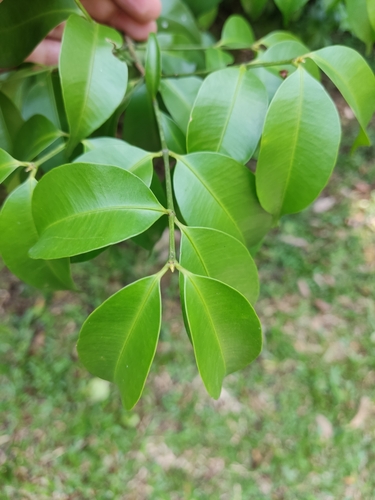
iNaturalist· cc-by-nc
(c) Martin Reith, some rights reserved (CC BY-NC)
Summary
Source: WikipediaCalophyllum brasiliense (guanandi) is a species of plant in the family Calophyllaceae. It is native to subtropical and tropical regions of Mexico, Central America, South America and the Caribbean.
Description
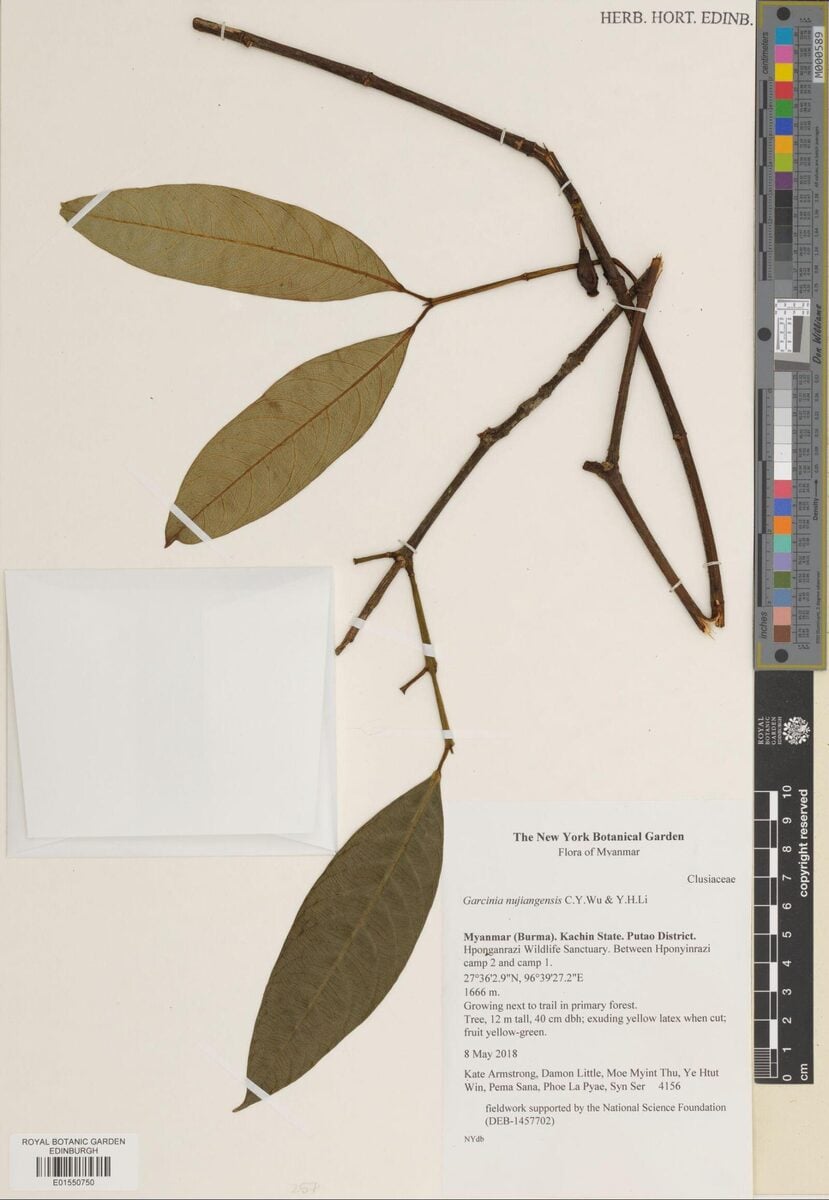
An evergreen tree. It grows 20-50 m tall. The trunk can be 1.8 m across. The crown is dense and rounded. The leaves are opposite. They are 6-13 cm long by 3-6 cm wide. They are oval and leathery. They are shiny green above and more pale underneath. The flowers are 10-13 mm across with 4 white sepals and 4 white petals. The flowers are in groups. The fruit is round and fleshy and up to 3 cm across.
Edible Uses
Edible Parts: Oil Edible Uses: Oil None known
Medicinal Uses
Skin Vermifuge The resin obtained from the crushed or cut bark, called bals'mo de mar'a, has been used medicinally. A decoction of the trunk bark, combined with the root-bark of Coutarea hexandra, is used as an antidiabetic and vermifuge. The plant (part not specified) is used to dress sores, and as a headache remedy. The plant contains xanthones, including guanandine, isoguanandine and jacareubine.
Known Hazards
The fruit is poisonous.
Distribution
It is a tropical plant.
Where It Grows
Amazon, Belize, Bolivia, Brazil, Central America, Colombia, Costa Rica, Cuba, Dominican Republic, El Salvador, French Guiana, Guatemala, Guianas, Guyana, Haiti, Honduras, Jamaica, Mexico, Nicaragua, North America, Panama, Paraguay, Peru, Puerto Rico, South America, Suriname, Trinidad & Tobago, USA, Venezuela, West Indies,
Cultivation
Brazil beauty leaf grows in the moister lowland and lower montane areas of the tropics, where it is found at elevations up to 1,500 metres. It grows best in areas where annual daytime temperatures are within the range 20 - 30°c, but can tolerate 15 - 38°c. It prefers a mean annual rainfall in the range 1,500 - 6,000mm, but tolerates 1,200 - 7,000mm. Succeeds in full sun or partial shade. A very tolerant plant, it occurs in nearly all the soil types. It seems to grow best on wet, humid, sites, but also grows well on pure sand and rock sandstone. In Puerto Rico, it occurs naturally on the north coast on sandy soils of the orders inceptisols, oxisols and alfisols. It has been planted on deep clays and serpentine soils in the mountains, and in shallow limestone soils near the coast. It does well on degraded sites, and is very resistant to salt and salt-laden winds. Established plants are very drought tolerant. Some trees bear fruit when only 3 years old.
Propagation
Seed - the tough endocarp inhibits water uptake and so germination will be hastened if this is broken with a hammer prior to sowing. Fresh seeds can be sown in situ directly into the soil, or in a seedbed. Average germination is about 70%. Seedlings transplant successfully when they are moved with a ball of earth, a task best carried out in the rainy season. Seeds stored for 1 year in a dry room have germinated fairly well. Fruits should not be stored at a temperature below 0°c., and the water content of the fruit should not be lower than 35%.
Other Uses
Essential Furniture Oil Soil reclamation Soil stabilization Wood Other uses rating: High (4/5). Agroforestry Uses: In the West Indies, it is planted as a shade tree for coffee and cacao and for windbreaks. It has been used to stabilize soils and to relieve soil compaction in degraded pastures. Other Uses: Oil has been extracted from the seeds. A yellowish-green essential oil is obtained from the wood, called Sandalo Ingles in Brazil. The heartwood is pink or yellowish pink to brick red or rich reddish-brown, marked with fine darker red striping; the 5 - 7cm wide band of sapwood is lighter in colour but not always clearly differentiated. The texture is medium and fairly uniform; the grain is generally interlocked but sometimes is straight; lustre is medium; odour and taste are not distinctive. The wood is moderately heavy; soft to moderately hard; strong, and fairly durable, being resistant to fungi and dry wood borers, though very susceptible to attack by dry-wood termites and not resistant to marine bores. It is rather slow to season, with a high risk of checking and distortion; once dry it is moderately stable in service. It is rather easy to work, usually yielding smooth surfaces if straight-grained though it usually tears and chips if the grain is interlocked. It is below average in planing, turning and boring; takes nails and screws well so long as it is pre-bored; glues correct. An attractive wood, it is similar to mahogany (Swietenia macrophylla) and has comparable uses. One of the most used woods in the American tropics, it is used for general construction, bridgework, railway ties, general wheelwright's work, dugouts, heavy carts, canoes, general shipbuilding, shingles, flooring, interior construction, and furniture. It is a good general utility wood where a fairly strong and moderately durable timber is required. The wood produces a fair quality face veneer but is not used extensively for this purpose because of the mechanical problems in veneer-cutting operations. Special Uses Food Forest
Notes
There are about 187-200 Calophyllum species. They are evergreen trees of the tropics.
Synonyms
Also Known As
Aceite, Buri, Cachicama, Calambuca, Capure, Cedro, Cojon, Guanandi
References (5)
- Bortolotto, I. M., et al, 2018, Lista preliminar das plantas alimenticias nativas de Mato Grosso do Sul, Brasil. Iheringia, Serie Botanica, Porto Alegre, 73 (supl.):101-116
- Grandtner, M. M., 2008, World Dictionary of Trees. Wood and Forest Science Department. Laval University, Quebec, Qc Canada. (Internet database http://www.WDT.QC.ca)
- Grandtner, M. M. & Chevrette, J., 2013, Dictionary of Trees, Volume 2: South America: Nomenclature, Taxonomy and Ecology. Academic Press p 91
- Roa, J. A. G. & Boada, D. S. G., 2018, Fundación para el Fortalecimiento de la Fruticultura y Plantas Alimenticias no Convencionales en Colombia.
- www.colecionandofrutas.org