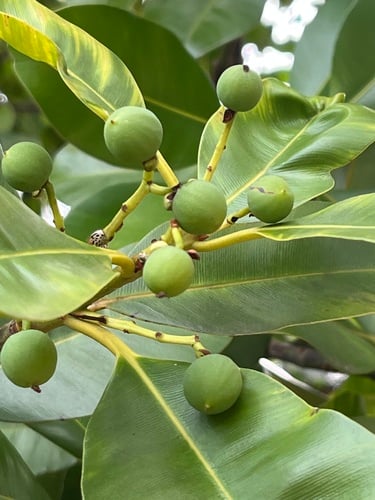
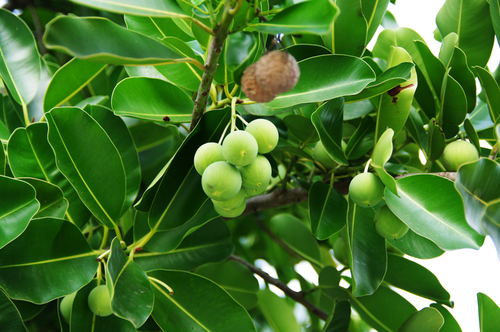
Garcinia parvifolia
(Miq.) Miq.
Brunei cherry
iNaturalist· cc-by-nc-sa
(c) Min Sheng Khoo, some rights reserved (CC BY-NC-SA)
iNaturalist· cc-by-nc-nd
(c) loupok, some rights reserved (CC BY-NC-ND)
Summary
Source: WikipediaGarcinia parvifolia, the Kundong, Kumanjing, Brunei cherry or Asam aur aur, is a tropical evergreen tree native to Borneo, Peninsular Malaysia, Sulawesi and Sumatra. The tree is found at elevations of 600–800 metres (2,000–2,600 ft) in humid environments, and grows to a height of 33 metres (108 ft). The bark, wood, leaves, and fruit of the kundong tree are used by humans.
Description
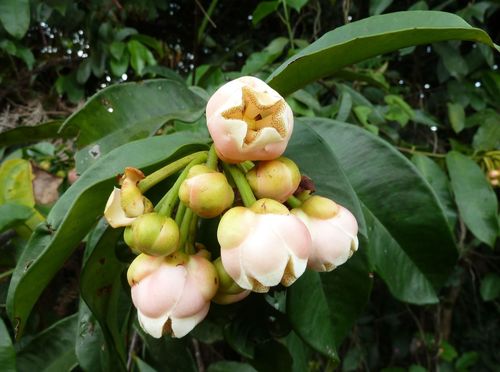
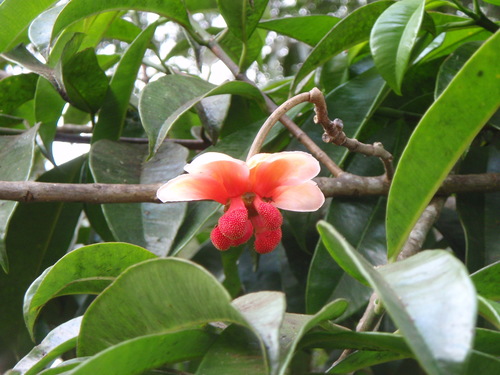
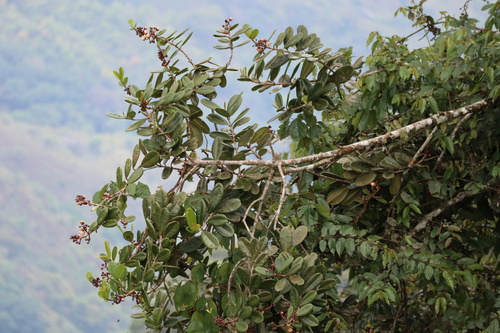
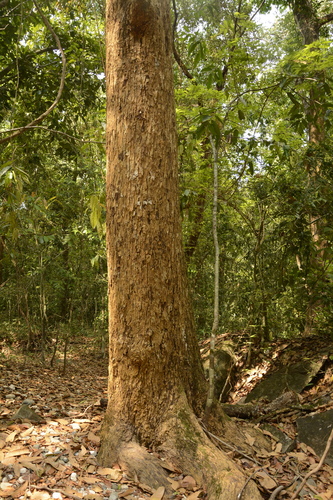
It is a small to medium sized tree. It can grow 25 m tall. The stem have white to yellow latex. The leaves are opposite and simple. The flowers are 9 mm across. The fruit are cherry sized with red to yellow skin. They are about 2 cm across. The pulp is white and juicy and slightly tart.
Edible Uses
The fruit are eaten fresh and are often eaten by children. Young fruit are sliced and sun-dried to make a sour condiment. The dried red rind is used to flavour curries and other dishes requiring a sour flavour, and the fruit also flavours other foods.
Traditional Uses
Fruit are eaten fresh. They are sour. They are also used to flavour other foods. The young fruit are sliced and sun dried and used as a sour condiment. The dried red rind is used to flavour curries and other dishes with a sour flavour.
Distribution
A tropical plant. It grows in forest up to 800 m above sea level. It grows on hillsides and along rivers.
Where It Grows
Asia, Brunei, Indochina, Indonesia, Malaysia, New Guinea, SE Asia, Singapore, Thailand,
Cultivation
Plants are grown from seed.
Propagation
Seed - we have no specific information on this species, but the seed of most members of the genus can be slow to germinate, even if sown fresh, often taking 6 months or more.
Other Uses
The plant is sometimes used as a rootstock for the mangosteen (Garcinia mangostana). The tree is a source of resin. The wood is used.
Other Information
The fruit are often eaten by children.
Notes
There are about 300 Garcinia species.
Synonyms
Also Known As
Asam aur aur, Asam kandis, Asam kundong, Bua lipau, Buah kuno, Bunog, Ceuri, Cha muang, Cirei, Kandis, Kandis burung, Kayu mein, Kecii, Kenis, Kundong, Manggis hutan, Sempat tebu
References (23)
- Ann. Mus. Bot. Lugduno-Batavum 1:208. 1864
- Burkill, I.H., 1966, A Dictionary of the Economic Products of the Malay Peninsula. Ministry of Agriculture and Cooperatives, Kuala Lumpur, Malaysia. Vol 1 (A-H) p 1073 (Also as Garcinia globulosa p 1066)
- Chai, P. P. K. (Ed), et al, 2000, A checklist of Flora, Fauna, Food and Medicinal Plants. Lanjak Entimau Wildlife Sanctuary, Sarawak. Forestry Malaysia & ITTO. p 170
- Chai, P.P.K., 2000, Development of the Lanjak Entimau Wild life sanctuary. Final report. ITTO and Sarawak Forestry. p 19
- Facciola, S., 1998, Cornucopia 2: a Source Book of Edible Plants. Kampong Publications, p 79
Show all 23 references Hide references
- Giesen, W., 2013, Paludiculture: sustainable alternatives on degraded peat land in Indonesia (revised draft)
- Hariyadi, B., 2008, The Entwined Tree: Traditional Natural Resource Management of Serampas, Jambi, Indonesia. Ph. D thesis. Univ. or Hawaii. p 402
- Hoare, A., 2003, Food use of the Lundayeh SW Sabah. Borneo Research Council.
- Milow, P., et al, 2013, Malaysian species of plants with edible fruits or seeds and their evaluation. International Journal of Fruit Science. 14:1, 1-27
- Ong, H. C., Mojiun, P. F. J., & Milow, P., 2011, Traditional knowledge of edible plants among the Temuan villagers in Kampung Guntor, Negeri Sembilan, Malaysia. African Journal of Agricultural Research Vol. 6(8), pp. 1962-1965, 18 April, 2011 (As Garcinia globulosa)
- Owen, S., 1993, Indonesian Food and Cookery, INDIRA reprints. p 47 (As Garcinia globulosa)
- Priyadi, H., et al, 2010, Five hundred plant species in Gunung Halimun Salak National Park West Java. A checklist including Sundanese names, distribution and use. CIFOR, FFPRI, SLU p 61
- PROSEA (Plant Resources of South East Asia) handbook, Volume 2, 1991, Edible fruits and nut. p 177
- Saw, L.G., LaFrankie, J. V. Kochummen, K. M., Yap S. K., 1991, Fruit Trees in a Malaysian Rain Forest. Economic Botany, Vol. 45, No. 1, pp. 120-136
- Septiani, Y. & Sidabutar, H., (Eds.) 2015, Biodiversity Survey. In the Sub Watershed Embaloh, Betung Kerihun National Park. ITTO p 82
- Shaffiq, A. M., A., et al, 2013, Marketable wild fruits of Sarawak, Borneo: Their mode of consumption, uses and sugar profiles. Indian Journal of Traditional Knowledge. Vol 12(2): 195-201
- Siong, K. H., 2003, Indigenous Fruits of Sarawak. ITTO & Sarawak Forest Department. p 49
- Slik, F., www.asianplant.net
- Suwardi, A. B., et al, 2020, Ethnobotany and conservation of indigenous edible fruit plants in South Aceh, Indonesia. Biodiversitas Vol. 21, No. 5, pp 1850-1860
- Uji, T., 2007, Keanekaragaman, Persebaran dan Potensi Jenis-jenis Garcinia. Berk. Penel. Hayati: 12 (129–135), 2007
- Ulian, T., et al, 2020, Unlocking plant resources to support food security and promote sustainable agriculture. Plants, People, Planet. 2020;2:421–445.
- Uphof,
- World Checklist of Useful Plant Species 2020. Royal Botanic Gardens, Kew