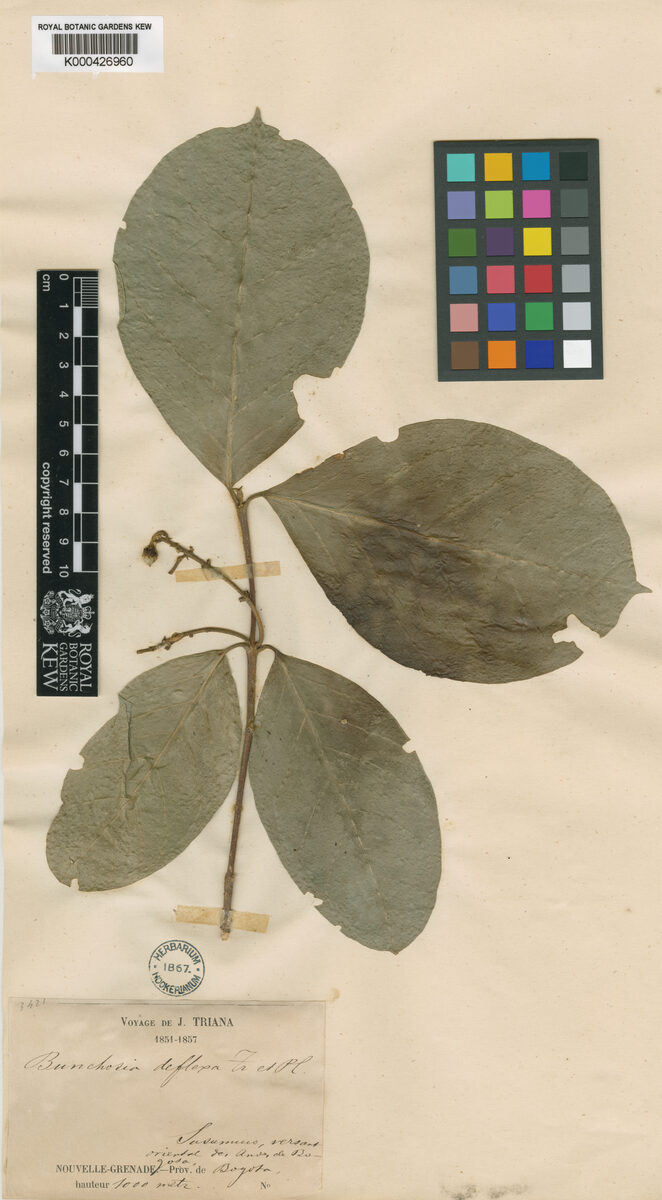
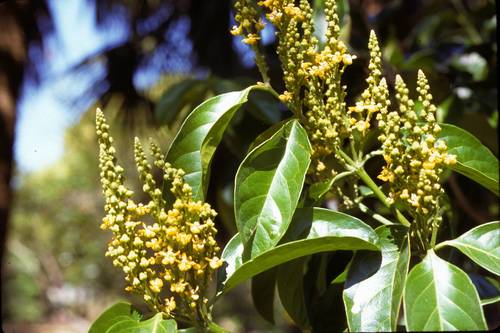
Byrsonima crispa
A. Juss.
Crisped byrsonima
No photos yet for Byrsonima crispa
Sign in to contribute a photoDescription
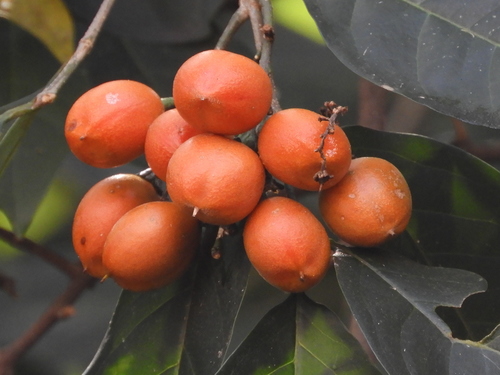
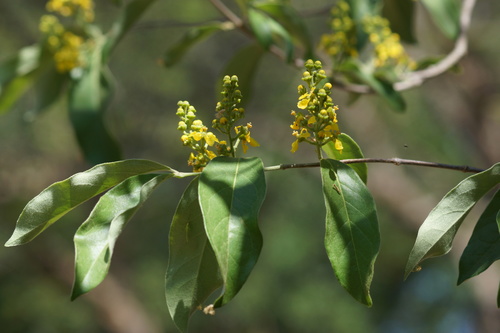
A bush or small tree. The leaves are oblong or sword shaped. The leaves are papery. The fruit are small and yellow.
This description is brief — help expand it
Edible Uses
The fruit pulp is eaten raw and used to make preserves.
Traditional Uses
The pulp of the fruit is eaten raw. They are also used for preserves.
This uses section is brief — help expand it
Distribution
It is a tropical plant.
Where It Grows
Amazon, Bolivia, Brazil, Central America, Colombia, Costa Rica, Guiana, Nicaragua, Panama, Peru, South America, Venezuela,
Other Uses
The wood (probably the bark) contains tannin and can be used as a dye. The wood is used for internal construction.
Notes
There are 127 Byrsonima species. They grow in tropical America.
Synonyms
Also Known As
Manteco de agua, Muruci da mata, Murici-vai, Nancite macho
References (12)
- Bircher, A. G. & Bircher, W. H., 2000, Encyclopedia of Fruit Trees and Edible Flowering Plants in Egypt and the Subtropics. AUC Press. p 71
- Cavalcante, P.B., 1991, Frutas comestíveis da Amazônia. Edições CEJUP
- Ferns, Useful Tropical Plants
- Grandtner, M. M., 2008, World Dictionary of Trees. Wood and Forest Science Department. Laval University, Quebec, Qc Canada. (Internet database http://www.WDT.QC.ca)
- Grandtner, M. M. & Chevrette, J., 2013, Dictionary of Trees, Volume 2: South America: Nomenclature, Taxonomy and Ecology. Academic Press p 83
Show all 12 references Hide references
- Kermath, B. M., et al, 2014, Food Plants in the Americas: A survey of the domesticated, cultivated and wild plants used for Human food in North, Central and South America and the Caribbean. On line draft. p 154
- Kew Plants of the World On line
- Lopez-Diago, D. & Garcia, N., 2021, Wild edible fruits of Colombia. Biota ColomBiana 22 (2) p 41
- Paz, F. S., et al, 2021, Edible Fruit Plant Species in the Amazon Forest Rely Mostly on Bees and Beetles as Pollinators. Journal of Economic Entomology, XX(XX), 2021, 1–13
- Roa, J. A. G. & Boada, D. S. G., 2018, Fundación para el Fortalecimiento de la Fruticultura y Plantas Alimenticias no Convencionales en Colombia.
- Villachica, H., 1996, Frutales y hortalizas promisorios de la Amazonía. Tratado de Cooperación Amazónica
- www.colecionandofrutas.org