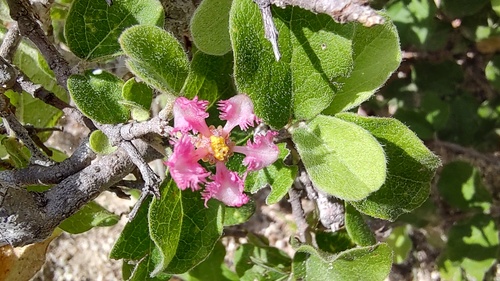
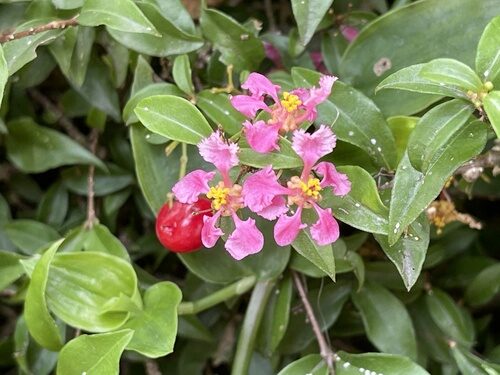
Bunchosia glandulifera
(Jacq.) Kunth
Cafe falso
iNaturalist· cc-by-nc-sa
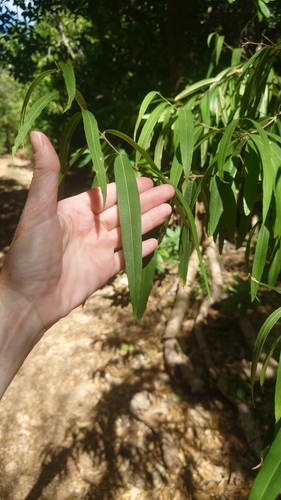
(c) Smithsonian Institution, National Museum of Natural History, Department of Botany, some rights reserved (CC BY-NC-SA)
iNaturalist· cc-by-nc
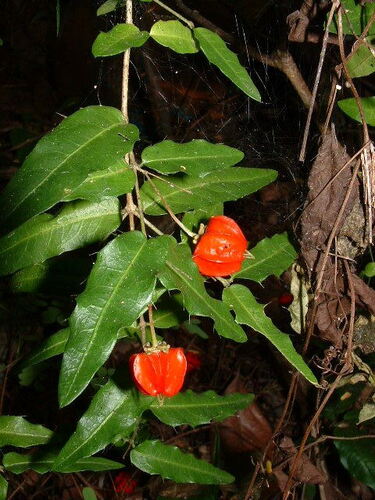
(c) akarena, some rights reserved (CC BY-NC)
Summary
Source: WikipediaBunchosia glandulifera, commonly known as peanut butter fruit, is a species of flowering plant in the acerola family, Malpighiaceae, that is native to Central America and South America. It produces small orange-red fruits of sticky and dense pulp, with a flavour and aroma resembling that of peanut butter. It is mostly eaten fresh, but is also used for jellies, jams or preserves. The superficial appearance of the berries are similar to coffee and in Brazil is accordingly called caferana or falso guarana. Bunchosia glandulifera has been introduced to the U.S. horticulture as Bunchosia argentea and was further distributed under this name.
Description
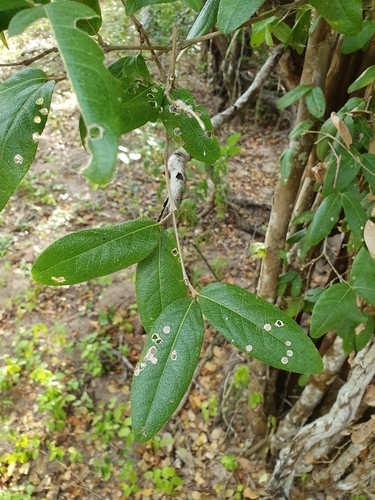
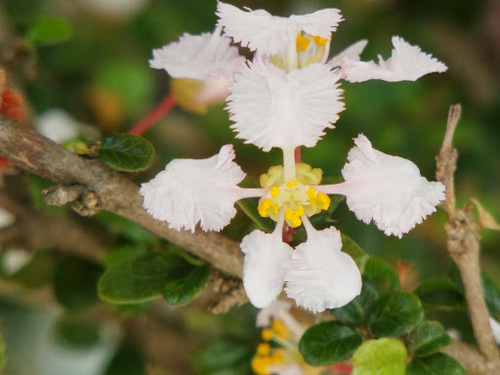
A shrub or small tree. It grows 5 m high. The leaves are opposite and simple. The flowers are yellow. The fruit are the size of a small plum.
This description is brief — help expand it
Edible Uses
The fruit are probably used as a coffee substitute.
Traditional Uses
Probably used as coffee.
This uses section is brief — help expand it
Distribution
A tropical plant. It needs a temperature above 15°C.
Where It Grows
Antigua, Antilles, Australia, Bolivia, Brazil, Colombia, Cuba, Dominican Republic, Ecuador, Guadeloupe, Guiana, Guianas, Haiti, Hispaniola, Martinique, Peru, Puerto Rico, South America, Suriname, Venezuela, West Indies,
Other Information
It is cultivated.
Notes
There are 68 Bunchosia species. It is the floral emblem of Puerto Rico.
Synonyms
Also Known As
Cerezo, Cerezo de fraile, Ciruela, Ciruelo, Hobo fraile, Mermelada
References (14)
- Altschul, S.V.R., 1973, Drugs and Foods from Little-known Plants. Notes in Harvard University Herbaria. Harvard Univ. Press. Massachusetts. no. 2067
- Bendezu, Y. F., 2018, Arboles nativos de lad Region Ucayali. Instituto Nacional de Innovacion Agraria. p 186
- Bernal,R., et al, (Eds), 2016, Catalogo de Plantas y Liquenes de Colombia, Volumen 11, Magnoliaceae a Zygophyllaceae. Universidad Nacional de Colombia. p 1515
- Bircher, A. G. & Bircher, W. H., 2000, Encyclopedia of Fruit Trees and Edible Flowering Plants in Egypt and the Subtropics. AUC Press. p 69
- Flores, Y., 2018, Arboles nativos de la Region Ucayili. Estacion Experimental Agragia Pucallpa. Pucallpa Peru, 375 p. p 186
Show all 14 references Hide references
- Grandtner, M. M., 2008, World Dictionary of Trees. Wood and Forest Science Department. Laval University, Quebec, Qc Canada. (Internet database http://www.WDT.QC.ca)
- Grandtner, M. M. & Chevrette, J., 2013, Dictionary of Trees, Volume 2: South America: Nomenclature, Taxonomy and Ecology. Academic Press p 80
- Kermath, B. M., et al, 2014, Food Plants in the Americas: A survey of the domesticated, cultivated and wild plants used for Human food in North, Central and South America and the Caribbean. On line draft. p 151
- NYBG herbarium "edible" (Also as Bunchosia emarginata var. martinicensis)
- Roa, J. A. G. & Boada, D. S. G., 2018, Fundación para el Fortalecimiento de la Fruticultura y Plantas Alimenticias no Convencionales en Colombia.
- Smith, N., Mori, S.A., et al, 2004, Flowering Plants of the Neotropics. Princeton. p 232
- Torre, de la, L., et al, 2008, Enciclopedia de las Plantas Útiles del Ecuador. Herbario QCA. Pontificia Universidad Católica del Ecuador. p 410
- F. W. H. A. von Humboldt et al., Nov. gen. sp. 5:119[folio]; 5:154[quarto]. 1822
- Zambrana, P, et al, 2017, Traditional knowledge hiding in plain sight – twenty-first century ethnobotany of the Chácobo in Beni, Bolivia. Journal of Ethnobiology and Ethnomedicine (2017) 13:57