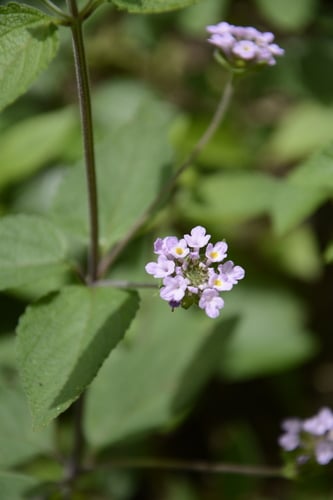
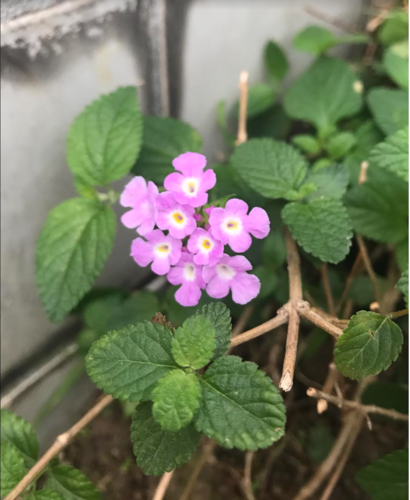
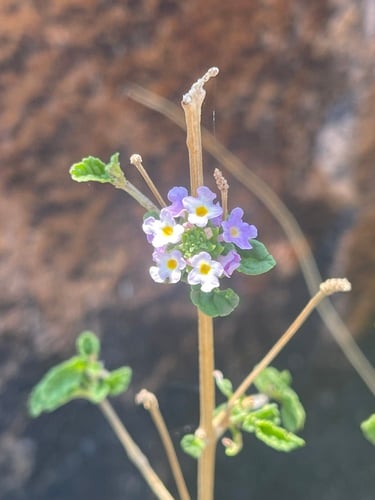
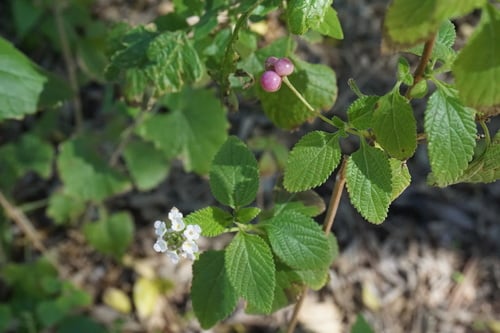
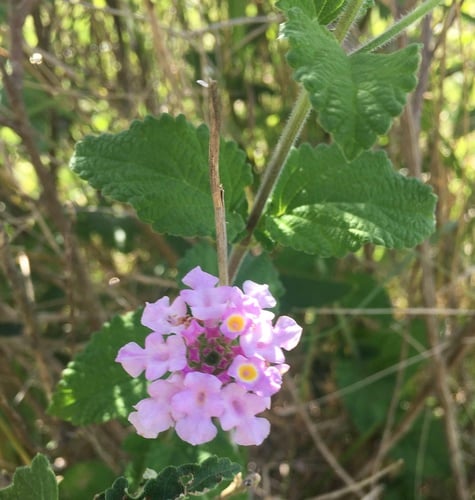
Lantana angolensis
Moldenke
Bird's brandy, Mauve lantana
iNaturalist· cc-by-nc
(c) Octávio Mateus, some rights reserved (CC BY-NC), uploaded by Octávio Mateus
iNaturalist· cc-by-nc
(c) Bart Wursten, some rights reserved (CC BY-NC)
iNaturalist· cc-by-nc
(c) Bart Wursten, some rights reserved (CC BY-NC)
Description
A shrub. It grows 1.5 m tall. It can be a bushy herb 20-70 cm high. There are several stems from a woody rootstock. The leafy branches are often short and have leaves crowded together. The leaves are 3-6 cm long by 2-3 cm wide. There are teeth around the edge. The flowering spikes are about 1 cm long. The fruit are about 3 mm long by 3 mm wide. They are dark purple when mature.
Edible Uses
The fruit are eaten raw.
Traditional Uses
The fruit are eaten raw.
This uses section is brief — help expand it
Known Hazards
Most of the plants sold as lantana are either Spanish flag (species of section Lantana and their hybrids, including L. camara, L. depressa, L. hirsuta, L. horrida, L. splendens, L. strigocamara, etc.), or trailing lantana (L. montevidensis). Numerous cultivars of the Spanish flag exist, including 'Irene', 'Christine' and 'Dallas Red' (all tall-growing cultivars) and several recently introduced shorter ones. The shorter cultivars may flower more prolifically than the taller ones. Lantana montevidensis gives blue (or white) flowers all year round. Its foliage is dark green and has a distinct odor. Although lantanas are generally hardy and, being somewhat toxic, usually rejected by herbivores, they may still become infested with pests. The edibility of Lantana berries is contested. Some experts claim Lantana berries are edible when ripe though like many other kinds of fruit, they are mildly poisonous if eaten while still green. Other experts claim that experimental research indicates that both unripe and ripe Lantana berries are potentially lethal, despite the claims by others that ripe berries are not poisonous. Extracts of Lantana camara may be used for protection of cabbage against the aphid Lipaphis erysimi. Tribal people of the MM Hills in southern Karnataka, India, produce roughly 50 different types of furniture from lantana. It is considered a "near match" to the more highly-priced cane and bamboo, while being resistant to sun, rain, and termite damage.
Distribution
It is a tropical plant. It grows in woodlands and on rocky outcrops. It grows between 850-1,500 m altitude. It grows in hot arid places with a marked dry season. It can grow in arid places.
Where It Grows
Africa, Angola, Botswana, Central Africa, East Africa, Malawi, Mozambique, Namibia, South Africa, Southern Africa, Zambia, Zimbabwe,
Notes
There are about 150 Lantana species.
Also Known As
Namandongo, Wildesalie
References (8)
- Flora Zambesiaca. http://apps.kew.org/efloras
- Fowler, D. G., 2007, Zambian Plants: Their Vernacular Names and Uses. Kew. p 85
- Peters, C. R., O'Brien, E. M., and Drummond, R.B., 1992, Edible Wild plants of Sub-saharan Africa. Kew. p 197
- Rodin, 1985,
- Roodt, V., 1998, Trees & Shrubs of the Okavango Delta. Medicinal Uses and Nutritional value. The Shell Field Guide Series: Part 1. Shell Botswana. p 197
Show all 8 references Hide references
- Royal Botanic Gardens, Kew (1999). Survey of Economic Plants for Arid and Semi-Arid Lands (SEPASAL) database. Published on the Internet; http://www.rbgkew.org.uk/ceb/sepasal/internet [Accessed 13th June 2011]
- Ruiters-Welcome, A. K., 2019, Food plants of southern Africa. Ph.D. thesis. Univ. of Johannesburg p 106
- Welcome, A. K. & Van Wyk, B.-E., 2019, An inventory and analysis of the food plants of southern Africa. South African Journal of Botany 122 (2019) 136–179