Celtis africana
Burm. f.
White stinkwood, Common celtis
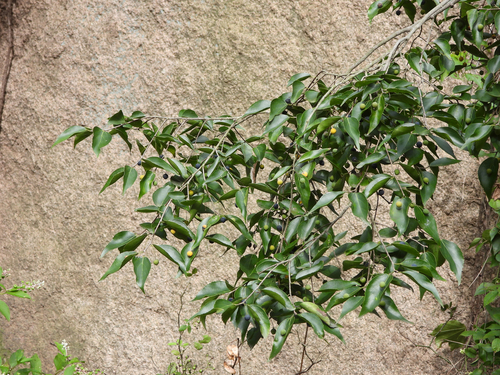
iNaturalist· cc-by-nc
(c) Richard Gill, some rights reserved (CC BY-NC)
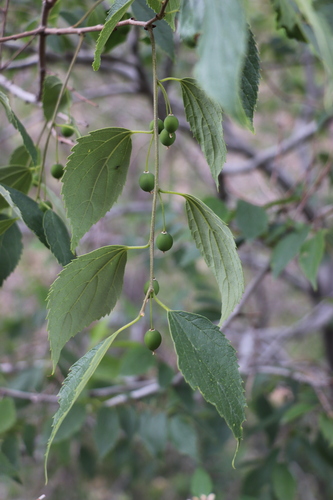
iNaturalist· cc-by-nc
(c) Richard Gill, some rights reserved (CC BY-NC)
iNaturalist· cc-by-nc
(c) Richard Gill, some rights reserved (CC BY-NC)
Summary
Source: WikipediaCeltis africana, the white stinkwood, is a deciduous tree in the family Cannabaceae. Its habit ranges from a tall tree in forest to a medium-sized tree in bushveld and open country, and a shrub on rocky soil. It occurs in Yemen and Somaliland and over large parts of Africa south of the Sahara. It is a common tree in the south and east of southern Africa, where the odour given off by freshly-cut green timber is similar to that of Ocotea bullata or black stinkwood.
Description
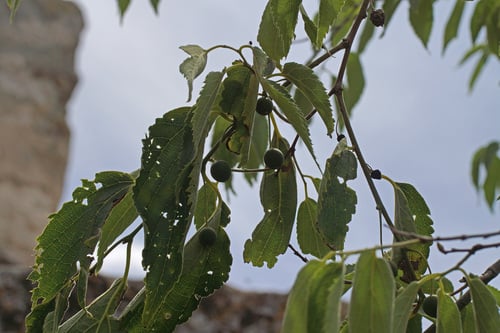
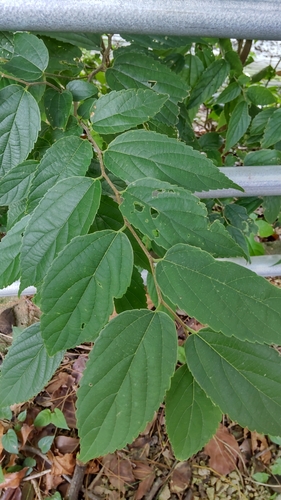
A tall tree. It grows 10-30 m high. It loses its leaves during the year. The trunk is stout. It has small buttresses near the base. The bark is smooth and grey. The wood has an unpleasant smell. The leaves in spring are soft green and then become dark green. The flowers are small and yellow. The fruit are small and round. They are 5-8 mm across and softly hairy. They are yellow or orange.
Edible Uses
The ripe fruit have a small amount of flesh that can be eaten raw. The leaves are used as a vegetable.
Traditional Uses
The ripe fruit have a small amount of flesh that can be eaten raw. The leaves are used as a vegetable.
This uses section is brief — help expand it
Medicinal Uses
Several plant parts are used in traditional medicine. The pounded bark is used to treat fever, headache and general malaise. A leaf decoction is applied to sore eyes. The roots are boiled and the infusion drunk to stop shaking. Unspecified plant parts are used to treat pleurisy. Methanol extracts from leaves and stems have shown significant antioxidant activity, which is likely due to the presence of polyphenolic compounds. Root and leaf extracts showed only slight or no activity on cestodes of the tapeworm Hymenolepis diminuta after one hour, but significant activity after 24 hours.
Known Hazards
The pollen has been recorded as an allergen.
Distribution
It is a tropical plant. It grows in mountain forest. In Malawi it grows between 750-2,200 m altitude. It is drought resistant. It is resistant to frost. It is often in rocky places and near rivers. In Brisbane Botanical Gardens.
Where It Grows
Africa, Angola, Arabia, Australia, Botswana, Central Africa, East Africa, Eswatini, Ethiopia, Ghana, Gibraltar, Kenya, Malawi, Middle East, Mozambique, Saudi Arabia, South Africa, Southern Africa, Sudan, Swaziland, West Africa, Yemen, Zambia, Zimbabwe,
Cultivation
It is easily grown from fresh seeds. It is best to collect seeds from the tree as they are less likely to be damaged by insects. Seeds germinate within 8-30 days.
Propagation
Seed - Fresh seeds germinate within 60 days and may have a high germination rate. Treatment is not necessary, but germination is hastened by soaking stones in cold water for 24 hours before sowing. They can be stored for some time in airtight containers. In South Africa seeds are sown in flat seedling trays filled with a mixture of 5 parts river sand and 1 part well decomposed compost placed in a warm but shaded place. To promote germination, seeds should be covered with a thin layer of river sand and kept moist; under these circumstances germination takes 15 - 30 days with a germination rate up to 70%. It is recommended to transplant seedlings into fertile soil. They should be watered sparingly.
Other Uses
The fibrous bark is often used for making ropes and cloth. The yellowish-white wood is heavy, hard, tough and strong. It is used for planks, yokes, triggers, axe handles, laths, fences, cooperage, railway ties etc. The heartwood is yellowish white or pale brown to greenish brown, occasionally with dark irregular streaks; it is not distinctly demarcated from the whitish sapwood. There is often a dark brown to black stain around the pith. The grain is usually straight, sometimes interlocked; texture fine to moderately coarse and even; when freshly cut, the wood has an unpleasant smell, which has sometimes been described as 'apple-like'. The wood is moderately heavy; moderately hard; strong; tough; of low durability and susceptible to attacks by blue-stain fungi, termites, Lyctus and marine borers. It is fairly easy to saw and work with both machine and hand tools, and has moderate blunting effect on cutting edges; in planing a reduced cutting angle is needed to avoid tearing at surfaces; it takes a good finish with nice polish without the use of a filler; it has good nailing properties, but with some tendency to splitting.; it glues well; boring and mortising should be done with good support.; the bending properties are excellent, but turning properties poor. The wood is used for construction, flooring, joinery, interior trim, mine props, furniture, ladders, toys, novelties, sporting goods, agricultural implements, tool handles, pestles, tent-bows, yokes, wagon-making, spoons, boxes and crates. It is suitable for ship building, railway sleepers, veneer and plywood. The wood is used for fuel and for charcoal production.
Production
It grows quickly. It grows 2 m per year. A fruit weighs about 0.2 g.
Notes
Also put in the family Ulmaceae.
Nutrition
| Part | Moisture | kJ | kcal | Protein | Vit A | Vit C | Iron | Zinc |
|---|---|---|---|---|---|---|---|---|
| Fruit | 51.8 | — | — | 7.7 | — | — | — | — |
Synonyms
Also Known As
Dhawashya, Kamutuna, Liklolo lelikhulu, Liklolo, Luvhambo, Metekoma, Mugara, Muguru, Mukonachando, Mulcherandore, Mumvumvu, Musvutaderere, Pohon kayu putih afrika, Qawo, Umdlawuthu, Umvumvu, Upi, Witstinkhout
References (25)
- Awas, T., 1997, A Study on the Ecology and Ethnobotany of Non-cultivated Food Plants and Wild Relatives of Cultivated crops in Gambella Region, Southwestern Ethiopia. Addis Ababa University. p 72
- Balemie, K., & Kebebew, F., 2006, Ethnobotanical study of wild edible plants in Derashe and Kucha Districts, South Ethiopia. Journal of Ethnobiology and Ethnomedicine.
- Beche D, Gebeyehu G, Feyisa K., 2016, Indigenous Utilization and Management of Useful Plants in and around Awash National Park, Ethiopia. J Plant Biol Soil Health. 3(1):12.
- Berihun, T. & Molla, E., 2017, Study on the Diversity and Use of Wild Edible Plants in Bullen District Northwest Ethiopia. Hindawi Journal of Botany. Article ID 8383468
- Fowler, D. G., 2007, Zambian Plants: Their Vernacular Names and Uses. Kew. p 78
Show all 25 references Hide references
- https://growwild.co.za Edible Indigenous plants
- Ichikawa, M., 1980, The Utilization of Wild Food Plants by the Suiei Dorobo in Northern Kenya. J. Anthrop. Soc. Nippon. 88(1): 25-48
- Joffe, P., 2007, Creative Gardening with Indigenous Plants. A South African Guide. Briza. p 89
- Kebebew, M. & Leta, G., 2016, Wild Edible Plant Bio-diversity and Utilization System in Nech Sar National Park, Ethiopia. International Journal of Bio-resource and Stress Management 2016, 7(4):885-896
- Long, C., 2005, Swaziland's Flora - siSwati names and Uses http://www.sntc.org.sz/flora/
- Lulekal, E., et al, 2011, Wild edible plants in Ethiopia: a review on their potential to combat food insecurity. Afrika Focus - Vol. 24, No 2. pp 71-121
- Magwede, K., van Wyk, B.-E., & van Wyk, A. E., 2019, An inventory of Vhavenḓa useful plants. South African Journal of Botany 122 (2019) 57–89
- Mbuvi, M. T. E., et al, 2019, Annonated checklist of plant species of Loita Forest Narok County, Kenya. Int. J. Adv. Res. Biol. Sci. (2019). 6(3): 54-110
- Mutie, F. M., et al, 2023, Important Medicinal and Food Taxa (Orders and Families) in Kenya, Based on Three Quantitative Approaches. Plants 2023, 12, 1145
- Ogle & Grivetti. 1985,
- Peters, C. R., O'Brien, E. M., and Drummond, R.B., 1992, Edible Wild plants of Sub-saharan Africa. Kew. p 194
- Ruiters-Welcome, A. K., 2019, Food plants of southern Africa. Ph.D. thesis. Univ. of Johannesburg p 105
- Sukarya, D. G., (Ed.) 2013, 3,500 Plant Species of the Botanic Gardens of Indonesia. LIPI p 187
- Teklehaymanot, T., and Giday., M., 2010, Ethnobotanical study of wild edible plants of Kara and Kwego semi-pastoralist people in Lower Omo River Valley, Debub Omo Zone, SNNPR, Ethiopia. J Ethnobiol Ethnomed. 2010; 6: 23.
- Venter, F & J., 2009, Making the most of Indigenous Trees. Briza. p 98
- von Katja Rembold, 2011, Conservation status of the vascular plants in East African rain forests. Dissertation Universitat Koblenz-Landau p 161
- Welcome, A. K. & Van Wyk, B.-E., 2019, An inventory and analysis of the food plants of southern Africa. South African Journal of Botany 122 (2019) 136–179
- White, F., Dowsett-Lemaire, F. and Chapman, J. D., 2001, Evergreen Forest Flora of Malawi. Kew. p 573
- Wilson, A. L. & Downs, C. T., 2012, Fruit nutritional composition and non-nutritive traits of indigenous South African tree species. South African Journal of Botany. 78:30-36
- www.zimbabweflora.co.zw 2011