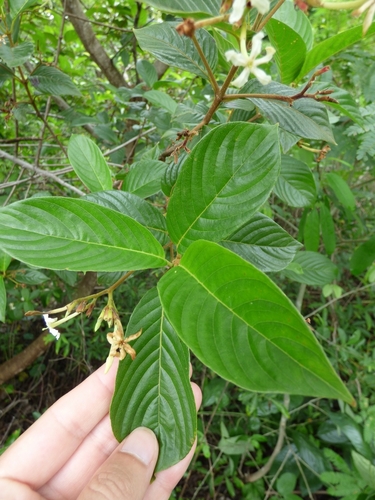
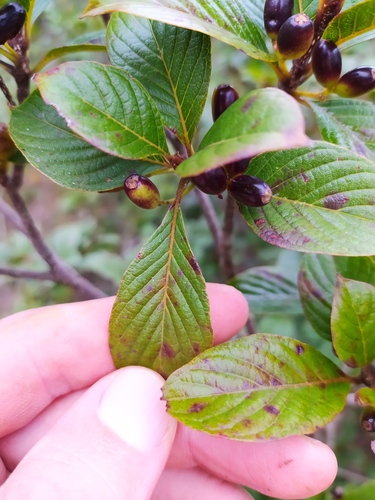
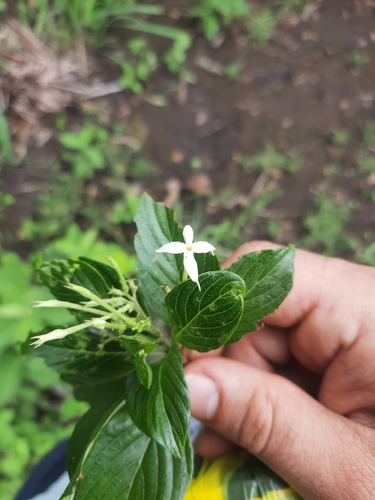
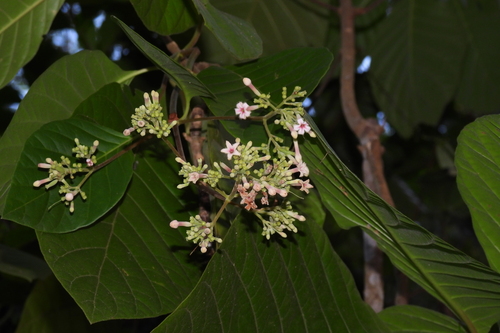
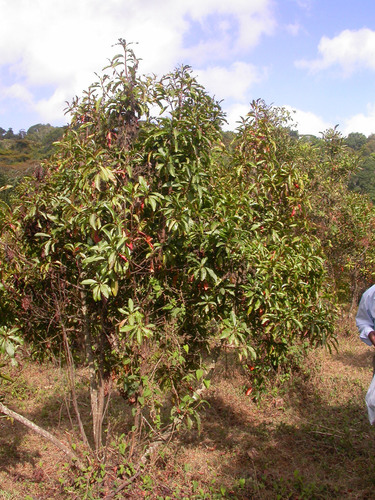
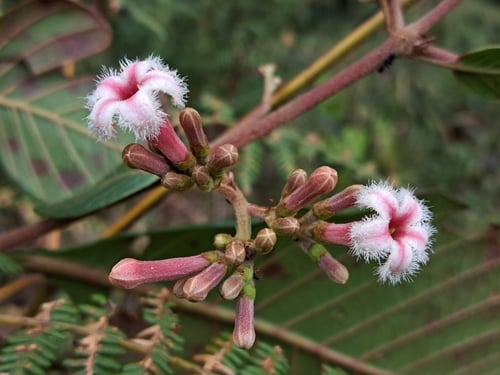
Feretia aeruginescens
Stapf & Hutch.
Red-leaved medlar
iNaturalist· cc-by-nc-sa
(c) Marco Schmidt, some rights reserved (CC BY-NC-SA), uploaded by Marco Schmidt
iNaturalist· cc-by-nc-sa
(c) Marco Schmidt, some rights reserved (CC BY-NC-SA)
Description
A straggling shrub. It grows 2-9 m tall. The young branches are hairy. The bark is thin and red and flakes off. The leaves are on new stems and branches. They are 3-14 cm long by 2-6 cm wide. They are narrowly oval. The flowers are on reduced spurs on older stems. They usually occur in pairs. The fruit is about 2 cm across and bright red. The seeds are 6-8 mm across and flattened.
Edible Uses
The fruit is eaten, though it is notably astringent.
Traditional Uses
The fruit is very astringent.
This uses section is brief — help expand it
Distribution
It is a tropical plant. It grows in woodland and often near rivers or anthills. It grows between 230-1,060 m altitude.
Where It Grows
Africa, Botswana, Central Africa, Congo, East Africa, Malawi, Mozambique, Namibia, Southern Africa, Tanzania, Zambia, Zimbabwe,
Nutrition
| Part | Moisture | kJ | kcal | Protein | Vit A | Vit C | Iron | Zinc |
|---|---|---|---|---|---|---|---|---|
| Fruit | 64 | 381 | 91 | 5 | — | — | — | — |
Synonyms
Also Known As
Caiabussa, Kalume-kakaonga, Kaonga, Munuyansankula, Nangisya, Pink medlar, Tsacama
References (8)
- Fowler, D. G., 2007, Zambian Plants: Their Vernacular Names and Uses. Kew. p 56
- Grivetti, L. E., 1980, Agricultural development: present and potential role of edible wild plants. Part 2: Sub-Saharan Africa, Report to the Department of State Agency for International Development. p 72
- Malaisse, F., 1997, Se nourrir en floret claire africaine. Approche ecologique et nutritionnelle. CTA., p 63
- Peters, C. R., O'Brien, E. M., and Drummond, R.B., 1992, Edible Wild plants of Sub-saharan Africa. Kew. p 170
- Pickering, H., & Roe, E., 2009, Wild Flowers of the Victoria Falls Area. Helen Pickering, London. p 102
Show all 8 references Hide references
- Scudder, 1971,
- Wild, 1975,
- World Checklist of Useful Plant Species 2020. Royal Botanic Gardens, Kew