Conostomium quadrangulare
(Rendle) Cufod.
Sweet flowers
wikimedia· cc0
Wikimedia Commons - Bentham-Moxon Trust.; Curtis, William; Curtis's botanical magazine dedications, 1827-1927 : portraits and biographical notes.; Royal Botanic Gardens, Kew.; Stanley Smith Horticultural Trust.
gbif· cc-by-sa
Susan Brown
gbif· cc-by-sa
Susan Brown
Description
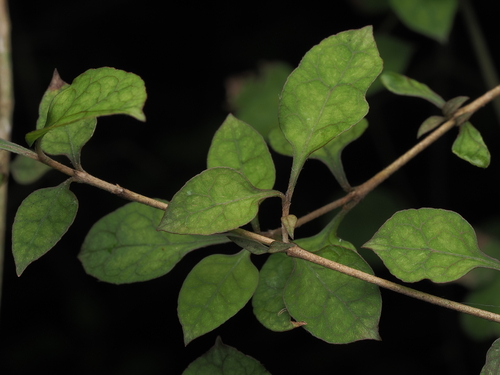
A herb. It can grow for one or more years. It grows 30-60 cm tall. It is only slightly branched. The root is woody and the stem has 4 ribs. The leaves are narrow and 2-9 cm long by 1-2 cm wide. They taper to the tip. The flowers do not have stalks and are in the axils of leaves. They form a leafy spike like group. These are 10-25 cm long. The lowers form a long tube and are green outside with a red tinge. The fruit is an oval capsule 5-7 mm long with 8 ribs. The seeds are chestnut brown and shiny. They are 3 sided.
Edible Uses
The flowers are consumed for their nectar.
Medicinal Uses
The plant is used in traditional medicine.
Distribution
It is a tropical plant. It grows in bush land in the lowlands and at medium altitudes. It is often in sandy places along temporary streams. It grows between 60 and 1,350 m above sea level in East Africa.
Where It Grows
Africa, East Africa, Ethiopia, Kenya, Sudan,
Cultivation
Plants can be grown from seed.
Notes
It is used in medicine.
Synonyms
Also Known As
Lokoroumwe
References (3)
- Morgan, W. T. W., 1981, Ethnobotany of the Turkana: Use of plants by a Pastoral People and Their Livestock in Kenya. Economic Botany 35(1):96-130
- Mutie, F. M., et al, 2023, Important Medicinal and Food Taxa (Orders and Families) in Kenya, Based on Three Quantitative Approaches. Plants 2023, 12, 1145
- Peters, C. R., O'Brien, E. M., and Drummond, R.B., 1992, Edible Wild plants of Sub-saharan Africa. Kew. p 169