Strychnos usambarensis
Gilg
iNaturalist· cc-by-nc
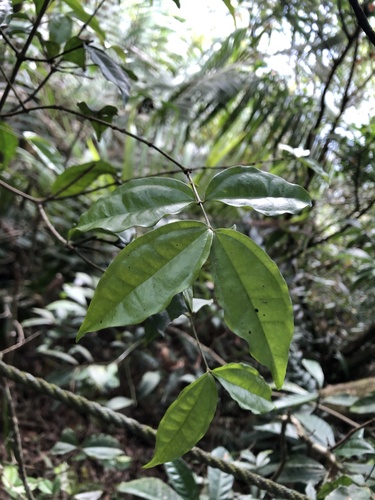
(c) Graeme White, some rights reserved (CC BY-NC), uploaded by Graeme White
iNaturalist· cc-by-nc
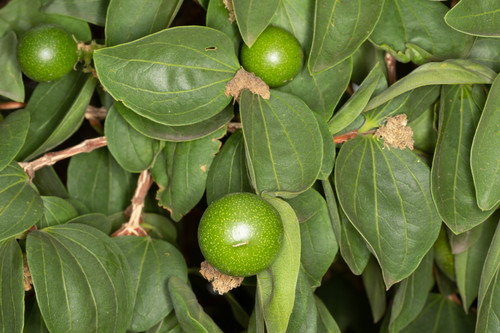
(c) Ricky Taylor, some rights reserved (CC BY-NC), uploaded by Ricky Taylor
iNaturalist· cc-by-nc
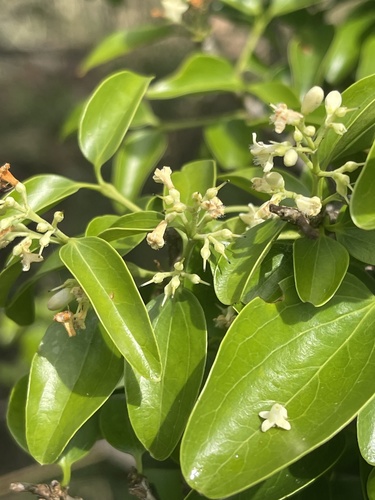
(c) Troos van der Merwe, some rights reserved (CC BY-NC), uploaded by Troos van der Merwe
Summary
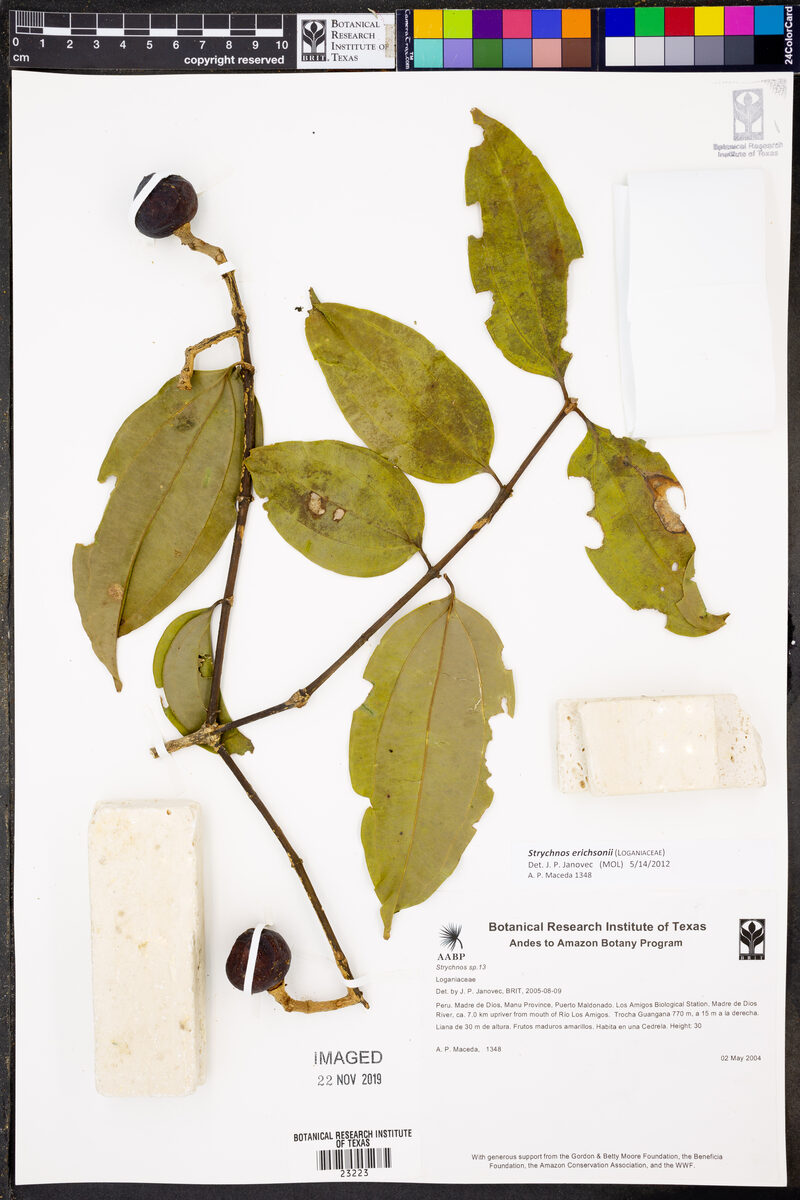
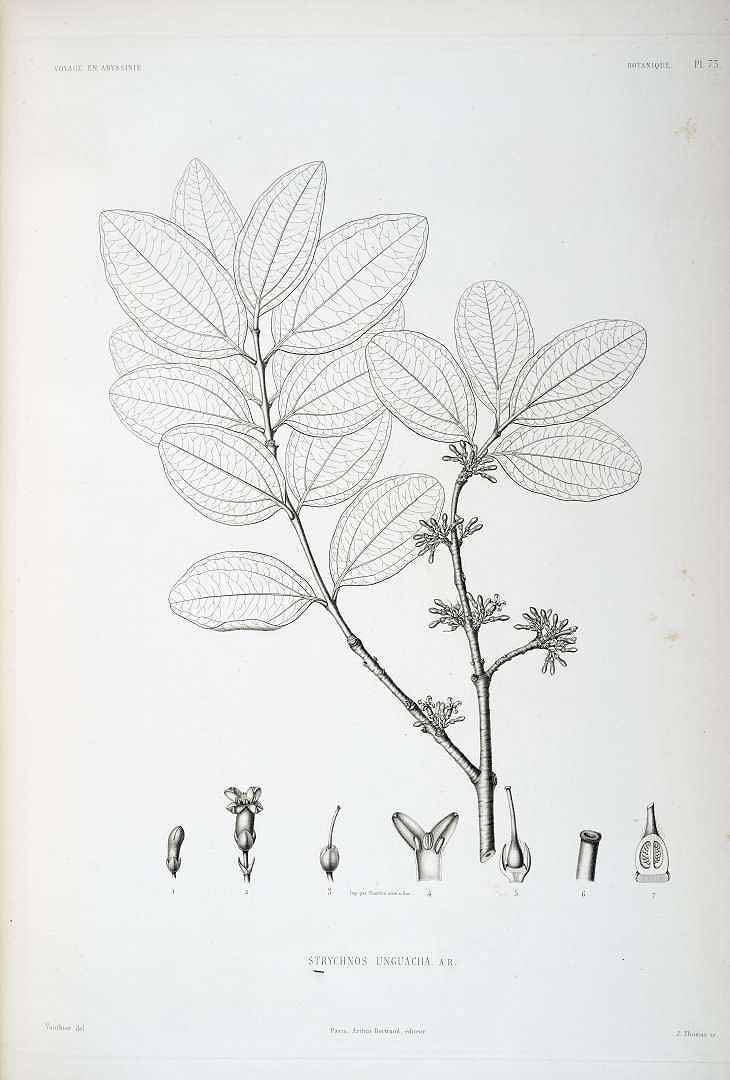
Source: WikipediaStrychnos usambarensis is a shrub or small tree up to 15m tall or a 70m long liane of Sub-Saharan Africa, occurring in forest and woodland, mountain ravines and coastal bush, often on rocky slopes and named for the Usambara Mountains of Tanzania. The species is found from Guinea east to Nigeria, from Congo east to Kenya and south to kloofs of the Magaliesberg of South Africa. Bantu tribes from Rwanda and Tanzania produce an arrow poison from the root bark and leaves of this species, sometimes combining it with extracts from other plants. (see Toxalbumin) The leaves are opposite, held in a horizontal plane, ovate to elliptic in shape with a characteristic drip-tip, and glossy dark green above. Flowers are small, in axillary clusters, whitish to yellowish-green, and fragrant. Fruits are soft-shelled and small, 1-1.5 cm in diameter, yellow when ripe, tapering to a collar at peduncle. The genus Strychnos is represented by some 300 species of lianes, shrubs and small trees, fairly evenly divided among Asia, America, and Africa.
Description
A shrub or climber. It can be a shrub 5 m high then climb to 70 m long. The fruit are orange when ripe but pale green when young. They are round and soft. They are 1-2 cm across.
Edible Uses
The fruit are eaten.
Medicinal Uses
Strychnos usambarensis is not used for medicinal purposes in Africa because of its toxicity. Several of its alkaloids show promising anticancer or antimalarial activities, and more research into the pharmacological activities of the compounds seems warranted. Strychnos usambarensis is the best investigated African Strychnos species and more than 60 indole alkaloids have been isolated from it. The ones that have been identified so far are predominantly dimeric terpenoid indole alkaloids. The root bark contains tertiary alkaloids and several important quaternary alkaloids and anhydronium bases. Among these are the retuline class alkaloids C-dihydrotoxiferine, C-curarine and C-calebassine and the monomeric C-fluorocurarine, which are also the active principles of calabash curare obtained from South American Strychnos species. The root bark also contains the less active afrocurarine, the monomeric tetracyclic alkaloid akagerine, the non-terpenoid alkaloids harmane and melinonine F and the monoquaternary alkaloids malindine and isomalindine, which belong to the group of trinitrogenated alkaloids. Four root alkaloids, the dimeric usambarensines, are of the corynanthean class. The leaf alkaloids are all of the corynanthean class, and belong to the usambarine group and the dimeric oxindole group. The main component of the leaves is the oxindole strychnofoline. Apart from alkaloids also known from other plant species, Strychnos usambarensis leaves contain some rare alkaloids with 5 nitrogen atoms such as strychnopentamine, its derivatives chrysopentamine, isostrychnopentamine and the oxindole strychnophylline. The muscle paralyzing, curare-like effect of the root bark is caused by the quaternary alkaloids, which block the excitation of the skeletal muscles. The paralyzing effect can be antagonized by acetylcholine. At higher doses the alkaloids cause a series of side-effects: drop in blood pressure, blocking of the vagus nerve, change in cardiac rate and frequency of respiration[. Malindine also has a strong muscle relaxant activity, which is not antagonized by acetylcholine and is not of the curare type. Akagerine and its derivatives are potent convulsant agents, but 100 times less active than strychnine. The usambarensines have no paralyzing effect on skeletal muscles, but do have an atropine-like and spasmolytic activity on smooth muscles. Harmane induces enrichment of biogene amines such as serotonine in the brain. In small doses it causes hallucinations, in high doses convulsions and respiratory paralysis. Harmane showed no antimicrobial activity. Strychnopentamine and 5’,6’-dihydrousambarensine showed strong activity against Plasmodium falciparum in vitro, but were inactive against Plasmodium berghei in vivo. However, isostrychnopentamine has an interesting antiplasmodial activity both in vitro against various chloroquine-resistant and chloroquine-sensitive strains of Plasmodium falciparum and in vivo against chloroquine-sensitive strains of rodent-infecting Plasmodium berghei and Plasmodium vinckei. Usambarine, usambarensine and 18,19-dihydrousambarine were less active against Plasmodium falciparum in vitro, but highly active against Entamoeba histolytica in vitro. Usambarensine and 5’, 6’-dihydrousambarensine are active against the gram-positive bacteria Staphylococcus aureus, Bacillus subtilis and Mycobacterium smegmatis.. Akagerine has only little antiprotozoal activity. Many of the Strychnos usambarensis alkaloids were shown to be markedly toxic to a number of tumour lines. A chloroform extract of the leaves is active against lymphatic leukaemia P-388 in mice in vivo. Especially strychnopentamine, chrysopentamine and isostrychnopentamine are regarded as potential anticancer agents. Curare alkaloids have played an important role in reducing the risk of anaesthesia, since much smaller amounts of anaesthetic are necessary. The drugs have made it possible to achieve adequate muscle relaxation for all clinical requirements.
Known Hazards
Various parts of Strychnos plants, especially the seeds and bark, contain toxic alkaloids such as strychnine and brucine. The fleshy pulp of the ripe fruits, however, is often edible. The root bark and leaves are used to produce arrow poison, sometimes in combination with other plants.
Distribution
It is a tropical plant. It grows in the lowlands and the highlands. It grows in rain-forest between sea level and 2,000 m above sea level.
Where It Grows
Africa, Botswana, Burkina Faso, Central Africa, Congo, East Africa, Mozambique, Sierra Leone, South Africa, Tanzania, West Africa, Zambia, Zimbabwe,
Other Uses
The wood is used for house construction.
Production
The fruit are available in the dry season.
Synonyms
Also Known As
Kangala, Mkwakwa, Mtonga, Nhacateme, Patancosse, Sumgba
References (3)
- East African Herbarium records, 1981,
- http://www.fao.org/forestry/25323-096344a3de335832e8f363c3ac5184a66.pdf
- Peters, C. R., O'Brien, E. M., and Drummond, R.B., 1992, Edible Wild plants of Sub-saharan Africa. Kew. p 142