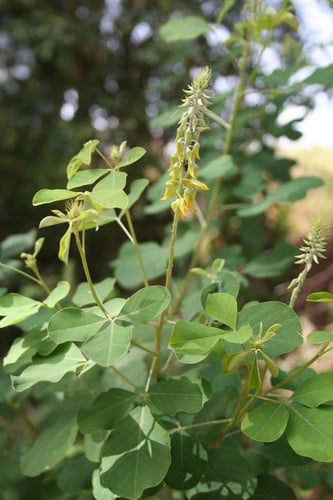
Senegalia burkei
(Benth.) Kyal. & Boatwr.
Black monkey thorn
iNaturalist· cc-by-nc
(c) Troos van der Merwe, some rights reserved (CC BY-NC), uploaded by Troos van der Merwe
iNaturalist· cc-by-nc
(c) Reuben Heydenrych, some rights reserved (CC BY-NC)
Description
A tree. It can grow 3-27 m high. It has strongly hooked thorns. They are in pairs. The leaves have 3-5 pairs of leaflet stalks with 4-10 pairs of leaflets. The flowers are in white spikes. The pods are flat and straight. They have obvious veins. The pods are 8-12 cm long.
Edible Uses
The gum is eaten.
Distribution
It is a tropical plant. It grows in sandy soils and hot dry woodland. It grows up to 400 m above sea level.
Where It Grows
Africa, Botswana, East Africa, Egypt, Eswatini, Malawi, Mozambique, South Africa, Southern Africa, Swaziland, Zimbabwe,
Notes
There are about 1,350 Acacia species. Over 1,000 occur in Australia. Also as Mimosaceae.
Synonyms
Also Known As
Micaia, Mokgwa, Mokoba, Mokotokoto, Mukaya, Tsene
References (4)
- Cunningham, 1985, (As Acacia burkei)
- Hassan, R. A. & Hamdy, R. S., 2021, Synoptic Overview of Exotic Acacia, Senegalia and Vachellia (Caesalpinioideae, Mimosoid Clade, Fabaceae) in Egypt. Plants 2021, 10, 1344. (As Acacia burkei)
- ILDIS Legumes of the World http:www;ildis.org/Legume/Web No 64 (As Acacia burkei)
- Peters, C. R., O'Brien, E. M., and Drummond, R.B., 1992, Edible Wild plants of Sub-saharan Africa. Kew. p 125 (As Acacia burkei)