Commiphora harveyi
(Engl.) Engl.
Copper-stem corkwood
iNaturalist· cc-by-nc
(c) Peter Vos, some rights reserved (CC BY-NC), uploaded by Peter Vos
iNaturalist· cc-by-nc
(c) Luc Strydom, some rights reserved (CC BY-NC)
iNaturalist· cc-by-nc
(c) Luc Strydom, some rights reserved (CC BY-NC)
Description
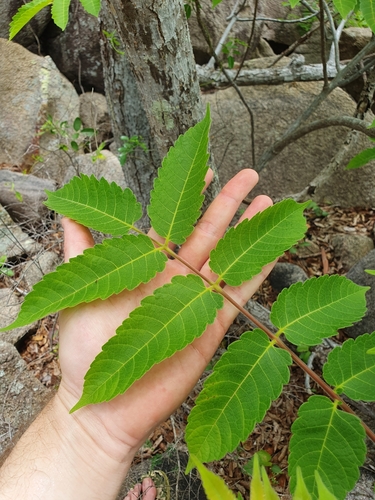
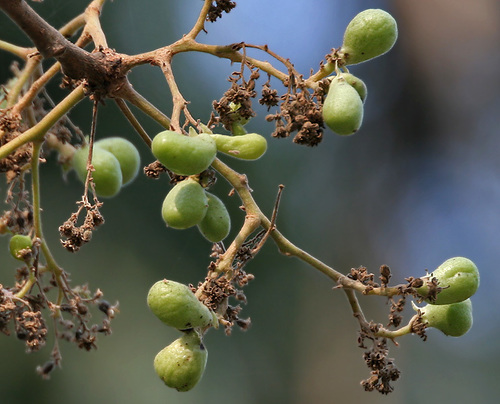
A small tree. It grows 4-18 m high. The bark is yellowish. It peels off in thin papery sheets. The leaves have 3 to 5 leaflets. The leaflets are well spaced and oval. They taper to the tip. There are some teeth. The leaves are 6 cm long by 2.5 cm wide. The flowers are small and in clusters in slender flower arrangements. The fruit are round and pointed and 1 cm long.
Edible Uses
The very soft heartwood is chewed. The plant is used as a famine food.
Traditional Uses
The very soft heartwood is chewed.
This uses section is brief — help expand it
Medicinal Uses
Traditional uses include chewing the heartwood.
Distribution
It is a subtropical plant.
Where It Grows
Africa, East Africa, Eswatini, Mozambique, South Africa, Southern Africa, Swaziland,
Other Information
It is a famine food.
Synonyms
Also Known As
Umnumbi, Umbanganglala
References (9)
- Fox, F. W. & Young, M. E. N., 1982, Food from the Veld. Delta Books. p 140
- Long, C., 2005, Swaziland's Flora - siSwati names and Uses http://www.sntc.org.sz/flora/
- Palmer & Pitman, 1972,
- Peters, C. R., O'Brien, E. M., and Drummond, R.B., 1992, Edible Wild plants of Sub-saharan Africa. Kew. p 73
- Ruiters-Welcome, A. K., 2019, Food plants of southern Africa. Ph.D. thesis. Univ. of Johannesburg p 40
Show all 9 references Hide references
- Swaziland's Flora Database http://www.sntc.org.sz/flora
- Welcome, A. K. & Van Wyk, B.-E., 2019, An inventory and analysis of the food plants of southern Africa. South African Journal of Botany 122 (2019) 136–179
- Wild, 1975,
- World Checklist of Useful Plant Species 2020. Royal Botanic Gardens, Kew