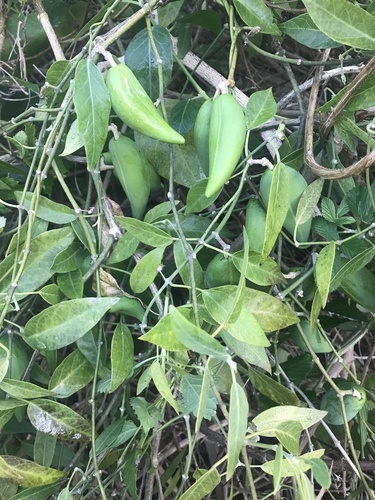
Cynanchum amplexicaule
(Siebold. & Zucc.) Hemsl.
Bai wei, He zhang xiao
gbif· cc-by-nc
University of Vermont
gbif· cc-by
The New York Botanical Garden
Summary
Perennial climbing vine reaching 1 m tall with hermaphrodite flowers. Blooms June to September with seeds maturing August to November. Tolerates light sandy, medium loamy, and heavy clay soils across mildly acidic to basic pH ranges. Grows in semi-shade or full light and prefers consistently moist soil.
Description
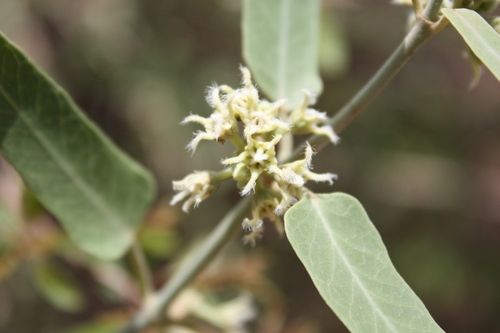
A herb. It grows 1 m tall. The leaves are opposite and without leaf stalks. They are oval and 4-6 cm long by 2-4 cm wide. The upper leaves are smaller. The fruit are sword shaped follicles 5-7 cm long by 5-8 mm wide.
Edible Uses
Young leaves can be eaten after boiling — some caution is advised given the toxicity notes associated with this plant. Young seedpods are also edible boiled, again with the same caution recommended.
Traditional Uses
CAUTION:
This uses section is brief — help expand it
Medicinal Uses
The decocted root is used together with other herbs as a diuretic and febrifuge. All parts of the plant are used medicinally for traumatic injury, rheumatic arthralgia, and swelling.
Distribution
It is a temperate plant. It grows on mountain slopes, grasslands, maritime dunes between 0–1000 m altitude in China.
Where It Grows
Asia, China, Japan, Korea,
Propagation
Sow seed in spring in a greenhouse. Once seedlings are large enough to handle, prick them out into individual pots and grow on under cover for at least their first winter before planting into permanent positions in late spring or early summer, after the last expected frosts. Division can be carried out in spring.
Other Uses
None known
Notes
Used in medicine. There are about 150-200 Cynanchum species. Probably now in Apocynaceae.
Synonyms
References (3)
- F. B. Forbes & W. B. Hemsley, J. Linn. Soc., Bot. 26:104. 1889
- Li Ping-tao; Michael G. Gilbert, W. Douglas Stevens, ASCLEPIADACEAE Flora of China.
- Plants for a Future database, The Field, Penpol, Lostwithiel, Cornwall, PL22 0NG, UK. http://www.scs.leeds.ac.uk/pfaf/