Willughbeia coriacea
Wall.
Heaven fruit, Borneo rubber
iNaturalist· cc-by
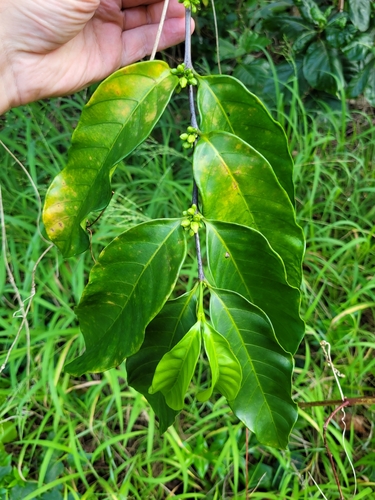
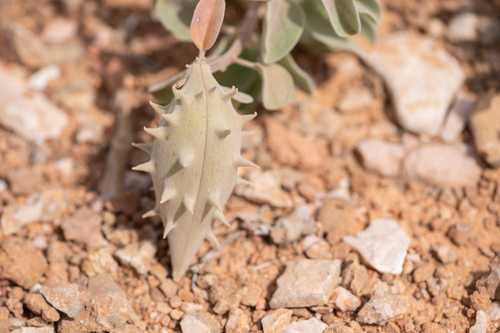
(c) pbsg, some rights reserved (CC BY), uploaded by pbsg
iNaturalist· cc-by
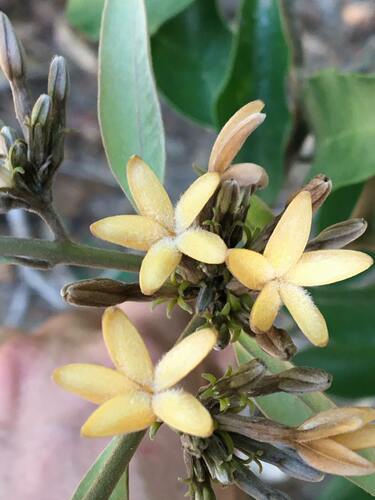
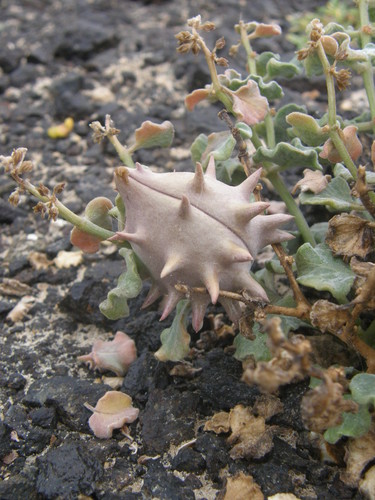
(c) pbsg, some rights reserved (CC BY)
Summary
Fast-growing evergreen climber reaching 30 m tall with narrow stems to 0.2 m diameter. Tolerates light sandy, medium loamy, and heavy clay soils with mildly acidic to mildly alkaline pH. Grows in semi-shade to full sun and prefers moist or wet conditions. Hardy to UK zone 10.
Description
A large climbing shrub. It grows 30 m long. The shoots are woody and have hooked leafless branches that attach to other plants. The leaf stalks are 1-4 cm long and the leaves are 3-30 cm long by 2-13 cm wide. The flowers are in the axils of the leaves. There are 3-25 flowers in a group. The fruit are round to pear shaped and 3-12 cm long by 2-7 cm wide. They are green, yellow or orange. The seeds are 13-18 mm long by 7-13 mm wide.
Edible Uses
The fruit is edible.
Traditional Uses
The ripe fruit are eaten raw.
This uses section is brief — help expand it
Medicinal Uses
The latex is used medicinally.
Distribution
A tropical plant. It grows in primary and secondary forests up to 1,600 m above sea level. It grows in Sabah in Borneo.
Where It Grows
Asia, Indochina, Indonesia, Malaysia, SE Asia, Singapore, Thailand,
Cultivation
Industrial Crop: Hydrocarbon Management: Standard Regional Crop. Humid tropics. Before the introduction of Hevea brasiliensis as the main source of rubber W. coriacea was cultivated in plantations to produce a high quality rubber.
Propagation
Seed.
Other Uses
A latex obtained from the plant produces good-quality rubber.
Other Information
It is cultivated.
Synonyms
Also Known As
Akar garok, Akar gerit hitam, Akar getah gaharu, Akar getah menjawa, Akar getah gegerip jantan, Akar getah jela, Akar getah ujul, Akar kubal, Akar jitan, Akar jualoh, Buah surga, Karet akar grutuk, Kelang, Lumbu jawa, Puchong kapur
References (11)
- Burkill, I.H., 1966, A Dictionary of the Economic Products of the Malay Peninsula. Ministry of Agriculture and Cooperatives, Kuala Lumpur, Malaysia. Vol 2 (I-Z) p 2301
- Hoare, A., 2003, Food use of the Lundayeh SW Sabah. Borneo Research Council.
- MacKinnon, K., 1981, The Ecology of Kalimantan. p 710
- Middleton, D. J. & Rodda, M., 2019, Apocynaceae. Flora of Singapore (Vol. 13:421-630, 2019) p 486
- Milow, P., et al, 2013, Malaysian species of plants with edible fruits or seeds and their evaluation. International Journal of Fruit Science. 14:1, 1-2
Show all 11 references Hide references
- Ong, H. C., Mojiun, P. F. J., & Milow, P., 2011, Traditional knowledge of edible plants among the Temuan villagers in Kampung Guntor, Negeri Sembilan, Malaysia. African Journal of Agricultural Research Vol. 6(8), pp. 1962-1965, 18 April, 2011 (As Willughbeia firma)
- Pl. asiat. rar. 3:45. 1832
- Siong, K. H., 2003, Indigenous Fruits of Sarawak. ITTO & Sarawak Forest Department. p 17
- Sukarya, D. G., (Ed.) 2013, 3,500 Plant Species of the Botanic Gardens of Indonesia. LIPI p 989 (Also as Willughbeia firma)
- Wiersema, J. H. & Leon, B., 2013, World Economic Plants. A Standard Reference CRC Press. 2nd Ed. p 728
- World Checklist of Useful Plant Species 2020. Royal Botanic Gardens, Kew