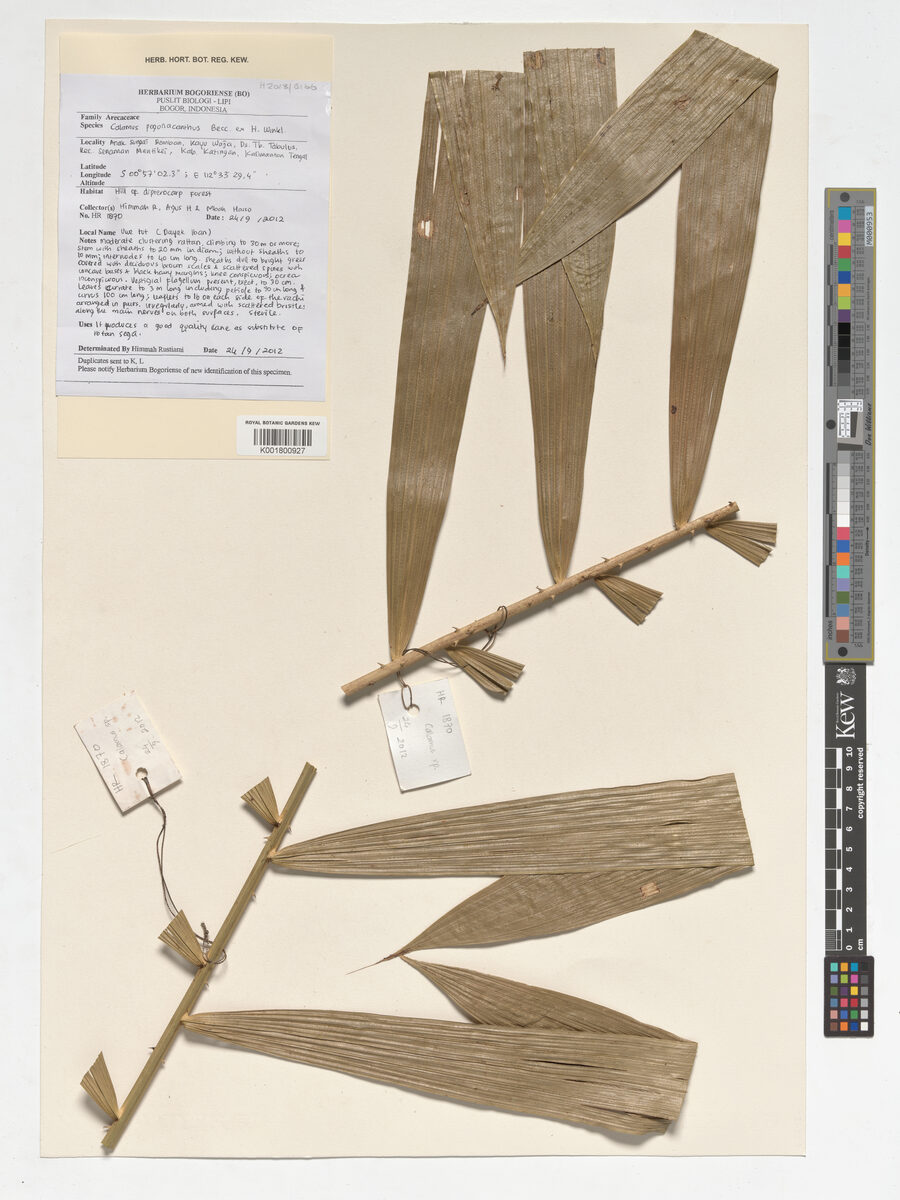
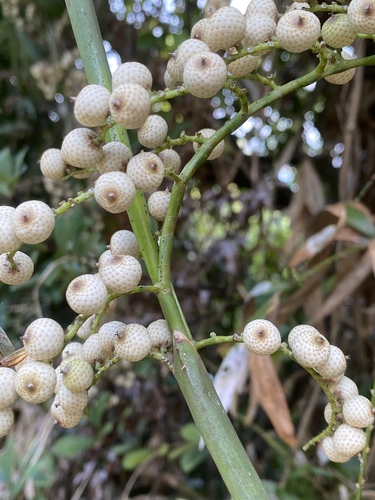
Raphia palma-pinus
(Gaertn.) Hutch.
Thatch palm
iNaturalist· cc-by-nc
(c) Carel Jongkind, some rights reserved (CC BY-NC), uploaded by Carel Jongkind
iNaturalist· cc-by-nc
(c) Carel Jongkind, some rights reserved (CC BY-NC), uploaded by Carel Jongkind
Summary
Source: WikipediaRaphia palma-pinus is a fast-growing evergreen tree reaching 10 m tall and 6 m wide. Hardy to UK zone 10, it thrives in light sandy, medium loamy, and heavy clay soils across mildly acid to neutral pH ranges, and tolerates very acid and saline conditions. The plant grows in semi-shade or full sun and prefers moist or wet soil.
Description
A palm. The trunk is 2-3 m high. It develops suckers and forms clump. The fronds are yellowish-green and not shiny.
This description is brief — help expand it
Edible Uses
None known
Medicinal Uses
The frond and petiole are used as a medicine to treat blood disorders.
Distribution
It is a tropical plant. It grows in wet swamps. It grows in the landward side of mangrove swamps.
Where It Grows
Africa, Côte d'Ivoire, Gambia, Ghana, Guinea, Guinée, Guinea-Bissau, Ivory Coast, Liberia, Senegal, Sierra Leone, West Africa,
Cultivation
A monocarpic plant - growing for several years without flowering, then producing a massive inflorescence and dying after setting seed.
Propagation
Seed.
Other Uses
The plant is a commercial source of piassava — the base of the petiole for a length of 100cm is retted and split to produce hard fibres. The mid-ribs of the leaves are used to make poles and are crafted into household furnishings such as chairs and beds. The fronds are widely used as thatch.
Synonyms
Also Known As
Apel, Batata, Befen, Chana bua, Dahare, Dara, Darre, Mambampa-tara, Tara, Tarra
References (4)
- Dalziel, J. M., 1937, The Useful plants of west tropical Africa. Crown Agents for the Colonies London.
- Gueye, M., et al, 2014, Wild Fruits Traditionally Gathered by the Malinke Ethnic Group in the Edge of Niokolo Koba Park (Senegal). American Journal of Plant Sciences 5, 1306-1317
- Manvell, A., 2011, Use of Non-Timber Forest Products around Sapo National Park, Liberia (Report B) p 52
- Peters, C. R., O'Brien, E. M., and Drummond, R.B., 1992, Edible Wild plants of Sub-saharan Africa. Kew. p 39