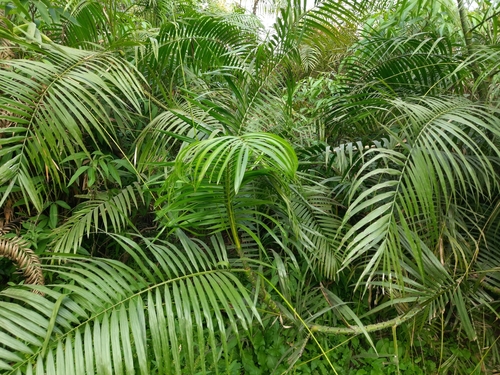
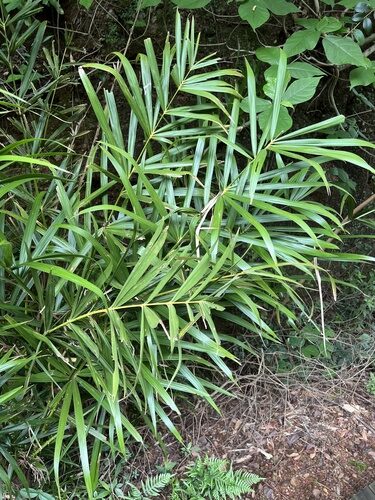
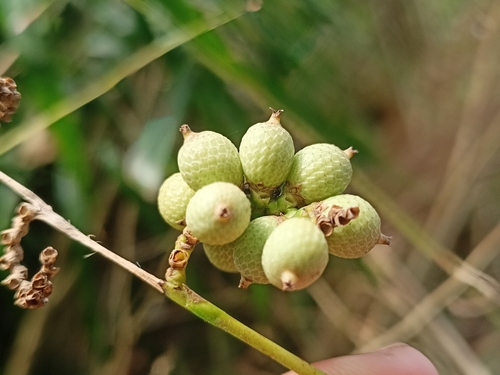
Butia paraguayensis
(Barb.Rodr.) L. H. Bailey
iNaturalist· cc-by-nc
(c) Ary Mailhos, some rights reserved (CC BY-NC)
iNaturalist· cc-by-nc
(c) Guillermo Menéndez, some rights reserved (CC BY-NC)
iNaturalist· cc-by-nc
(c) Ary Mailhos, some rights reserved (CC BY-NC)
Summary
Source: WikipediaButia paraguayensis is a species of Butia palm tree found in the cerrado region of South America. Its natural range runs from Mato Grosso do Sul and São Paulo in southern Brazil through Paraguay to northern Argentina and Uruguay. It was given the name dwarf yatay palm in English by 2000, and it is locally known as yata'i in Guaraní in Paraguay, or butiá-do-cerrado in Portuguese in Rio Grande do Sul, Brazil.
Description
A palm tree. The trunk is short and 1-2 m tall or underground. The trunk is 10-20 cm across.
This description is brief — help expand it
Edible Uses
In Paraguay the fruit and palm hearts are eaten by local tribal communities (Ava Chiripá, Aché, others). The leaves are also used to make hats and other handicrafts. The unripe, green fruit are believed to be useful for combating intestinal worms. In Paraguay the nuts are reputed to be of good use as fish bait. The fruit are not considered edible in Argentina. In Uruguay the single remaining, picturesque population has some ecotourism value. This species is sometimes, be it rarely, cultivated (in Argentina, England, California). It is advised to plant the palms in full sunlight. It is said to take −11 °C, but should be protected at −4 °C in the Netherlands.
Distribution
It is a subtropical plant. In Argentina it grows between 100-300 m above sea level. In Townsville palmetum.
Where It Grows
Argentina, Australia, Brazil*, Paraguay, South America, Uruguay,
Synonyms
Also Known As
Butiezeiro-anao, Coco amargoso, Yatay guazu
References (4)
- Bortolotto, I. M., et al, 2018, Lista preliminar das plantas alimenticias nativas de Mato Grosso do Sul, Brasil. Iheringia, Serie Botanica, Porto Alegre, 73 (supl.):101-116
- Brack, P., et al, 2020, Frutas nativas do Rio Grande do Sul, Brasil: riqueza e potencial alimentício. Native fruits of Rio Grande do Sul, Brazil: richness and potential as food. Rodriguésia 71: e03102018.
- Brevard County Edible Acres
- www.colecionandofrutas.org