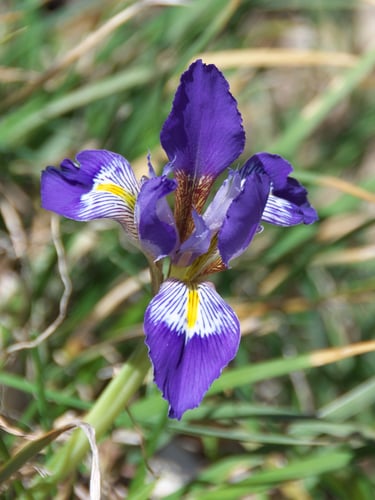
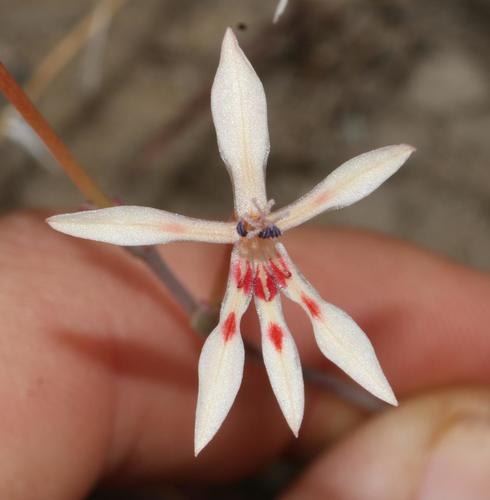
Tritonia nelsonii
Baker
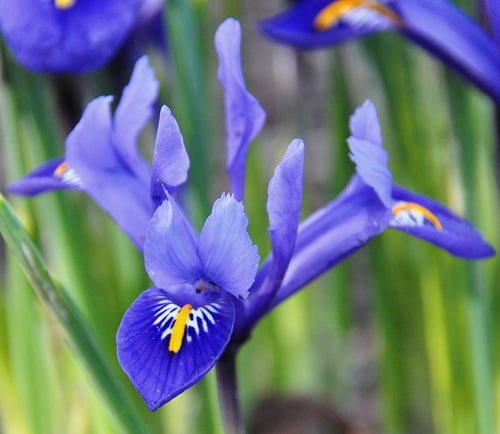
iNaturalist· cc-by-nc
(c) Richard Gill, some rights reserved (CC BY-NC), uploaded by Richard Gill
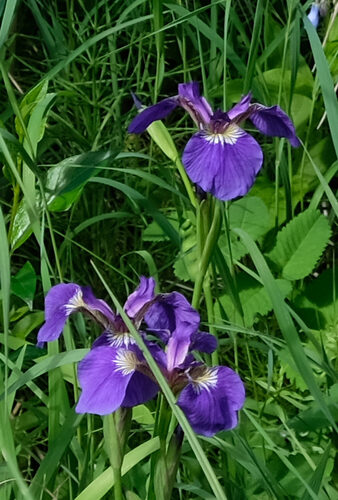
iNaturalist· cc-by-nc
(c) Stephen Cousins, some rights reserved (CC BY-NC), uploaded by Stephen Cousins
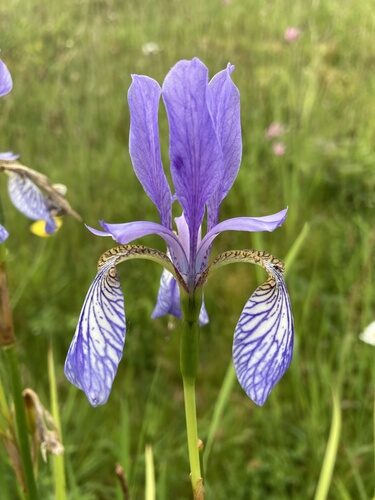
iNaturalist· cc-by-nc
(c) Matt Prinsloo, some rights reserved (CC BY-NC), uploaded by Matt Prinsloo
Summary
Source: WikipediaTritonia nelsonii is a perennial flowering plant belonging to the genus Tritonia. The species is native to Gauteng, Limpopo, Mpumalanga and Botswana.
Description
An erect herb. It arises from a round corm. The corm is covered with fibres. There are 4-8 leaves that are narrowly sword shaped and spread out like a fan. They have a slender base. The flower spikes have 2-20 flowers. The flowers are 25 mm long and are trumpet shaped and orange-red. The fruit is an oval capsule. The seeds are round and light brown.
Edible Uses
The corms are eaten as a snack, either raw or roasted.
Traditional Uses
The corms are eaten as a snack and also roasted and eaten.
This uses section is brief — help expand it
Distribution
It is a subtropical plant.
Where It Grows
Africa, Botswana, South Africa, Southern Africa,
Synonyms
Also Known As
Dichuge
References (5)
- Fox, F. W. & Young, M. E. N., 1982, Food from the Veld. Delta Books. p 241
- Mogg, 1975,
- Peters, C. R., O'Brien, E. M., and Drummond, R.B., 1992, Edible Wild plants of Sub-saharan Africa. Kew. p 34
- Ruiters-Welcome, A. K., 2019, Food plants of southern Africa. Ph.D. thesis. Univ. of Johannesburg p 69
- Welcome, A. K. & Van Wyk, B.-E., 2019, An inventory and analysis of the food plants of southern Africa. South African Journal of Botany 122 (2019) 136–179