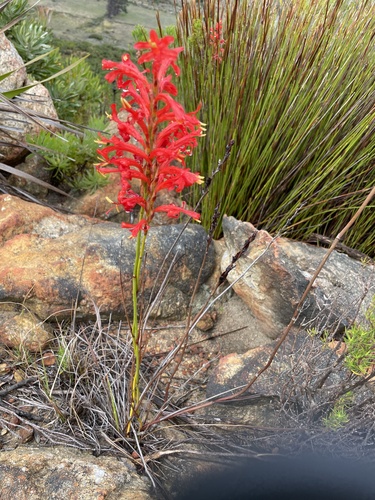
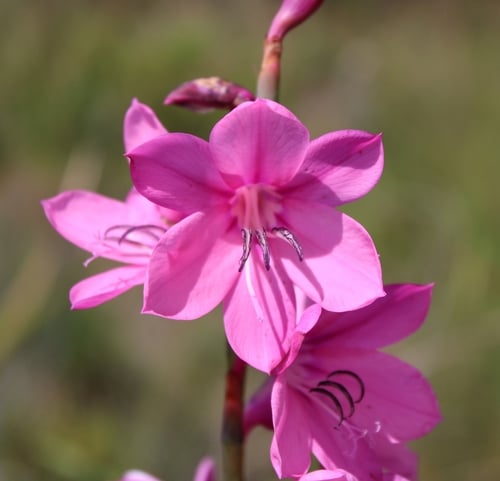
Gladiolus dalenii
Van Geel
Parrot-beak gladiolus, Dragon's head lily
iNaturalist· cc-by-nc-nd
(c) John Trent, some rights reserved (CC BY-NC-ND), uploaded by John Trent
iNaturalist· cc-by-nc
(c) Richard Gill, some rights reserved (CC BY-NC)
Summary
Source: WikipediaGladiolus dalenii is a species of flowering plant in the iris family Iridaceae. It is one of the most widely distributed species of Gladiolus, ranging from eastern South Africa and Madagascar throughout tropical Africa and into western Arabia. It is the main parental species of the large flowering grandiflora hybrids. This species is also unusual in its genus in including diploid, tetraploid and hexaploid races. The hybrids produced from it are often tetraploids. It produces five tall flower spikes of yellow to scarlet flowers, often streaked red over a yellow ground color, generally with a yellow throat. In cultivation, it prefers a light sandy neutral to slightly acid soil with a pH between 6.5 and 7 in a sunny sheltered position and requires a stony gritty loam.
Description
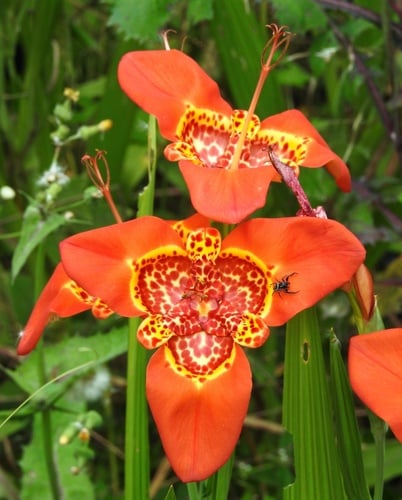
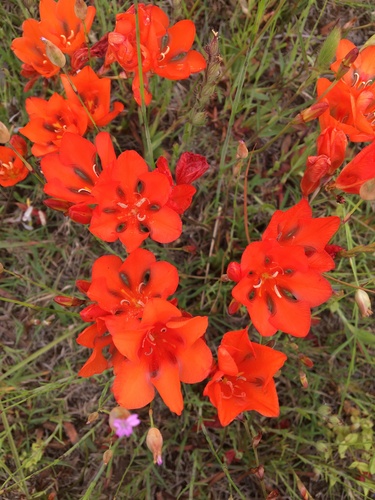
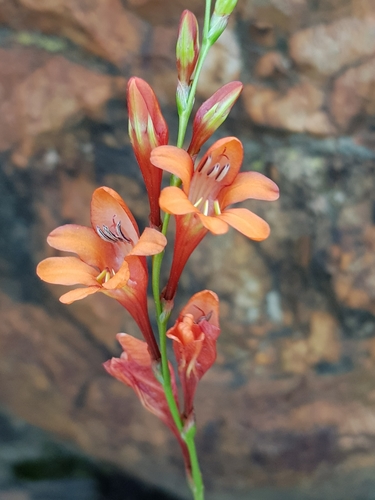
A herb. It grows up to 90 cm high. The leaves are near the base and long and narrow. The leaves are 2 cm wide. The flowers are on stalks about as high as the leaves. The flowers are usually turned to one side. They are yellow with reddish dots. The flower tube is 3 cm long. The fruit is an oblong capsule.
Edible Uses
The flowers can be eaten raw or cooked. Before use, the anthers are removed; the flowers are then added to salads or used as a boiled vegetable. Children also suck the flowers for their copious quantities of nectar.
Traditional Uses
The anthers are removed and the flowers are eaten raw in salads. They are also used as a potherb. Children suck the flowers for the nectar. The corm is used to make a sweet drink. It is a milk substitute. The corm is eaten cooked.
Medicinal Uses
None known.
Distribution
A tropical plant. It grows in wetter areas. It is often in places with a summer rainfall. It needs to be in a sunny position. In Zimbabwe it grows between 980-1,910 m above sea level. It grows in savannah woodland and wet grass savannah.
Where It Grows
Africa, Asia, Australia, Botswana, Burkina Faso, East Africa, Eswatini, Ethiopia, Ghana, Guinea, Guinée, Guinea-Bissau, Lesotho, Mali, Mozambique, Nepal, Nigeria, Sierra Leone, South Africa, Southern Africa, Swaziland, West Africa, Zambia, Zimbabwe,
Cultivation
Prefers a sunny sheltered position in a light sandy neutral to slightly acid soil with a pH between 6.5 and 7. Requires a stony gritty loam. This species is not very cold-hardy, tolerating temperatures down to about 0°c. In Britain it may be possible to plant the corms out in spring, harvest them in the autumn and store them overwinter in a cool frost-free place. This species is one of the parents of the cultivated garden gladiolas.
Propagation
Sow seed in early spring in a greenhouse at 15°C, where it usually germinates freely. Seed can also be sown as soon as ripe in autumn in a warm greenhouse. Sow thinly so seedlings can remain in the pot undisturbed for their first year, with occasional liquid feeding to prevent nutrient deficiency. Pot up small bulbs when dormant in autumn, placing 2–3 per pot, and grow on for another year or two under glass before planting out in late spring. For division, dig up corms in October, dry at around 20°C in well-ventilated conditions, and store in a cool but frost-free place over winter, planting out approximately 10 cm deep in April. Cormlets collected at lifting can be stored the same way; larger ones can be planted out in spring, while smaller ones are best grown on for a year under glass first.
Other Uses
None known.
Other Information
The nectar is sucked especially by children.
Notes
There are about 150-300 Gladiolus species.
Synonyms
Also Known As
Djabreguele, Hwenyanguruve, Indokwe, Khahla-ea-kholo, Kitungutungu, Sidvwana, Yellow gladiolus
References (23)
- Abbiw, D.K., 1990, Useful Plants of Ghana. West African uses of wild and cultivated plants. Intermediate Technology Publications and the Royal Botanic Gardens, Kew. p 31
- Bot. Mag. 57: t. 3032. 1830 (As Gladiolus psittacinus)
- Burkill, H. M., 1985, The useful plants of west tropical Africa, Vol. 2. Kew.
- Brickell, C. (Ed.), 1999, The Royal Horticultural Society A-Z Encyclopedia of Garden Plants. Convent Garden Books. p 472
- Dalziel, J. M., 1937, The Useful plants of west tropical Africa. Crown Agents for the Colonies London.
Show all 23 references Hide references
- Facciola, S., 1998, Cornucopia 2: a Source Book of Edible Plants. Kampong Publications, p 122
- Fox, F. W. & Young, M. E. N., 1982, Food from the Veld. Delta Books. p 240
- Grivetti, L. E., 1980, Agricultural development: present and potential role of edible wild plants. Part 2: Sub-Saharan Africa, Report to the Department of State Agency for International Development. p 24 (As Gladiolus quartinianus)
- Lewis, G.J. & Obermeyer, A.A., 1972, Gladiolus: a revision of the South African species. J.S.African Bot. Suppl. 10
- Malaisse, F., 1997, Se nourrir en floret claire africaine. Approche ecologique et nutritionnelle. CTA., p 63 (As Gladiolus natalensis var. natalensis)
- Morton, J.K., 1961, West African Lilies and Orchids. Longmans. p 39 (As Gladiolus primulinus)
- Peters, C. R., O'Brien, E. M., and Drummond, R.B., 1992, Edible Wild plants of Sub-saharan Africa. Kew. p 32
- Pickering, H., & Roe, E., 2009, Wild Flowers of the Victoria Falls Area. Helen Pickering, London. p 66
- Plants for a Future database, The Field, Penpol, Lostwithiel, Cornwall, PL22 0NG, UK. http://www.pfaf.org/ (Also as Gladiolus quartinianus)
- Plowes, N. J. & Taylor, F. W., 1997, The Processing of Indigenous Fruits and other Wildfoods of Southern Africa. in Smartt, L. & Haq. (Eds) Domestication, Production and Utilization of New Crops. ICUC p 191
- Ruiters-Welcome, A. K., 2019, Food plants of southern Africa. Ph.D. thesis. Univ. of Johannesburg p 67
- Sert. bot. 2, t. 18. 1829
- Swaziland's Flora Database http://www.sntc.org.sz/flora
- Tent. fl. abyss. 2:306. 1850 (As Gladiolus quartinianus)
- Vinnicombe, 1976,
- Welcome, A. K. & Van Wyk, B.-E., 2019, An inventory and analysis of the food plants of southern Africa. South African Journal of Botany 122 (2019) 136–179
- World Checklist of Useful Plant Species 2020. Royal Botanic Gardens, Kew
- www.zimbabweflora.co.zw 2011