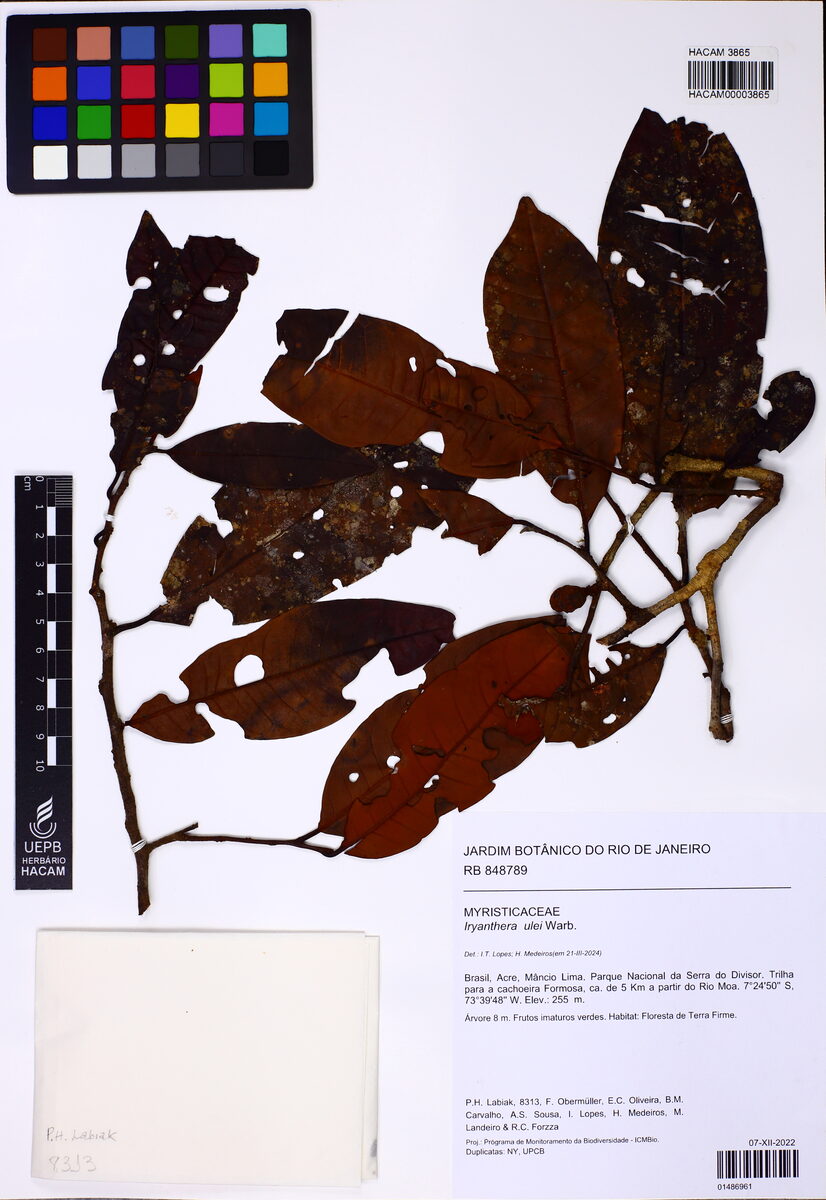
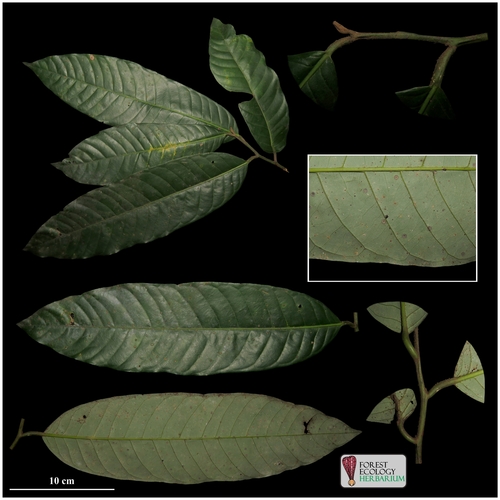
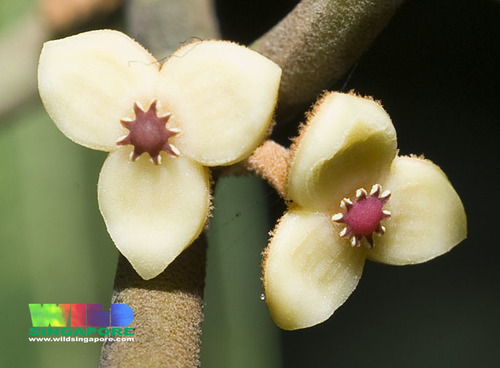
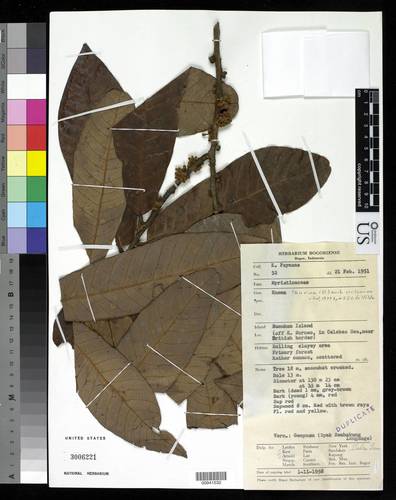
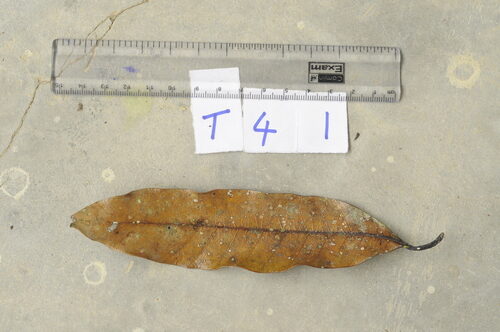
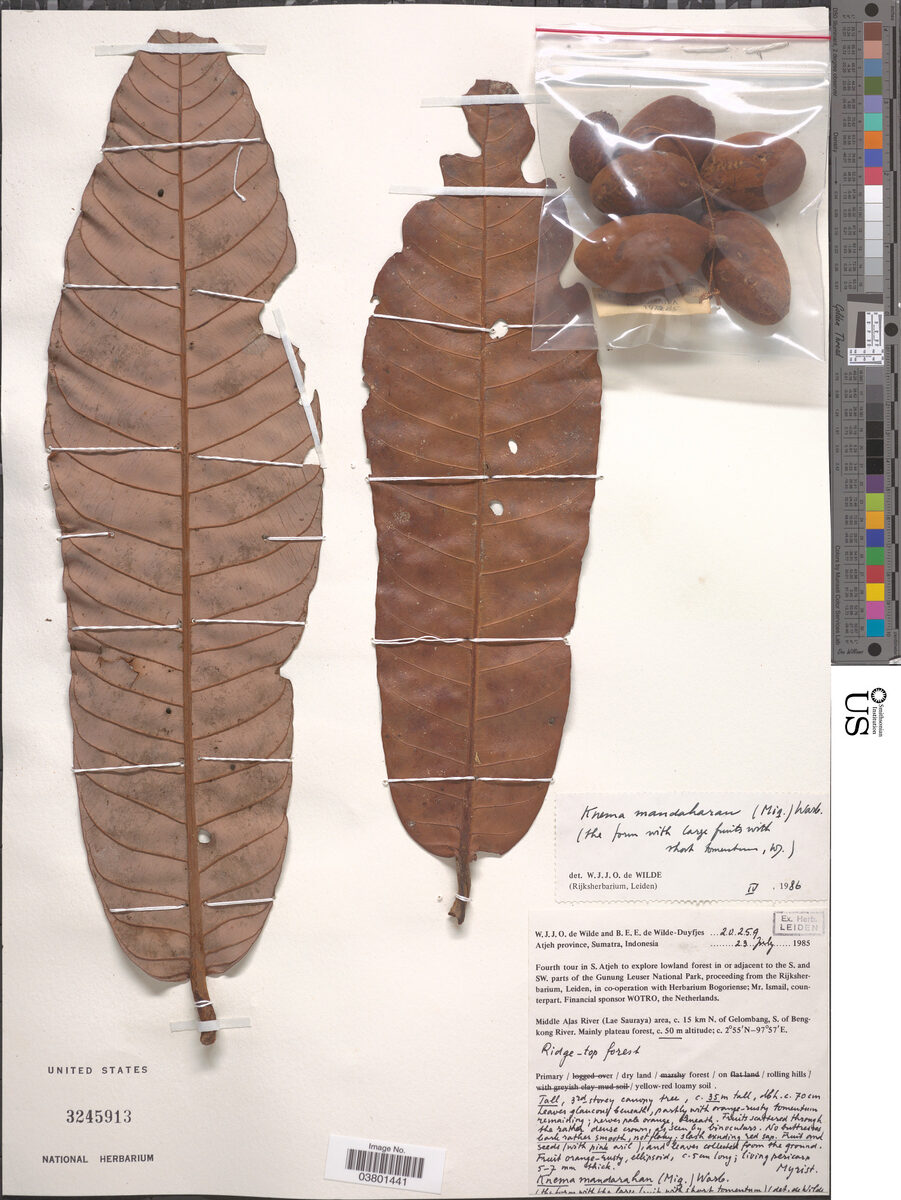
Iryanthera paraensis
Hub.
Para iryanthera
gbif· cc-by-nc
C. Dennis : Field Museum of Natural History - Botany Department
gbif· cc-by-nc
I. Huamantupa : Universidad Nacional San Antonio Abad de Cusco
gbif· cc-by-nc
C. Dennis : Field Museum of Natural History - Botany Department
Description
A tree. It grows 23 m tall. The fruit is a flattened capsule. It is 1.8 cm long by 2.1 cm wide and 0.9 cm thick. It is green to orange-red. It tapers to the base. The aril of fleshy layer around the seed is edible.
Edible Uses
Fruit - raw. The purple-red aril surrounding the seed is eaten. The fruit has a vertical groove, it is attached to the trunk.
Traditional Uses
The aril or fleshy layer around the seeds is eaten.
This uses section is brief — help expand it
Distribution
It is a tropical plant. It grows in marsh forest and along water courses.
Where It Grows
Amazon, Brazil, Colombia, Ecuador, Guiana, Guianas, Guyana, Peru, South America, Suriname, Venezuela,
Other Uses
Bark thin, smooth, slightly sweet, reddish or chocolate brown, and yields, when cut, a small amount of dark reddish brown resin. The wood varies in colour from pale yellowish to russet brown with pale grayish cast. The texture is fine and uniform; the grain straight. The wood is of medium weight, durable; it takes a smooth finish. Growth rings are faintly visible owing to slight variation in depth of colour. The wood is used for fuel. We do not have any more information on the wood of this species, but the following is a general description for the wood of this genus:- The heartwood is variable, light pinkish cinnamon, dull oatmeal, medium to dark brown, sometimes reddish or purplish; it is often not very clearly demarcated from the wide band of oatmeal-coloured sapwood. The texture is medium; the grain mostly straight; lustre is medium to fairly high; without distinctive odour or taste. The wood can be air-dried with little or only moderate difficulty; slight to moderate checking and warp may develop. All of the species in this genus have very good machining properties and produce smooth surfaces on the normally straight-grained material. The wood is easily peeled for veneer. It is used for purposes such as millwork, turnery, furniture, boxes and crates, veneer and plywood, general construction, fiberboard, and particleboard.
Synonyms
Also Known As
Broedoe-oedoe, Cumala colorada, Kirikaua, Sangretoro, Srebebe, Tosopasa, Yawekague
References (6)
- Grandtner, M. M. & Chevrette, J., 2013, Dictionary of Trees, Volume 2: South America: Nomenclature, Taxonomy and Ecology. Academic Press p 330
- Kermath, B. M., et al, 2014, Food Plants in the Americas: A survey of the domesticated, cultivated and wild plants used for Human food in North, Central and South America and the Caribbean. On line draft. p 451
- Lopez-Diago, D. & Garcia, N., 2021, Wild edible fruits of Colombia. Biota ColomBiana 22 (2) p 44
- Roa, J. A. G. & Boada, D. S. G., 2018, Fundación para el Fortalecimiento de la Fruticultura y Plantas Alimenticias no Convencionales en Colombia.
- van Roosmalen, M.G.M., 1985, Fruits of the Guianan Flora. Utrecht Univ. & Wageningen Univ. p 316
Show all 6 references Hide references
- Vasquez, R. and Gentry, A. H., 1989, Use and Misuse of Forest-harvested Fruits in the Iquitos Area. Conservation Biology 3(4): 350f