Enterolobium schomburgkii
(Benth.) Benth.
iNaturalist· cc-by-nc
(c) Nils Servientis - Bivouac Naturaliste, some rights reserved (CC BY-NC)
iNaturalist· cc-by-nc
(c) Nils Servientis - Bivouac Naturaliste, some rights reserved (CC BY-NC)
iNaturalist· cc-by-nc
(c) Nils Servientis - Bivouac Naturaliste, some rights reserved (CC BY-NC)
Description
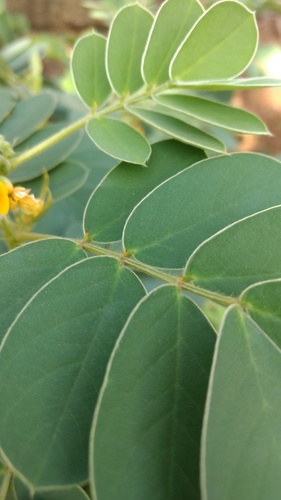
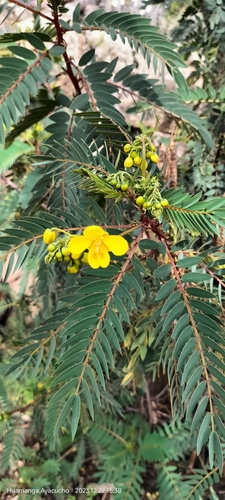
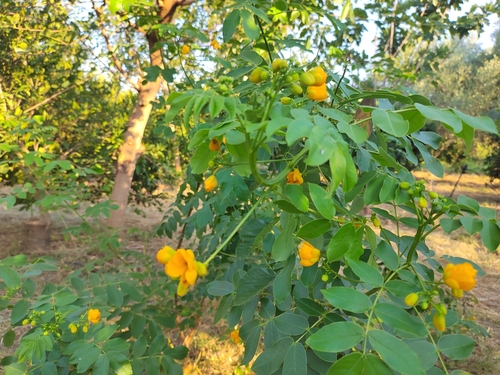
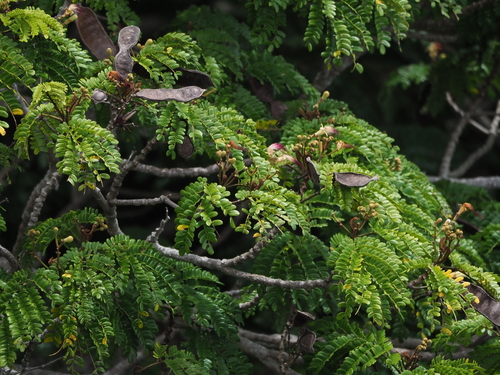
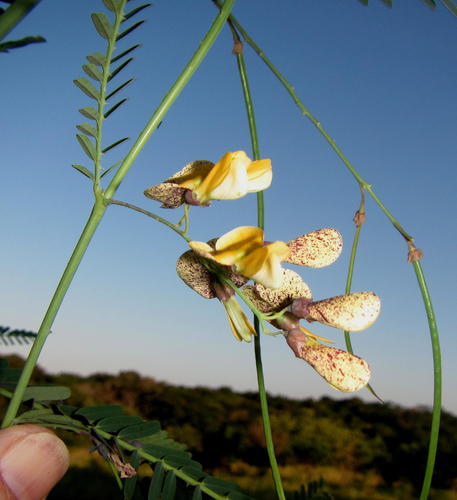
A tree. It grows 30 m high. The crown is flattened. The trunk is thick. The bark is almost colourless and has sticky sap. The twigs are angular and have a rusty coating. The leaves are compound. There are 12-18 pairs of leaflet stalks with 40-60 pairs of leaflets. They are leathery. The flower heads are in bundles. They are in the axils of leaves. They have a rusty coating. The fruit is a coiled pod. It is woody and 5-10 cm across. The pod is 2-3 cm wide. It is reddish brown and has veins across it. It is swollen over the seeds. There are many flat seeds. They are greenish and in a yellow pulp. The pulp is sweet and edible.
Edible Uses
The sweet pulp inside the coiled pods is edible.
Known Hazards
Some people are allergic to the dust produced when working with the wood.
Distribution
A tropical plant. It grows in rainforest and on ridges.
Where It Grows
Amazon, Bolivia, Brazil, Central America, Colombia, Costa Rica, French Guiana, Guatemala, Guiana, Guianas, Guyana, Mexico, North America, Panama, Peru, South America, Suriname, Venezuela,
Cultivation
Succeeds in full sun to fairly dense shade. Grows best in a fertile, well-drained, sandy soil that is rich in organic matter. This species has a symbiotic relationship with certain soil bacteria; these bacteria form nodules on the roots and fix atmospheric nitrogen. Some of this nitrogen is utilized by the growing plant but some can also be used by other plants growing nearby.
Propagation
Seed - it has a hard seedcoat and benefits from scarification before sowing to speed up and improve germination. This can usually be done by pouring a small amount of nearly boiling water on the seeds (being careful not to cook them!) and then soaking them for 12 - 24 hours in warm water. By this time they should have imbibed moisture and swollen - if they have not, then carefully make a nick in the seedcoat (being careful not to damage the embryo) and soak for a further 12 hours before sowing. Sow the treated seed in a sunny position in a nursery seedbed. A high germination rate can be expected from treated seeds, with the seed sprouting within 10 - 15 days.
Other Uses
The heartwood is light yellowish brown, sometimes with darker streaks; it is clearly demarcated from the 3 - 5cm wide band of deep cream coloured sapwood. The texture is medium; the grain straight or interlocked, sometimes wavy, lustre is low to medium, there is no odour or taste. The wood is heavy; moderately hard to hard; elastic; moderately durable, being very resistant to attack by both white rot and brown-rot fungi, dry wood borers and termites. It seasons somewhat slowly with a high risk of checking and distortion; once dry it is moderately to poorly stable in service. The wood is somewhat hard to cut, power tools are generally required; raised grain occurs when planing in the presence of interlocked grain; nailing and screwing are good; gluing is correct for internal purposes. It is used for decorative laminas, furniture, cabinet making, flooring blocks and boards, door jambs, agricultural implements, tool handles, cart bodies, frames, boat building, beams, scantlings, laths etc.
Notes
Also as Mimosaceae.
Synonyms
Also Known As
Boegoe-bati-batra, Dormilon, Tama-ren-prokoni, Vilco pashaco
References (7)
- Bendezu, Y. F., 2018, Arboles nativos de lad Region Ucayali. Instituto Nacional de Innovacion Agraria. p 129
- Condit, R., et al, 2011, Trees of Panama and Costa Rica. Princeton Field Guides. p 190
- Flores, Y., 2018, Arboles nativos de la Region Ucayili. Estacion Experimental Agragia Pucallpa. Pucallpa Peru, 375 p. p 129
- Lopez-Diago, D. & Garcia, N., 2021, Wild edible fruits of Colombia. Biota ColomBiana 22 (2) p 37
- Roa, J. A. G. & Boada, D. S. G., 2018, Fundación para el Fortalecimiento de la Fruticultura y Plantas Alimenticias no Convencionales en Colombia.
Show all 7 references Hide references
- Trans. Linn. Soc. London 30(3):599. 1875
- van Roosmalen, M.G.M., 1985, Fruits of the Guianan Flora. Utrecht Univ. & Wageningen Univ. p 232