Bouea macrophylla
Griffith
Maprang
iNaturalist· cc-by-nc
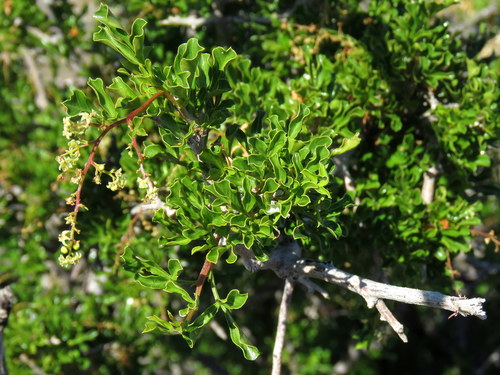
(c) Rafidah Abdul Rahman, some rights reserved (CC BY-NC), uploaded by Rafidah Abdul Rahman
iNaturalist· cc-by-nc
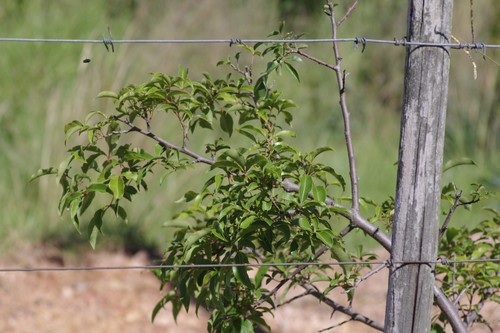
(c) Rafidah Abdul Rahman, some rights reserved (CC BY-NC)
Summary
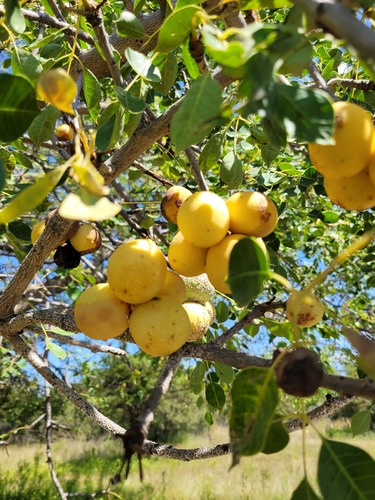
Source: WikipediaBouea macrophylla, commonly known as gandaria, Burmese plum, Marian plum, plum mango, mango plum or maprang in English, is a species of flowering plant native to Southeast Asia. The tree belongs to the family Anacardiaceae which also includes mango and cashew. The tree and its fruit are commonly confused with the closely related Bouea oppositifolia, both of which show considerable morphological variation. B. macrophylla has long lanceolate leaves and round yellow fruit, while B. oppositifolia has shorter oblong leaves and oval red/yellow fruit.
Description
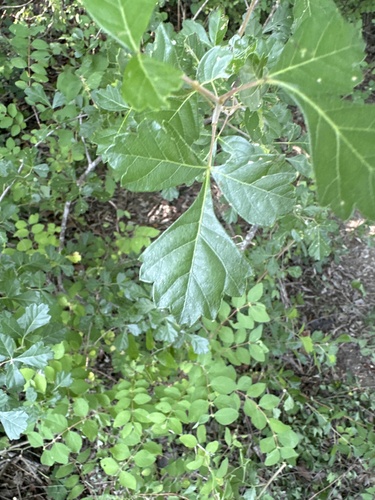
A medium sized tree. It grows 10-20 m tall. The bark is light brown and cracked. The branches are low and hanging. They can be angular or flattened. The leaves occur opposite one another along the stem. They are simple and oblong. They are 14-30 cm long by 5-8 cm wide. The leaves are opposite one another but each pair is at right angles to the nearby ones. The leaves are rough. The base is wedge shaped and they taper to the tip. The flowers are small and green. They occur in clusters at the ends of branches or in the axils of leaves. These flowering stalks are 4-12 cm long. The fruit are small and oval with one large seed. The fruit are 2.5-5 cm across. They are orange. They have a thin skin and edible flesh. There are several different named kinds.
Edible Uses
Both the leaves and fruit from the tree can be eaten. The leaves can be eaten raw when they are still young, and can be used in salads. While the seed is edible, the endosperm is generally bitter. The fruit is very acidic and has a mango-like flavour. It can be eaten raw, or made into dishes such as pickle, compote, or sambal. Unripened fruit can be used to make rojak and asinan. In Ambon, the fruit is made for juice.
Traditional Uses
The ripe fruit are used fresh or cooked and used in preserves. They are peeled. The young green fruit are pickled for curries. The young leaves can be eaten fresh and with rice.
Distribution
A tropical plant. It grows in the lowlands. It grows in the humid tropics. It does best in light fertile soil. It grows naturally up to 300 m altitude but has been planted up to 850 m altitude. In Cairns Botanical Gardens.
Where It Grows
Asia, Australia, Bangladesh, China, Cuba, Indochina, Indonesia, Laos, Malaysia*, Myanmar, Peru, Puerto Rico, SE Asia*, Singapore, South America, Taiwan, Thailand, West Indies,
Cultivation
Plants are normally grown from seed. It can be grown by air-layering or grafting. A spacing of 10 m x 12 m is used. Young plants need shade.
Propagation
Seed - Young trees need shade from the strongest sun. Grafting
Other Uses
The heartwood is dark brown with black streaks; it is sharply demacated from the light brown sapwood, which has a reddish tinge. Figures are formed by dark-coloured wood parenchyma on flat-sawn surfaces; dark-coloured corewood may be present; vessel lines are distinct: the texture is coarse and even; the grain is straight and/or interlocked. The wood is moderately hard to hard. It is suitable for medium construction under cover, whilst other uses include veneer and plywood, planking, general cabinet works and furniture. The wood is said to be durable, but is generally considered of poor quality and is only used for minor purposes.
Production
The first harvest is ready after 8-10 years using seedlings and after 5-6 years using vegetative plants. A mature tree can produce 200 kg of fruit in a season.
Other Information
It is a cultivated food plant. Fruit are sold in markets. The young leaves are also sold in markets.
Notes
There are 3 accepted Bouea species.
Nutrition
| Part | Moisture | kJ | kcal | Protein | Vit A | Vit C | Iron | Zinc |
|---|---|---|---|---|---|---|---|---|
| Fruit | 83 | 251 | 60 | 0.8 | — | — | 0.9 | — |
| Leaves | 81 | 251 | 60 | 3.1 | — | — | 4.7 | — |
Synonyms
Also Known As
Bandaria, Gandaria, Gondongan, Jantake, Kondongan, Kundag, Kundang, Kundang daun besar, Kundangan setar, Ma praang, Pao gandari, Rembunia, Remenya, Rumenia, Setar, Si-kundangan, Somprang, Star
References (44)
- Ali, A. M. S., 2005, Homegardens in Smallholder Farming Systems: Examples from Bangladesh. Human Ecology, Vol. 33, No. 2 pp. 245-270
- Arora, R. K., 2014, Diversity in Underutilized Plant Species - An Asia-Pacific Perspective. Bioversity International. p 60
- Bircher, A. G. & Bircher, W. H., 2000, Encyclopedia of Fruit Trees and Edible Flowering Plants in Egypt and the Subtropics. AUC Press. p 62
- Blench, R., 2004, Fruits and Arboriculture in the Indo-Pacific Region. Indo-Pacific Prehistory Association Bulletin 24. (Taipei Papers Volume 2) p 35
- Burkill, I.H., 1966, A Dictionary of the Economic Products of the Malay Peninsula. Ministry of Agriculture and Cooperatives, Kuala Lumpur, Malaysia. Vol 1 (A-H) p 358
Show all 44 references Hide references
- Chayamarit, K., 1994, Preliminary Checklist of the Family Anacardiaceae in Thailand. Thai For. Bull. 22:1-25
- Coronel, R.E., 1982, Fruit Collections in the Philippines. IBPGR Newsletter p 9
- Ding Hou, 1978, Anacardiaceae, in Flora Malesiana Ser 1 Vol 8(3) p 468
- Facciola, S., 1998, Cornucopia 2: a Source Book of Edible Plants. Kampong Publications, p 9
- Food Composition Tables for use in East Asia FAO http://www.fao.org/infoods/directory No. 414
- Food Composition Tables for use in East Asia FAO http://www.fao.org/infoods/directory No. 828 (Bouea spp.)
- Hu, Shiu-ying, 2005, Food Plants of China. The Chinese University Press. p 515
- INFOODSUpdatedFGU-list.xls
- J. Asiat. Soc. Bengal 23:635. 1854
- Kiple, K.F. & Ornelas, K.C., (eds), 2000, The Cambridge World History of Food. CUP p 1798
- Lembaga Biologi Nasional, 1977, Buah-Buahan, Balai Pustaka, Jakarta. p 38
- Macmillan, H.F. (Revised Barlow, H.S., et al) 1991, Tropical Planting and Gardening. Sixth edition. Malayan Nature Society. Kuala Lumpur. p 295
- Martin, F.W. & Ruberte, R.M., 1979, Edible Leaves of the Tropics. Antillian College Press, Mayaguez, Puerto Rico. p 174
- Martin, F. W., et al, 1987, Perennial Edible Fruits of the Tropics. USDA Handbook 642 (As Bouea gandaria)
- McMakin, P.D., 2000, Flowering Plants of Thailand. A Field Guide. White Lotus. p 104
- Miguel, E., et al, 1989, A checklist of the cultivated plants of Cuba. Kulturpflanze 37. 1989, 211-357
- Milow, P., et al, 2013, Malaysian species of plants with edible fruits or seeds and their evaluation. International Journal of Fruit Science. 14:1, 1-27
- Morton, J. F., 1987, Fruits of Warm Climates. Wipf & Stock Publishers p 237
- Norfaizal, , M., et al, 2014, Flora Diversity of Sungai Teris, Karu Wildlife reserve, Pahang, Malaysia. Journal of Wildlife and Parks (2014) 28 : 81-91
- Ochse, J.J. et al, 1931, Vegetables of the Dutch East Indies. Asher reprint. p 35
- Ong, H., et al, 2012, Traditional knowledge and usage of edible plants among the Semai community of Kampung Batu 16, Tapah, Perak, Malaysia. Scientific Research and Essays Vol. 7(4), pp. 441-445, 30 January, 2012
- PROSEA (Plant Resources of South East Asia) handbook, Volume 2, 1991, Edible fruits and nut. p 98
- Priyadi, H., et al, 2010, Five hundred plant species in Gunung Halimun Salak National Park West Java. A checklist including Sundanese names, distribution and use. CIFOR, FFPRI, SLU p 33
- Rivero, J. A., y Brunner, B. R., 2007, Arborels frutales exoticas y poco conocidos en Puerto Rico. Universidad de Puerto Rico. p 12
- Saw, L.G., LaFrankie, J. V. Kochummen, K. M., Yap S. K., 1991, Fruit Trees in a Malaysian Rain Forest. Economic Botany, Vol. 45, No. 1, pp. 120-136
- Slik, F., www.asianplant.net
- Soepadmo, E., et al (Eds), 1996, Tree Flora of Sabah and Sarawak. Volume 2 FRIM p 7
- Suksri, S., et al, 2005, Ethnobotany in Bung Khong Long Non-Hunting Area, Northeast Thailand. Kasetsart J., (Nat. Sci) 39: 519-533
- Sukarya, D. G., (Ed.) 2013, 3,500 Plant Species of the Botanic Gardens of Indonesia. LIPI p 160
- Tankard, G., 1990, Tropical fruit. An Australian Guide to Growing and using exotic fruit. Viking p 111
- Tate, D., 1999, Tropical Fruit. Archipelago Press. Singapore. p 38
- Terra, G.J.A., 1973, Tropical Vegetables. Communication 54e Royal Tropical Institute, Amsterdam, p 29
- Tominaga, T., 1992, Fruits and Vegetables in Markets in Bintulu, Sarawak, Malaysia. Journ. Fac. Agri. Shinshu Univ. 29:137-147
- USDA, ARS, National Genetic Resources Program. Germplasm Resources Information Network - (GRIN). [Online Database] National Germplasm Resources Laboratory, Beltsville, Maryland. Available: www.ars-grin.gov/cgi-bin/npgs/html/econ.pl (10 April 2000)
- Wiersema, J. H. & Leon, B., 2013, World Economic Plants. A Standard Reference CRC Press. 2nd Ed. p 108
- Wong, K. C., Collection and Evaluation of Under-Utilized Tropical and Subtropical Fruit Tree Genetic Resources in Malaysia. JIRCAS International Symposium Series No. 3: 27-38
- World Checklist of Useful Plant Species 2020. Royal Botanic Gardens, Kew
- Zawiah, N. & Othaman, H., 2012, 99 Spesies Buah di FRIM. Institut Penyelidikan Perhutanan Malaysia. p 70
- Zeven, A. C. & de West, J. M. J., 1982, Dictionary of cultivated plants and their regions of diversity. Wageningen. p 49