Apocynum venetum
L.
Dogbane, Netting hemp
iNaturalist· cc-by-nc
(с) Chuangzao, некоторые права защищены (CC BY-NC), загрузил Chuangzao
iNaturalist· cc-by-nc
(с) Теймуров А.А., некоторые права защищены (CC BY-NC), загрузил Теймуров А.А.
iNaturalist· cc-by-nc
(с) Aleksandr Popov / Александр Попов, некоторые права защищены (CC BY-NC), загрузил Aleksandr Popov / Александр Попов
Summary
Source: WikipediaApocynum venetum, commonly known as sword-leaf dogbane, is a plant species in the dogbane family that is poisonous but used as a source of fiber, medicine, and nectar for production of honey.
Description
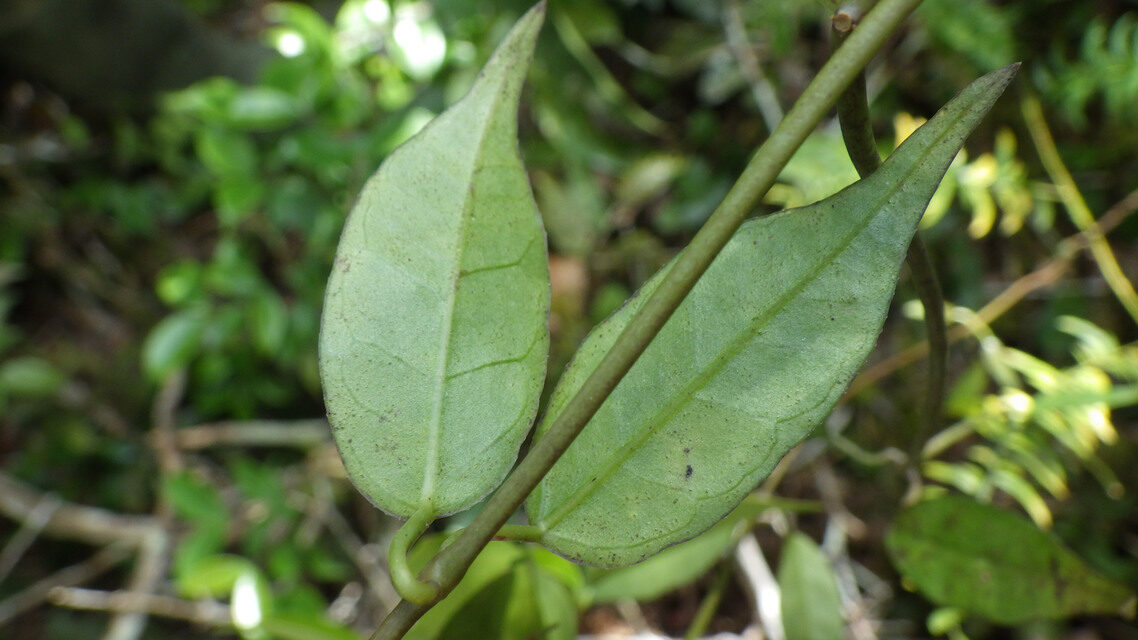
A erect herb. It has milky sap. It grows 1-2 m high. It has rhizomes or underground stems that are pink. The branches are purple-red. The leaves are opposite. They are narrowly sword shaped and 1-5 cm long by 1-2 cm wide. The flowers are pink or purple. They are in clusters at the ends of branches. The fruit are 2 long follicles 8-15 cm long and 2-3 mm wide. There are many seeds.
Edible Uses
None known
Traditional Uses
The leafy shoots are gathered and steamed and dried then used for tea.
This uses section is brief — help expand it
Medicinal Uses
Cardiotonic Diuretic Hypotensive The leaves or the whole herb is cardiotonic, diuretic and hypotensive. It is used in the treatment of hypertensive headache, dizziness, insomnia, irritability, oliguria and nephritic oedema. It increases the renal blood flow and can be used for renal and cardiac oedema and ascites of liver cirrhosis.
Known Hazards
All parts of the plant are poisonous.
Distribution
It is a temperate plant. In China it grows in lowlands near lakes. It grows in wetlands. In north China is grows in salty barren areas and on the edges of deserts.
Where It Grows
Asia, China, Europe, India, Japan, Korea, Mongolia, Pakistan, Russia, Tibet,
Cultivation
Succeeds in sun or shade in most well-drained but moisture-retentive soils. Plants can be invasive. The flowers are attractive to bees.
Propagation
Seed - best sown as soon as it is ripe in late summer and overwintered outdoors. The seed requires a period of cold stratification if it is to germinate well. Prick out the seedlings when large enough to handle and grow them on in a cold frame for their first winter, planting out in late spring of the following year. Division in spring just before active growth begins. Plants can also be divided in the autumn.
Other Uses
Fibre The bark yields a fibre that is used for making twine, bags, linen etc. It can be harvested after the leaves fall in autumn but is probably at its best as the seed pods are forming. The dogbane-milkweed family Asclepias, Apocynum, Calotropis, and Trachomitum spp) has been used for fiber industrial crops for millennia with a number in cultivation as regional crops. All of these crops are dual-purpose fibres, offering bast fibres from the stem and seed fiber or ‘floss’ in the fruit pods. Many have also been identified as potential hydrocarbon crops due to high latex content. Could be integrated into various agroforestry systems rather than as monocultures [1-1]. Special Uses Carbon Farming
Notes
It is also used in medicine.
Synonyms
Also Known As
Bargasun chai
References (5)
- Hu, Shiu-ying, 2005, Food Plants of China. The Chinese University Press. p 629
- Khasbagan, Hu-Yin Huai, and Sheng-Ji pei, 2000, Wild Plants in the Diet of Athorchin Mongol Herdsmen in Inner Mongolia. Economic Botany 54(4): 528-536
- Urgamal, M., Oyuntsetseg, B., Nyambayar, D. & Dulamsuren, Ch. 2014. Conspectus of the vascular plants of Mongolia. (Editors: Sanchir, Ch. & Jamsran, Ts.). Ulaanbaatar, Mongolia. “Admon“ Press. 334pp. (p. 79-90).
- World Checklist of Useful Plant Species 2020. Royal Botanic Gardens, Kew
- Zhang, Y., et al, 2014, Diversity of wetland plants used traditionally in China: a literature review. Journal of Ethnobiology and Ethnomedicine. 10:72