Ochroma pyramidale
(Cav. ex Lam.) Urb.
Balsa tree
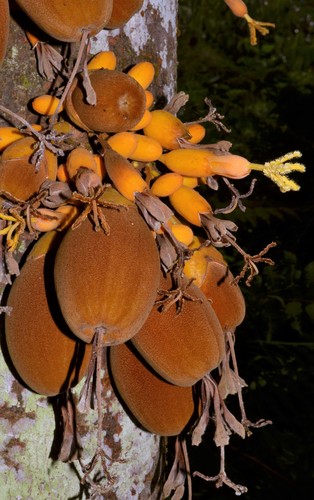
iNaturalist· cc-by-nc
(c) pkondrashov, some rights reserved (CC BY-NC)
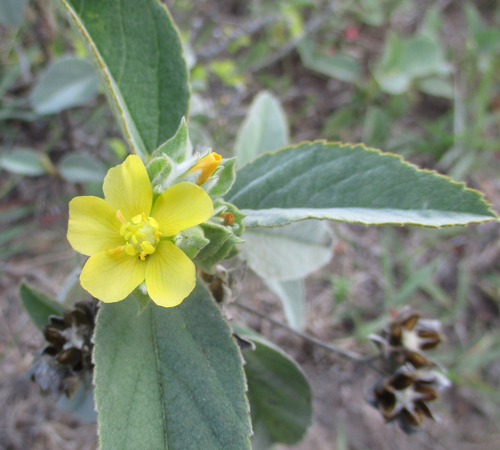
iNaturalist· cc-by-nc
(c) Delvis Romero, some rights reserved (CC BY-NC)
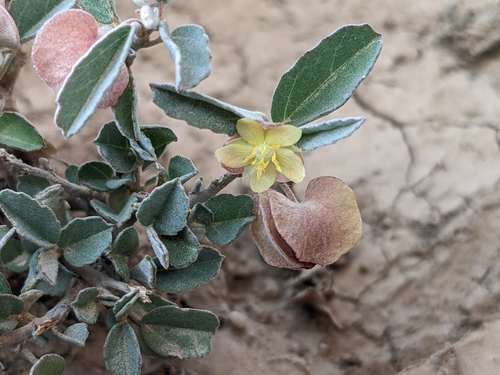
iNaturalist· cc-by-nc-sa
(c) Manuel de Jesús Hernández Ancheita, some rights reserved (CC BY-NC-SA)
Summary
Source: WikipediaAn evergreen tree reaching 30m tall with fast growth, hardy to UK zone 10 and frost tender. It requires full sun and well-drained soil, adapting to sandy, loamy, or heavy clay soils with acidic to alkaline pH. The tree tolerates moist conditions and some drought. Flowers are pollinated by bats and birds.
Description
A tree. It grows 25 m high. The bark is smooth and grey. The trunk can have buttresses. The branches are thick. The leaf blades are 30 cm long and broad. They have 3-5 lobes. They are softly hairy and grey-green. The flowers are bell shaped and erect. They are 12 cm long. The fruit is a capsule 25 cm long. It opens with 5 valves. There is silvery-brown fluff with many small seeds. The seeds are 5 mm long.
Edible Uses
None known
Medicinal Uses
The root bark is emetic.
Distribution
It is a tropical plant. In Costa Rica it grows from sea level to 1,200 m altitude. It grows in open areas.
Where It Grows
Africa, Amazon, Andes, Antilles, Asia, Australia, Belize, Bolivia, Brazil, Cameroon, Caribbean, Central America, Colombia, Costa Rica, Cuba, Dominica, Dominican Republic, Ecuador, El Salvador, Guadeloupe, Guatemala, Guiana, Guyana, Haiti, Honduras, Jamaica, Marquesas, Martinique, Mexico, Myanmar, Nicaragua, North America, Pacific, Panama, Papua New Guinea, PNG, Puerto Rico, SE Asia, South America, St. Lucia, Trinidad and Tobago, Venezuela, Vietnam, West Indies,
Cultivation
A plant of the lowland humid tropics, also succeeding at elevations up to 1,000 metres. It grows best in areas where annual daytime temperatures are within the range 18 - 35°c, but can tolerate 15 - 38°c. When dormant, the plant can survive temperatures down to about 5°c. It prefers a mean annual rainfall in the range 2,500 - 3,000mm, but tolerates 1,500 - 4,000mm. It can tolerate a dry season of up to 4 months, but only if the relative humidity does not normally drop below 75%. Prefers a deep, fertile, moisture-retentive but well-drained soil in a sunny position. Prefers a pH in the range 5.5 - 6.5, tolerating 5 - 8. Plants are very tolerant of salt-laden winds. A very fast-growing, but short-lived tree. It can reach a height of 20 metres, with a bole diameter of up to 60cm within 7 years and has been known to grow even faster on very rich soils. Trees can commence flowering and producing viable seeds when 3 - 4 years old. They can flower and produce seed all year round. Trees usually reach maturity when about 12 - 15 years old, after which they deteriorate rapidly, growth slows, the heartwood becomes waterlogged and doty (not sure what this means; it might be based on dotage - becoming old and senile), and the new growth is hard and heavy. Annual wood production potential is 17 - 30 cubic metres per hectare. The tree is highly sensitive to fire damage.
Propagation
Seed requires high temperatures to germinate and can be sown directly in the field or in a nursery. Freshly collected seed has only 10% germination. The seed has an impervious testa that must be ruptured by heat — such as boiling water or fire — before germination will occur. Under natural conditions, forest clearance exposes soil to sunlight, triggering germination. In nursery conditions, seeds are sown in lines 3–4cm apart under slight shade in sterilized soil to prevent damping-off. Pre-treated seeds show 65–75% germination in 6–28 days; seedlings are then pricked out and transferred to containers. The very small seeds should be collected from standing trees and can be stored for several years in jute bags or closed containers.
Other Uses
A typical pioneer species, balsa is fast-growing and rapidly colonizes clearings. The woolly fibre from the seedpods can be used like kapok as stuffing for pillows and mattresses. Fibre from the bark has been used to make ropes. The heartwood is white to grey-white, sometimes with a pinkish tinge near the heart in older trees, and is not clearly demarcated from the sapwood. The grain is straight, the texture coarse and even, with a silky lustre. The heartwood is too heavy for commercial use and most commercially traded stock is sapwood. Balsa is the lightest known commercial timber, even lighter than cork. High-grade timber weighs less than 150 kg/m³ at 12% moisture content and is generally produced by trees aged 8–9 years; older trees produce heavier heartwood considered of secondary quality. The outermost sapwood differs significantly from inner wood — the outer 3cm is on average 2.2 times heavier than the inner 3cm. The wood is very soft and weak but has a good strength-to-weight ratio; wood from older trees tends to be brittle. It is non-durable and prone to attack by Anobium and Lyctus borers, termites, and longhorn beetles. Shrinkage from green to oven-dry is small to medium; kiln drying is preferable to air drying to minimize splitting and warping. Movement in service is small. The wood works very easily with hand and machine tools, though sharp tools are needed to prevent crumbling. It takes nails and screws readily but is too soft to hold them well. Planing is nearly impossible; gluing properties are good, and it stains, polishes, and paints satisfactorily, though it is very absorbent. Bending properties are poor. Balsa has an unusually high buoyancy and provides very efficient insulation against heat and sound, remaining effective at temperatures as low as -250°C. Some older trees develop a pink heartwood that is brittle and markedly inferior to the sapwood. The wood is suitable for pulping by chemical and semi-chemical processes, yielding 45–50% pulp with good strength characteristics; the pulp bleaches easily without loss of strength, making it suitable for printing and writing papers. Uses include floats, buoys, lifejackets, life-belts, surfboards, aircraft construction, ship and boat building, lightweight boxes, toys, model making, laboratory mounting boards, core stock in sandwich construction, surgical splints, packaging of fragile articles, and insulation against temperature, vibration, and sound. Slightly heavier wood is used for matches, popsicle sticks, toothpicks, and pulp and paper production.
Notes
Also put in the family Bombacaceae. In the subfamily Bombacoideae.
Synonyms
Also Known As
Algodon, Arbol de lgodon, Balsa, Balsa de lana, Balsa lanero, Balsamo, Balsillo, Boya, Burillo, Cajeto, Caore, Catillo, Ceibo de lana, Chan-tho, Corcho, Cuano, Enca, Enea, Gatillo, Gonote, Guano, Hpaw-thit, Huampo, Huempo, Jonote real, Lana, Lanera, Lanero, Maho, Mahodem, Mapajo, Menudito, Topa, Tucumo
References (8)
- Condit, R., et al, 2011, Trees of Panama and Costa Rica. Princeton Field Guides. p 270
- Grandtner, M. M. & Chevrette, J., 2013, Dictionary of Trees, Volume 2: South America: Nomenclature, Taxonomy and Ecology. Academic Press p 451
- Pittier, 1978,
- Plants of Haiti Smithsonian Institute http://botany.si.edu/antilles/West Indies
- Repert. Spec. Nov. Regni Veg. Beih. 5:123. 1920
Show all 8 references Hide references
- Roa, J. A. G. & Boada, D. S. G., 2018, Fundación para el Fortalecimiento de la Fruticultura y Plantas Alimenticias no Convencionales en Colombia.
- Zambrana, P, et al, 2017, Traditional knowledge hiding in plain sight – twenty-first century ethnobotany of the Chácobo in Beni, Bolivia. Journal of Ethnobiology and Ethnomedicine (2017) 13:57
- Zuchowski W., 2007, Tropical Plants of Costa Rica. A Zona Tropical Publication, Comstock Publishing. p 44