Grewia tenax
(Forsk.) Fiori
Small-leaved white raisin
iNaturalist· cc-by
(c) Wynand Uys, some rights reserved (CC BY), uploaded by Wynand Uys
iNaturalist· cc-by
(c) Karim Haddad, some rights reserved (CC BY)
iNaturalist· cc-by
(c) Karim Haddad, some rights reserved (CC BY)
Summary
Source: WikipediaGrewia tenax, called the phalsa cherry, white crossberry, raisin bush, gangara, gangu, or kanger, is a species of flowering plant in the family Malvaceae. It is native to Africa, from the Sahara to Tanzania and parts of southern Africa, the Arabian Peninsula, and on to the Indian subcontinent. The ripe fruit is edible and is consumed by local peoples either fresh, dried, or powered in drinks.
Description
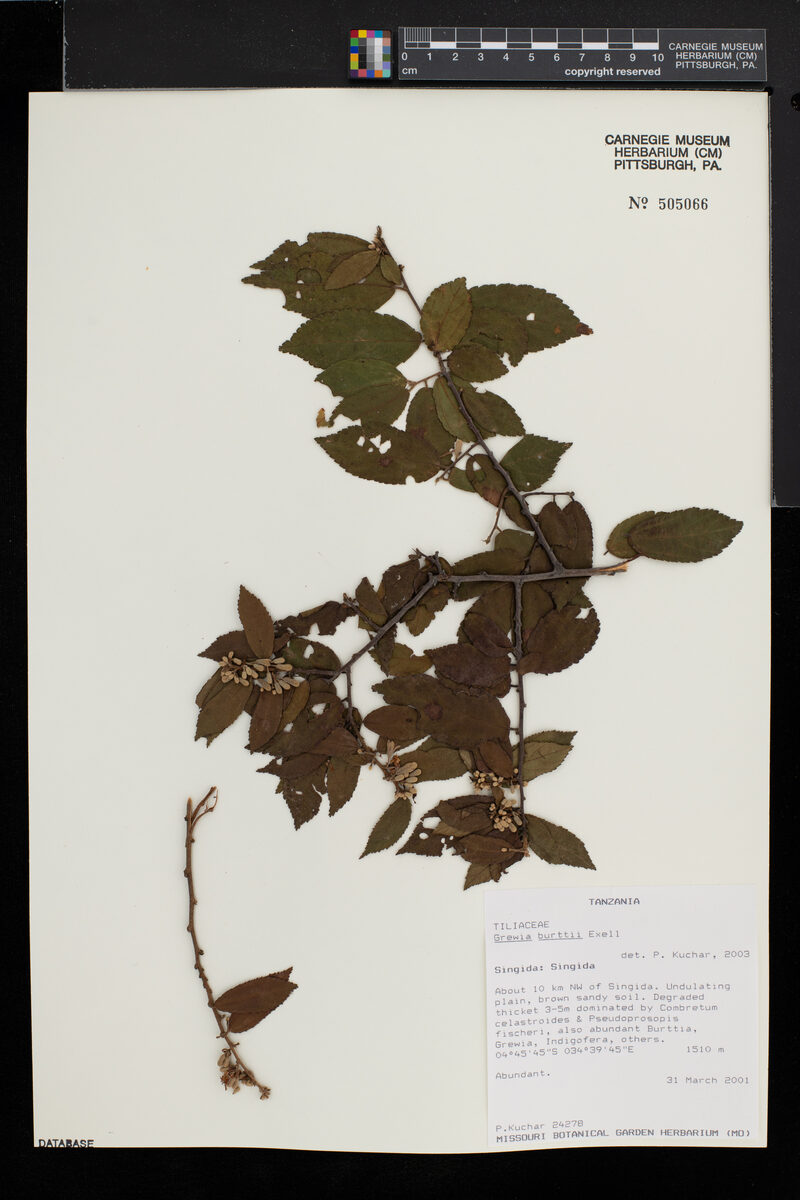
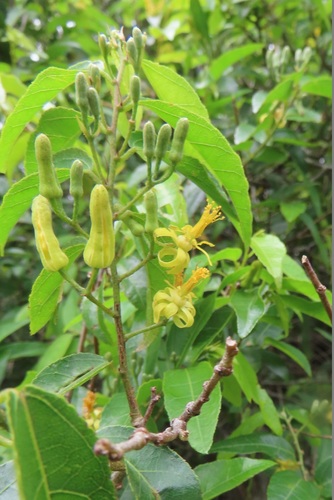
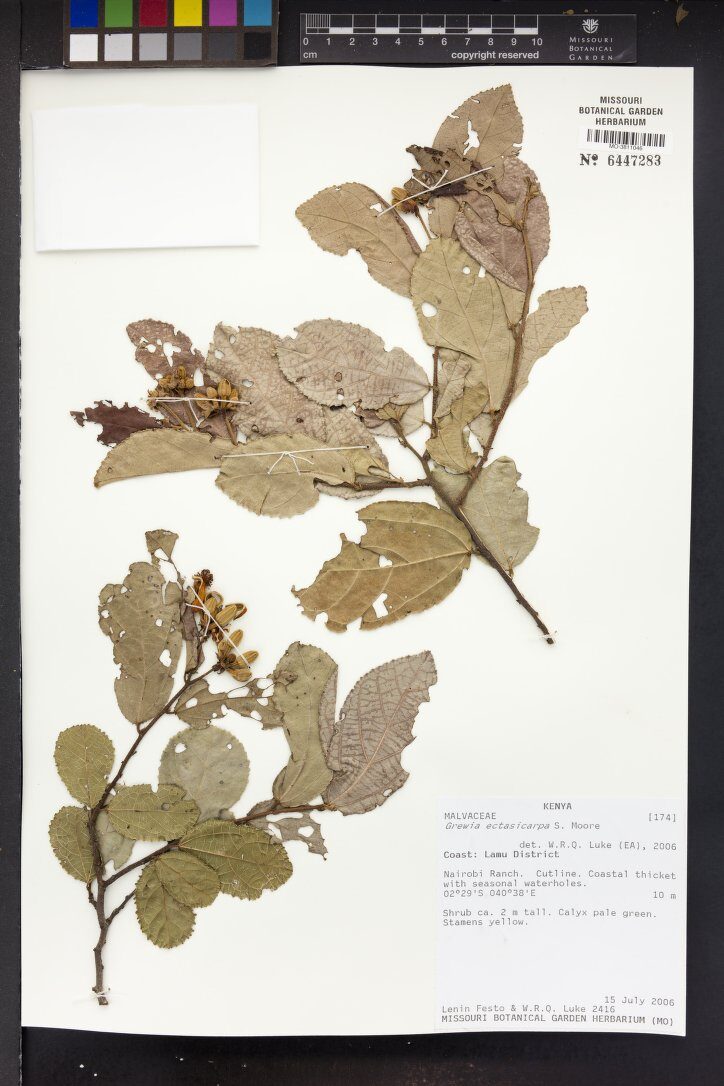
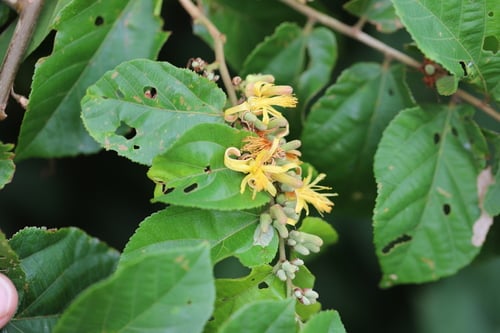
A shrub. It grows up to 2 m tall. Often it lies along the ground. The leaves are small and nearly round. They are 5 cm long. They have 5 main veins. The tip of the leaf is pointed and the edge has teeth. The lower leaf surface has hairs. The flowers are white and occur singly. They are 2 cm across. They are on long slender branches. The fruit are orange red and smooth. They have 1-4 lobes. They are the size of a small maize grain. They are edible.
Edible Uses
The ripe fruit are eaten fresh and raw, or dried for later consumption and added to grains in porridge. A drink is made by soaking the fruit overnight, then pressing, sieving, and sweetening the juice. The seeds are also edible.
Traditional Uses
The ripe fruit are eaten fresh and raw. They are also dried for eating later. They are added to grains in porridge. A drink is made by soaking the fruit overnight then pressing, sieving and sweetening the juice. The seeds are edible.
Medicinal Uses
Grewia species are valued in many cultures for their medicinal virtues. The main medicinal action appears to come from the mucilage that is found in the leaves, stems and roots, which has been shown to have soothing and healing properties. Taken internally it is often used as a remedy for diarrhoea and dysentery, for example, whilst externally it is applied to wounds, cuts, ulcers, irritations etc. The plant can be taken as a simple infusion or decoction, or it can be applied topically as a poultice of the plant, or the mucilage can be extracted from the plant, if required, by maceration and then decoction. The roots are used to make a poultice and are used for curing various skin diseases. A mucilage obtained from the bark is reported to possess bactericidal activity and is used in the treatment of tuberculosis. The mucilaginous bark preparation is used by women as a treatment against hair vermin. The plant (parts not specified) is used as a remedy for colds and chest complaints and is also a chief constituent in a typhoid remedy A decoction of the wood is given in the treatment of coughs and pains. A ethanolic extract of the aerial parts was found to exhibit CNS depressant activity
Distribution
A tropical plant. It grows in arid zones. It occurs in very dry woodland and semi-desert scrub. It grows on rocky and gravely soils. It grows in the Sahel. It is often near temporary pools. It is in areas with over 200 mm rainfall. It can tolerate salt. In East Africa it grows between sea level and 1,500 m altitude. It can grow in arid places. It grows in the Sahara.
Where It Grows
Africa, Algeria, Arabia, Asia, Botswana, Burkina Faso, Cameroon, Central Africa, Chad, Djibouti, East Africa, Egypt, Ethiopia, India, Iran, Kenya, Malawi, Mali, Mauritania, Mediterranean, Middle East, Morocco, Namibia, Niger, Nigeria, North Africa, Pacific, Pakistan, Sahel, Senegal, Somalia, Southern Africa, Southern Africa, South Sudan, Sri Lanka, Sudan, Tanzania, Tonga, Uganda, West Africa, Western Sahara, Yemen, Zimbabwe,
Cultivation
Plants can be grown from seeds.
Propagation
Seed - germination is reportedly difficult in this species. However, germination percentages of over 75% have been achieved by pretreating the seed by repeated washing and scrubbing until all the flesh is removed. Germination then occurs after 10 days.
Other Uses
The bark is used to make ropes and for binding work in hut construction. The heartwood is brown, the sapwood yellow. The wood is extremely hard, close-grained and termite-resistant. It is used for walking sticks, implement handles, spear and harpoon-shafts, canoes etc. The wood is used as a fuel and for making charcoal. The shrub can be used for hedging. The plant has an aggressive root system, which holds fast to the soil protecting it from water and wind erosion; whilst its leaf litter improves soil physical and chemical properties. Combined with its sturdy growth habit, it seems to have promise as a dune fixing plant in desert reclamation projects. Intercropping with this plant may not affect crop growth adversely.
Production
In NW Pakistan fruit are available in August.
Other Information
The fruit are eaten especially by children.
Notes
Chemical composition (Sudan sample): Protein (crude) = 6.3% (dry). Fat = 0.4% (dry). Fibre (crude) = 8.1% (dry). Ash = 4.5% (dry). Carbohydrate (soluble): Starch = 15.1% dry). Sucrose = 1.6% (dry). D-glucose = 21.0% (dry). D-fructose = 24.3% (dry). Amino acids (g [16g N]-1): Aspartic acid = 8.1g. Threonine = 2.1g. Serine = 2.4g. Glutamic acid = 6.2g. Proline = 11.6g. Glycine = 3.5g. Alanine = 2.4g. Valine = 2.8g. Cysteine = 1.0g. Methionine = 0.7g. Isoleucine = 2.0g. Leucine = 3.4g Tyrosine = 2.5g. Phenylalanine = 2.2g. Lysine = 2.0g. Histidine = 1.1g. Arginine = 3.2g. Minerals: Sulphur = 0.10% (dry). Potassium = 0.08% (dry). Magnesium = 0.17% (dry). Calcium = 0.61% (dry). Na = 0.01% (dry). K = 1.45% (dry). Zinc = 21 mg/kg-1 (dry). Iron = 74 mg/kg-1 (dry). Manganese = 10 mg/kg-1 (dry). Copper = 7 mg/kg-1 (dry). There are about 200 Grewia species. They are mostly tropical. The fruit of most may be edible. These were in the Sparrmanniaceae and the Tiliaceae.
Nutrition
| Part | Moisture | kJ | kcal | Protein | Vit A | Vit C | Iron | Zinc |
|---|---|---|---|---|---|---|---|---|
| Fruit - dry | 9.2 | 1157 | 277 | 5.5 | — | — | — | — |
| Fruit | 59.1 | — | — | 4.5 | — | 161 | 125 | — |
Synonyms
Also Known As
Achuchu, Chaberi, Chaqlessa, Chari, Daieta-konso, Daiyta, Damak, Deka tuntuna, Dhafaruur, Eka fila, Eng'omo, Engoma, Gaddem, Gangara, Gangee, Gangeran, Gangerun, Gango, Gangu kanger, Giddem, Gidem, Gondni, Guddeim, Gundukadira, Gwangi, Gwigo, Hedayito, Horma-daiyta, Huda, Kadadari, Kakoon, Kaladi, Kamanmua, Kanatol, Kango, Khedar, Khus, Mine gure, Mkokora, Mkoma, Nari, Oqombi, Pasthawnai, Phalsa cherry, Saarkama, Sari, Small-leaved white cross-berry, Schohudt, Tapadi, Tarakat, Taran, Toronwo
References (71)
- ABDELMUTI,
- Addis, G., Asfaw, Z & Woldu, Z., 2013, Ethnobotany of Wild and Semi-wild Edible Plants of Konso Ethnic Community, South Ethiopia. Ethnobotany Research and Applications. 11:121-141
- Addis, G., et al, 2013, The Role of Wild and Semi-wild Edible Plants in Household Food Sovereignty in Hamer and Konso Communities, South Ethiopia. Ethnobotany Research & Applications. 11:251-271
- Agric. Colon. 5, suppl. 23. 1912
- Ahmad, K. & Pieroni, A., 2016, Folk knowledge of wild food plants among the tribal communities of Thakht-e-Sulaiman Hills, North-West Pakistan. Journal of Ethnobiology and Ethnomedicine, 12:17
Show all 71 references Hide references
- Al-Fatimi, M. A., Wild Edible Plants Traditionally Collected and Used in Southern Yemen. Research Square. University of Aden. p 19
- Ambasta, S.P. (Ed.), 2000, The Useful Plants of India. CSIR India. p 250
- Asfaw, Z. and Tadesse, M., 2001, Prospects for Sustainable Use and Development of Wild Food Plants in Ethiopia. Economic Botany, Vol. 55, No. 1, pp. 47-62
- Assefa, A. & Abebe, T., 2010, Wild Edible Trees and Shrubs in the Semi-arid Lowlands of Southern Ethiopia. Journal of Science and Development 1 (1) 2010
- Bahru, T., et al, 2013, Wild Edible Plants: Sustainable Use and Management by Indigenous Communities in and the Buffer Area of Awah National Park, Ethiopia. Ethiop. J. Sci., 36(2): 93-108
- Ballal, M. E., et al, 2014, Ethno-botany of Natural Forests of Nuba Mountains, South Kordofan State, Sudan. Journal of Forest Poducts & Industries. 3(1):13-19
- Barrau, J., 1961 (1976 reprint), Subsistence Agriculture in Polynesia and Micronesia. Bernice P. Bishop Museum Bulletin 223, Honolulu, Hawaii, p 63 (As Grewia populifolia)
- Bernholt, H. et al, 2009, Plant species richness and diversity in urban and peri-urban gardens of Niamey, Niger. Agroforestry Systems 77:159-179
- Burkill, H. M., 1985, The useful plants of west tropical Africa, Vol. 5. Kew.
- Dale, I. R. and Greenway, P. J., 1961, Kenya Trees and Shrubs. Nairobi. p 569
- Dharani, N., 2002, Field Guide to common Trees & Shrubs of East Africa. Struik. p 238
- Dobriyal, M. J. R. & Dobriyal, R., 2014, Non Wood Forest Produce an Option for Ethnic Food and Nutritional Security in India. Int. J. of Usuf. Mngt. 15(1):17-37
- Edwards. S., et al, (Eds), 1995, Flora of Ethiopia and Eritrea. Vol.2, Part 2 Canellaceae to Euphorbiaceae. Uppsala, Sweden. p 162
- Ethiopia: Famine Food Field Guide. http://www.africa.upenn.edu/faminefood/category3.htm
- Exell, A.W. et al, (Ed), 1963, Flora Zambesiaca Vol 2 Part 1 Crown Agents, London. p 59
- Facciola, S., 1998, Cornucopia 2: a Source Book of Edible Plants. Kampong Publications, p 241
- FAO, 1988, Traditional Food Plants, FAO Food and Nutrition Paper 42. FAO Rome p 314
- Feyssa, D. H., et al, 2011, Seasonal availability an consumption of wild edible plants in semiarid Ethiopia; Implications to food security and climate change adaptation. Journal of Horticulture and Forestry 3(5): 138-149
- Flora Somalia Vol. 1, 1993, http://plants.jstor.org
- Flora of Pakistan. www.eFloras.org
- GAMMIE, (As Grewia populifolia)
- Gemedo-Dalle, T., et al, 2005, Plant Biodiversity and Ethnobotany of Borana Pastoralists in Southern Oromia, Ethiopia. Economic Botany 59(1) pp. 43-65
- Goode, P., 1989, Edible Plants of Uganda. FAO p 30
- Grivetti, L. E., 1980, Agricultural development: present and potential role of edible wild plants. Part 2: Sub-Saharan Africa, Report to the Department of State Agency for International Development. p 41 (As Grewia populifolia)
- Grubben, G. J. H. and Denton, O. A. (eds), 2004, Plant Resources of Tropical Africa 2. Vegetables. PROTA, Wageningen, Netherlands. p 562
- Gueye, M., et al, 2014, Wild Fruits Traditionally Gathered by the Malinke Ethnic Group in the Edge of Niokolo Koba Park (Senegal). American Journal of Plant Sciences 5, 1306-1317
- GUPTA & KANODIA,
- Hedrick, U.P., 1919, (Ed.), Sturtevant's edible plants of the world. p 334 (As Grewia populifolia)
- http://www.fao.org/forestry/25323-096344a3de335832e8f363c3ac5184a66.pdf
- Ichikawa, M., 1980, The Utilization of Wild Food Plants by the Suiei Dorobo in Northern Kenya. J. Anthrop. Soc. Nippon. 88(1): 25-48
- INFOODS:FAO/INFOODS Databases
- Jardin, C., 1970, List of Foods Used In Africa, FAO Nutrition Information Document Series No 2.p 141
- Khan, D. & Shaukat, S.S., 2006, The Fruits of Pakistan: Diversity, Distribution, Trends of Production and Use. Int. J. Biol. Biotech., 3(3):463-499
- Le Houerou, H. N., (Ed.), 1980, Browse in Africa. The current state of knowledge. International Livestock Centre for Africa, Ethiopia. p 163
- Lulekal, E., et al, 2011, Wild edible plants in Ethiopia: a review on their potential to combat food insecurity. Afrika Focus - Vol. 24, No 2. pp 71-121
- Malan & Owen-Smith, 1974,
- Mannheimer, C. A. & Curtis. B.A. (eds), 2009, Le Roux and Muller's Field Guide to the Trees and Shrubs of Namibia. Windhoek: Macmillan Education Namibia. p 326
- Maundu, P. et al, 1999, Traditional Food Plants of Kenya. National Museum of Kenya. 288p
- Marwat, S. K., 2011, Medico-ethnobotanical studies of edible wild fruit plants species from the flora of northwestern Pakistan (D. I. Khan district). Journal of Medicinal Plants Research Vol. 5(16) pp 3679-3686.
- Maydell, H. von, 1990, Trees and shrubs of the Sahel: their characteristics and uses. Margraf. p 297
- Moksia, F., et al, 2019, Diversity and Socio-Economic Value of Wild Edible Plants in the Mounts Mandara Region, Cameroon. International Journal of Sciences. Vol. 8:10
- Morgan, W. T. W., 1981, Ethnobotany of the Turkana: Use of plants by a Pastoral People and Their Livestock in Kenya. Economic Botany 35(1):96-130
- Mutie, F. G., 2020, Conservation of Wild Food Plants and Their Potential for Combatting Food Insecurity in Kenya as Exemplified by the Drylands of Kitui County. Plants 2020, 9, 1017
- Mutie, F. M., et al, 2023, Important Medicinal and Food Taxa (Orders and Families) in Kenya, Based on Three Quantitative Approaches. Plants 2023, 12, 1145
- Nassif, F., & Tanji, A., 2013, Gathered food plants in Morocco: The long forgotten species in Ethnobotanical Research. Life Science Leaflets 3:17-54
- Omer, M., 2011, Diversity of Woody Species, Local Knowledge and Management Practices in Different Land Use Systems of Awbare Wereda, Jig-Jiga Zone of Somali Region, Ethiopia. M. Sc. thesis Addis Abba University p 47
- Palgrave, K.C., 1996, Trees of Southern Africa. Struik Publishers. p 581
- Peters, C. R., O'Brien, E. M., and Drummond, R.B., 1992, Edible Wild plants of Sub-saharan Africa. Kew. p 193
- Royal Botanic Gardens, Kew (1999). Survey of Economic Plants for Arid and Semi-Arid Lands (SEPASAL) database. Published on the Internet; http://www.rbgkew.org.uk/ceb/sepasal/internet [Accessed 11th June 2011]
- Ruiters-Welcome, A. K., 2019, Food plants of southern Africa. Ph.D. thesis. Univ. of Johannesburg p 76
- Salih, N. K. M., & Ali, A. H., 2014, Wild food trees in Eastern Nuba Mountain, Sudan: Use, diversity, and threatening factors. Journal of Agriculture and Rural Development in the Tropics and Subtropics Vol. 115 No. 1 pp 1-7
- SAXENA,
- SHANKARNARAYAN & SAXENA,
- Shekhawat, G.S. & Anand, S., 1984, An Ethnobotanical Profile of Indian Desert. J. Econ. Tax. Bot. Vol.5 No.3 pp 591-598
- Singh, H.B., Arora R.K.,1978, Wild edible Plants of India. Indian Council of Agricultural Research, New Delhi. p 62, 82
- Symb. bot. 1:33. 1790 (As Grewia populifolia)
- Tanaka,
- Termote, C., et al, 2014, Assessing the potential of wild foods to reduce the cost of a nutritionally adequate diet: An example from eastern Baringo District, Kenya. Food and Nutrition Bulletin, vol. 35, no. 4
- Uphof,
- van Wyk, Be., & Gericke, N., 2007, People's plants. A Guide to Useful Plants of Southern Africa. Briza. p 44
- Wehmeyer, A. S, 1986, Edible Wild Plants of Southern Africa. Data on the Nutrient Contents of over 300 species
- Welcome, A. K. & Van Wyk, B.-E., 2019, An inventory and analysis of the food plants of southern Africa. South African Journal of Botany 122 (2019) 136–179
- World Checklist of Useful Plant Species 2020. Royal Botanic Gardens, Kew
- www.worldagroforestrycentre.org/treedb/
- Young, H., et al, 2005, Darfur - Livelihoods under Siege. Feinstein International Famine Center. p 175
- Young, H. et al, 2016, Risk, Resilience and Pastoralist Mobility. Feinstein International Center. p 58