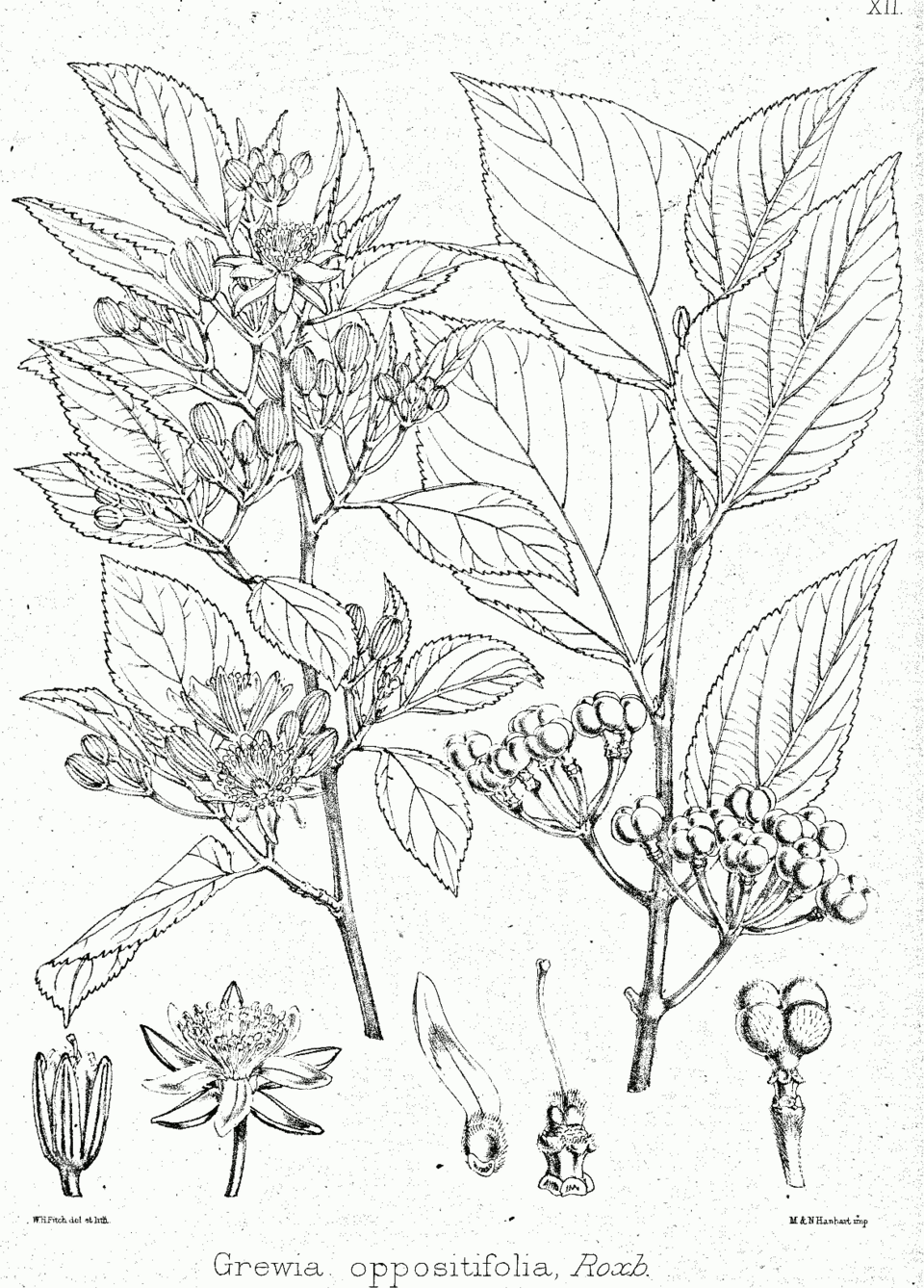
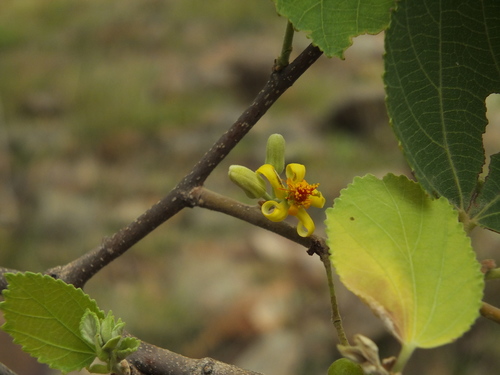
Grewia tiliifolia
Vahl
iNaturalist· cc-by-nc
(c) zxchang, some rights reserved (CC BY-NC), uploaded by zxchang
iNaturalist· cc-by-nc
(c) zxchang, some rights reserved (CC BY-NC)
Summary
Source: WikipediaGrewia tiliifolia (syn. Grewia damine) is a species of flowering plant in the family Malvaceae sensu lato. A tree reaching 8 m (26 ft), it is found in monsoon and intermediate forest gaps and fringes of Sri Lanka, where the plant is known as "daminiya" in Sinhala and "chadachchi" in Tamil. It is also found in Pakistan (Sind, Punjab), India (Punjab, Madhya Pradesh, Peninsula), Nepal and Southeast Asia. Grewia tiliifolia is used in traditional medicine, using bark and roots for fractures, diarrhoea and skin diseases. Its wood is used for tool handles. The fruit is edible.
Description
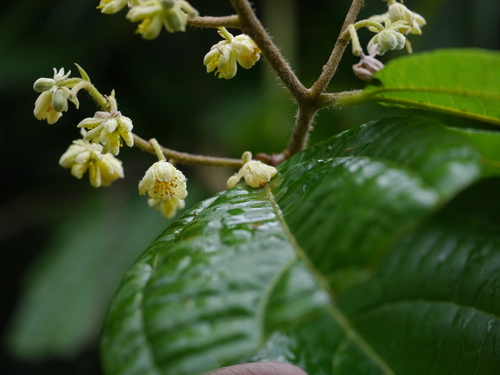
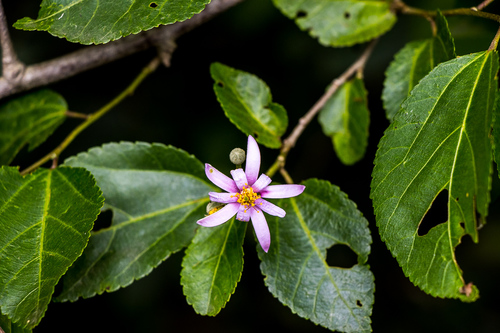
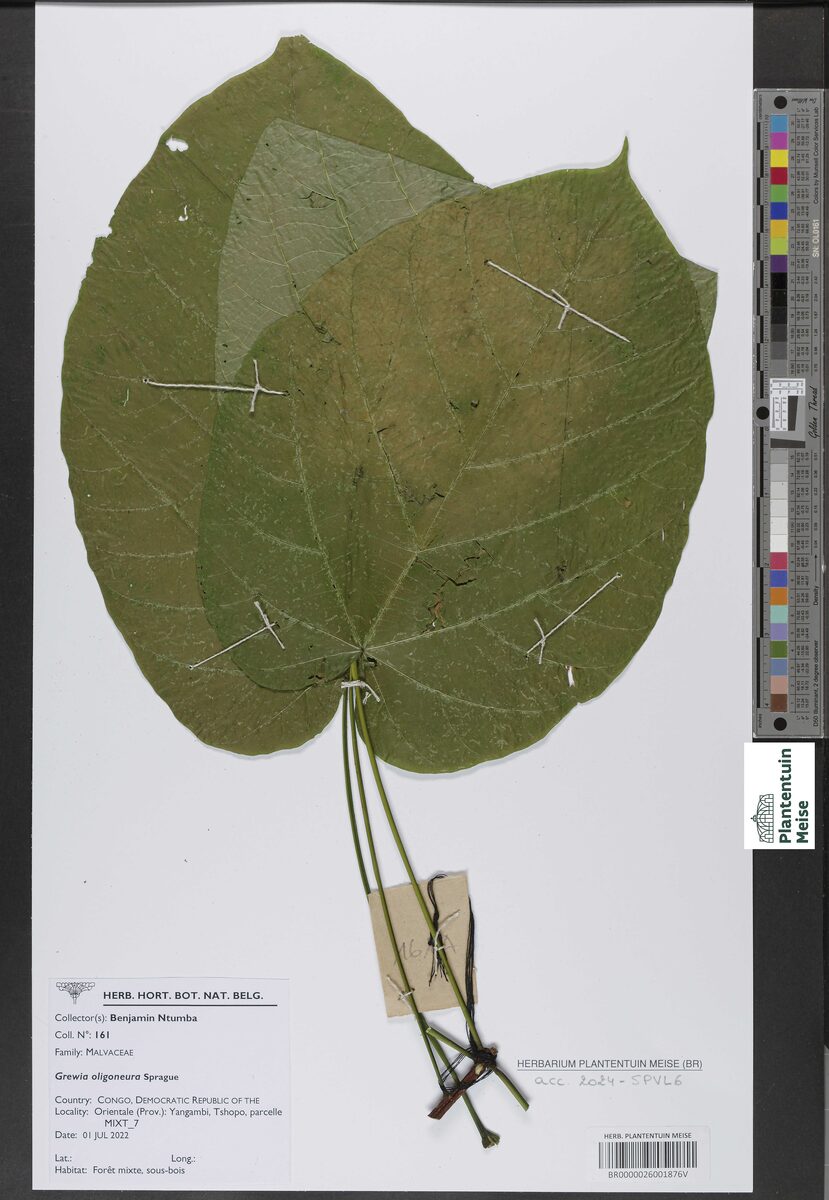
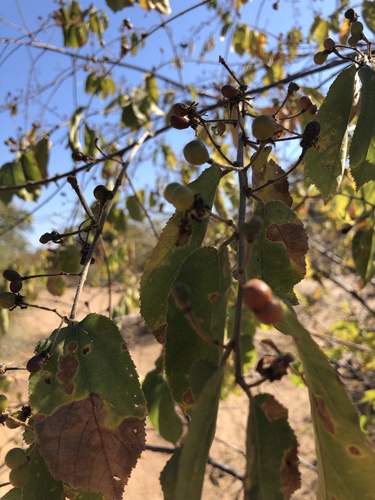
A shrub or small tree. It grows 5-8 m tall. They young parts are covered with star shaped hairy scales. The leaves are 7-20 cm long by 6-12 cm wide. They are oval with a pointed tip. The two halves of the leaf blade are unequal. The edge has teeth. They are hairy below. The base is rounded or heart shaped. There are 5-7 veins. The fruit are yellowish. They occur in large clusters of 10-12. The fruit is fleshy with a hard covering over the seed. The fruit has 3-4 lobes and is blackish. They are pea sized.
Edible Uses
Fruit - raw. An agreeable, acid flavour, but a lot of seeds and little pulp. The black, globose fruit is about the size of a pea. The fruit is a good source of micronutrients such as anthocyanins, phenols, flavonoids and vitamin C. They have a moderate antioxidant activity and make an excellent, healthful addition to the diet
Traditional Uses
The tender leaves are eaten. The ripe fruit are eaten raw.
This uses section is brief — help expand it
Medicinal Uses
The fruit is antioxidant. A thick mucilage can be extracted from the bark and this, combined with the powdered seed of Panicum miliaceun, is taken as a remedy for dysentery. The bark is used to heal wounds, cure kapha, vata, burning sensation, throat complaints, biliousness and diseases of the nose and blood. It is also used in the treatment of dysentery, and is employed externally to remove the irritation from cow-itch. The powdered wood is emetic and is used as an antidote to opium poisoning. An ethanolic extract of the aerial parts has shown CNS depressant and diuretic activity while that of stem bark exhibited spermic and hypotensive activity.
Distribution
It is a tropical plant. They are common in Western India. In southern China it grows in open woodland and grassland between 600-1,600 m above sea level. In Yunnan.
Where It Grows
Africa, Asia, Bangladesh, Cambodia, China, East Africa, Himalayas, India, Indochina, Laos, Malaysia, Myanmar, Northeastern India, SE Asia, Thailand, Vietnam,
Cultivation
A plant of the moist, lowland tropics and subtropics, where it is found at elevations up to 900 metres. It grows best in areas where annual daytime temperatures are within the range 30 - 42°c, but can tolerate 7 - 47°c. Mature plants can be killed by temperatures of -5°c or lower, but young growth will be severely damaged at -1°c. It prefers a mean annual rainfall in the range 1,000 - 2,500mm, but tolerates 750 - 4,000mm. Succeeds in full sun and light shade. Succeeds in a range of well-drained soils. Prefers a pH in the range 6 - 6.5, tolerating 5.5 - 7.
Propagation
Seed - we have no specific information for this species but seed of this genus is generally best sown as soon as it is ripe. Stored seed has a hard seedcoat and may benefit from scarification before sowing in order to speed up and improve germination. This can usually be done by pouring a small amount of nearly boiling water on the seeds (being careful not to cook them!), allowing the mix to cool somewhat and then leaving it in a warm place to soak for 12 - 24 hours. Sow the seeds in situ or in a nursery seedbed or trays - do not allow the compost to become dry. Germination and early growth are usually quite quick. Cuttings - best taken with a heel.
Other Uses
A fibre from the inner bark is used to make cordage. The brown heartwood is in a thin layer; the sapwood is white. The wood is close-grained, hard. It is used for shafts, shoulder poles, masts, golf clubs, tool handles, oars and all purposes for which elasticity, strength and toughness are required.
Production
In southern India plants flower and fruit February to June.
Notes
There are about 200 Grewia species. They are mostly tropical. The fruit of most may be edible. These were in the Sparrmanniaceae and the Tiliaceae.
Nutrition
| Part | Moisture | kJ | kcal | Protein | Vit A | Vit C | Iron | Zinc |
|---|---|---|---|---|---|---|---|---|
| Leaves - dry | 9 | 1185 | 283 | 6.9 | — | 4.2 | 6.4 | 2.8 |
| Fruit | — | — | — | — | 70.5 | 31.1 | 5.4 | — |
Also Known As
Butale, Chadachi, Chadicha, Charachi, Dahi-bhat, Dalmon, Daman, Dhaman, Dhamana, Dhamasi, Dhamin, Dhamni, Dhamuro, Dhanuvriksha, Dhomoni, Ettatada, Jhujhana, Kakai, Kharmati, Khesla rodgei, Lumma, Pharsa, Pholsa, Pin-ta-yaw, Rodaga, Sadachi, Ta-yaw, Thadsal, Unnam, Unnu, Valukkaimaram
References (30)
- Ajesh, T. P., et al, 2012, Ethnobotanical Documentation of Wild Edible Fruits used by Muthuvan Tribes of Idukki, Kerala-India. International Journal of Pharma and Bio Sciences 3(3): 479-487
- Ambasta, S.P. (Ed.), 2000, The Useful Plants of India. CSIR India. p 250
- Arinathan, V., et al, 2007, Wild edibles used by Palliyars of the western Ghats, Tamil Nadu. Indian Journal of Traditional Knowledge. 6(1) pp 163-168
- Bajpai, O., et al, 2015, Tree species of the Himalayan Terai region of Uttar Pradesh, India: a checklist. Check List 11(4): 1718
- Bandana, P. & Debabrata, P., 2015, Wild Edible Plant Diversity and its Ethno-medicinal use by Indigenous Tribes of Koraput, Odisha, India. Research Journal of Agriculture and Forestry Sciences. Vol. 3(9), 1-10, October (2015)
Show all 30 references Hide references
- Bandyopadhyay, S. et al, 2009, Wild edible plants of Koch Bihar district, West Bengal. Natural Products Radiance 8(1) 64-72
- Bole, P.V., & Yaghani, Y., 1985, Field Guide to the Common Trees of India. OUP p 37
- Chandrakumar, P., et al, 2015, Ethnobotanical studies of wild edible plants of Gond, Halba and Kawar tribes of Salekasa Taluka, Gondia District, Maharashtra State, India. International Research Journal of Pharmacy 6(8)
- Chaudhary, L. B., et al, 2014, Tree Resources of Katerniaghat Wildlife Sanctuary, Uttar Pradesh, India with especial emphasis on Conservation Status, Phenology and Economic Values. International Journal of Environment. 3(1)
- Chauhan, S. H., et al, 2018, Consumption patterns of wild edibles by the Vasavas: a case study from Gujarat, India. Journal of Ethnobiology and Ethnomedicine (2018) 14:5
- GAMMIE,
- Hedrick, U.P., 1919, (Ed.), Sturtevant's edible plants of the world. p 334
- Jadhav, R., et al, 2015, Forest Foods of Northern Western Ghats: Mode of Consumption, Nutrition and Availability. Asian Agri-History Vol. 19, No. 4: 293-317
- Jose, D. T. & Sasidharan, N., 2016, Checklist of wild edible plants of Aralam Wildlife sanctuary, Kerala, India. South Indian Journal Of Biological Sciences 2016; 2(1); 141‐144
- Karuppusamy, S., et al, 2011, Antioxidant activity of selected lesser known edible fruits from Western Ghats, of India. Indian Journal of Natural Products and resources. 2(2): 174-178
- Kiran, K. C., et al, 2019, Diversity and Seasonal Availability of Potential Wild Edible Plants from Vidarbha Region of Maharashtra State, India. Int.J.Curr.Microbiol.App.Sci (2019) 8(2): 1434-1446
- Pasha, M. K. & Uddin, S. B., 2019, Minor Edible Fruits of Bangladesh. Bangladesh J. Plant Taxon. 26(2): 299–313
- Prabha, Y. P., et al, 2010, Documentation of Wild Edible Plants of Melghat Forest, Dist. Amravati, Maharashtra State, India. Ethnobotanical Leaflets 14: 751-58, 2010.
- Prachi, K., et al, 2012, Underutilized wild fruits of North Maharashtra. Journal of Research in Plant Sciences. (2012) 1:071-076
- Pradhan, R., et al, 2020, Potential Wild Edible Plants and its Significance in Livelihood of Indigenous People of Male Mahadeshwara Hills, Karnataka. Economic Affairs Vol. 64, No. 4 pp. 01-14
- Ramachandran, V.S. and Nair, V.J., 1981, Ethnobotanical studies in Cannanore District, Kerala State (India). J Econ. Tax. Bot. Vol 2 pp 65-72
- Ramachandran, V. S., 2007, Wild edible plants of the Anamalais, Coimbatore district, western Ghats, Tamil Nadu. Indian Journal or Traditional Knowledge. 6(1) pp 173-176
- Rasingam, L., 2012, Ethnobotanical studies on the wild edible plants of Irula tribes of Pillur Valley, Coimbatore district, Tamil Nadu, India. Asian Pacific Journal of Tropical Biomedicine. (2012) S1493-S1497
- Reddy, K. N. et al, 2007, Traditional knowledge on wild food plants in Andhra Pradesh. Indian Journal of Traditional Knowledge. Vol. 6(1): 223-229
- Sarvalingam, A., et al, 2014, Wild edible plant resources used by the Irulas of the Maruthamalai Hills, Southern Western Ghats, Coimbatore, Tamil Nadu. Indian Journal of Natural Products and Resources 5(2):198-201
- Singh, H.B., Arora R.K.,1978, Wild edible Plants of India. Indian Council of Agricultural Research, New Delhi. p 62
- Singh, V. and Singh, P., 1981, Edible Wild Plants of Eastern Rajasthan. J. Econ. Tax. Bot. Vol 2 pp 197-207
- Symb. bot. 1:35. 1790 "tiliaefolia"
- Yadav, D. K., 2011, Study on Biodiversity and Edible Bioresources of Betla National Park, Palamu, Jharkhand (India). The 2011 Las Vegas International Academic Conference.
- Yesodharan, K. & Sujana, K. A., 2007, Wild edible plants traditionally used by the tribes in the Parambokulam Wildlife Sanctuary, Kerala, India. Natural Product Radiance 6(1) pp 74-80